Climbing Mount Olympus in Greece: Routes, Refuges, Difficulty and Best Time

Rintsje Bosch
Rintsje Bosch
Rintsje Bosch
27 Oct 2026 • 13 min read
Climbing Mount Olympus in Greece: Routes, Refuges, Difficulty and Best Time
Trekking experts per destination
Free cancellation up to eight weeks in advance
Quick personal advice

Climbing Mount Olympus, the highest mountain in Greece at 2,918 m and the mythical home of the Greek gods, is a multi-day hike from the Aegean coast into a high, rocky massif of 52 peaks. Old forests of Bosnian pine give way to the open Plateau of the Muses, then to bare ridges and summits above the clouds, with nights in simple mountain refuges along the way. The trails to the refuges, to Profitis Ilias and to Skolio are demanding hiking; the final metres to Mytikas are a real Class III scramble that requires hands, feet and a head for heights. We offer our self-guided Mount Olympus hut-to-hut trek as a four-day loop from Litochoro, as well as a guided ascent to Mytikas for those who want safety equipment and an expert on the mountain with them.

What is Mount Olympus and how high is it?

Mount Olympus is the highest mountain in Greece, a massif of 52 peaks in northern Greece between Thessaloniki and Larissa, rising almost straight from the Aegean coast. This page is about that mountain, not the peaks of the same name in Washington State, Utah or Cyprus.

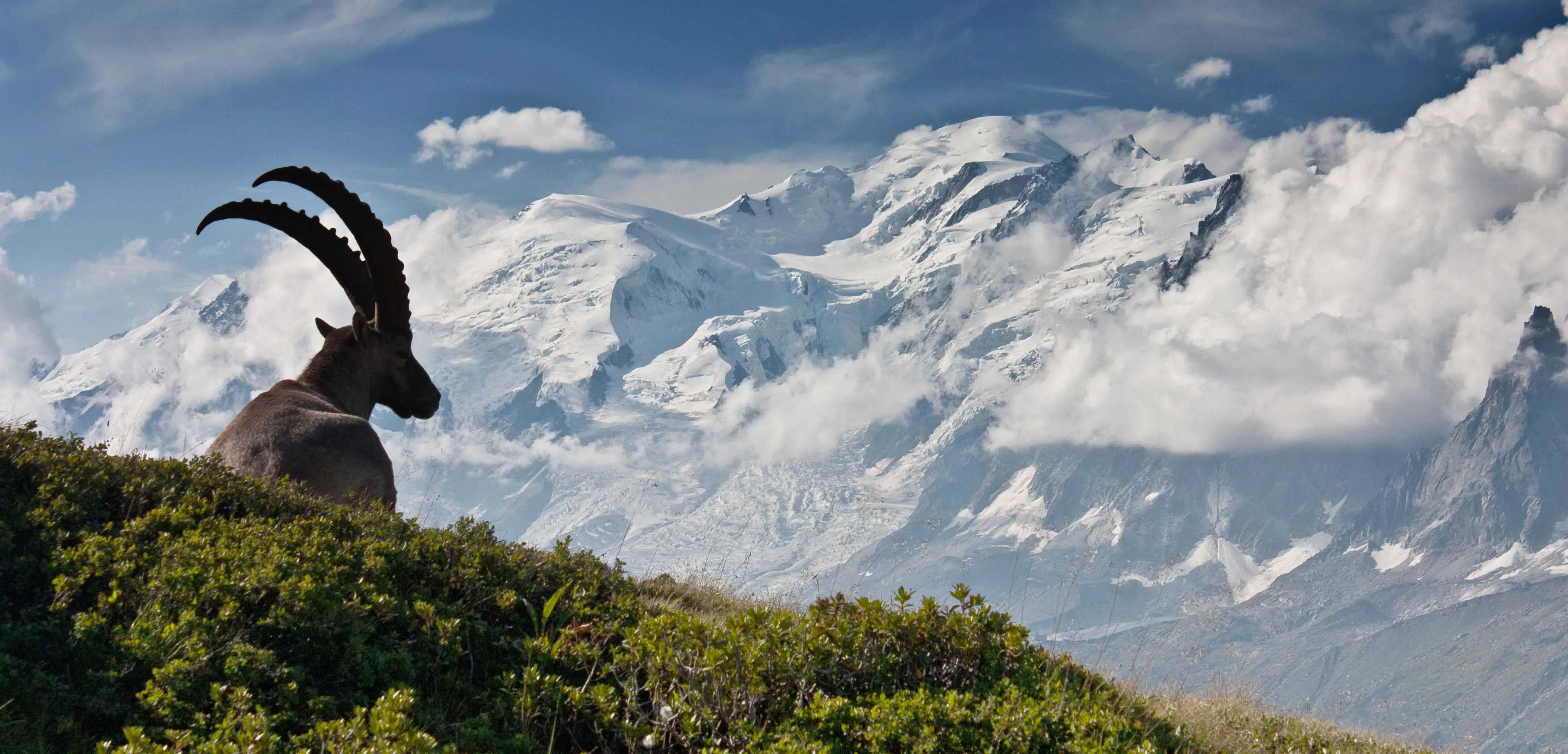
The mountain became Greece's first national park in 1938 and is also a UNESCO Biosphere Reserve. More than 1,500 plant species grow on its slopes. The Balkan chamois lives in the alpine zone above the tree line; golden eagles, vultures and peregrine falcons circle the ridges.

In Greek mythology, Mount Olympus was the home of the twelve Olympian gods: Zeus, Hera, Poseidon and the rest. The jagged peak called Stefani is still known as the Throne of Zeus.

On 2 August 1913, Mytikas was climbed for the first time by the Swiss photographer Frédéric Boissonnas and his companion Daniel Baud-Bovy, guided by the local hunter Christos Kakalos from Litochoro. The Kakalos refuge on the Plateau of the Muses is named after him. Mount Olympus is one of several mountain areas for walking and hiking holidays in Greece.

Mount Olympus height and the main peaks

Mount Olympus reaches 2,918 m at its highest point, Mytikas; some sources give 2,917 m, reflecting small differences in measurement. The main peaks and what they mean for hikers:

  • Mytikas, 2,918 m: highest point of Greece; the final section is a Class III scramble
  • Stefani: just below Mytikas; also a scramble, the so-called Throne of Zeus
  • Skolio, 2,911 m: third highest, reached by a hiking trail; a complete summit day
  • Skala, 2,882 m: a summit on the ridge where the Mytikas scramble starts; steep, but reached on a path
  • Profitis Ilias, 2,803 m: an easy 40-minute walk from the Kakalos refuge; outstanding views
  • Skourta, 2,485 m: a waypoint on day 2 of our route, with 360-degree alpine views
What is Mount Olympus and how high is it?

How difficult is climbing Mount Olympus?

For a fit hiker, climbing Mount Olympus to the refuges, to the Plateau of the Muses and to Skolio is a demanding but non-technical mountain hike. Only the final section to Mytikas is a scramble. The challenge comes from three things.

Fitness. Our four-day self-guided loop covers 39.8 km with 2,770 m of ascent. Day 1 climbs 1,710 m in about 7 hours 40 minutes; day 4 descends 1,930 m in about the same time. Your knees will feel the descent: trekking poles are worth bringing.

Terrain. The lower slopes are covered in forest with well-used paths. Above about 2,000 m the terrain opens up into rocky, exposed ground. Loose stones are present across most of the upper mountain. Below the tree line, paths are clear; above it, some care is needed in cloud.

Weather. Conditions near the summits are very different from the coast. On a warm summer day the beach can be hot while the summit ridge has strong, cold wind with temperatures close to 0 degrees Celsius. Afternoon thunderstorms occur in summer. Start early, ask the refuge staff about the forecast before you leave.

Can a beginner climb Mount Olympus? A fit beginner with experience of long day hikes can complete the hut-to-hut route and reach Skolio. Mytikas is not a beginner objective unless you go with a guide who brings safety equipment. From Prionia, the route to a summit and back takes two days with one night in a refuge. From Litochoro on foot it takes three to four days.

Mytikas: the scramble to the highest summit

Class III on the Yosemite Decimal System means you use both hands and both feet, the ground falls away sharply on at least one side, and a fall can cause serious injury. Two routes reach Mytikas: from Skala along the exposed ridge, or up the steep Louki gully. Both involve loose rock. Stones kicked free by the person above you are a real hazard, which is why a helmet matters even for experienced scramblers.

Snow or wet rock change the difficulty significantly. If there is any ice, the route is not suitable without specialist equipment.

Skolio, at 2,911 m, is a genuine summit with a direct view across to Mytikas and Stefani. Many hikers reach Skolio and consider the day complete.

On the guided ascent, the guide provides helmets, harnesses and a rope, and decides on the day whether conditions allow the group to go to the top.

Should you climb Mount Olympus with a guide or self-guided?

Self-guided works well for fit, experienced hikers who plan to stay on the hiking trails, visit the Plateau of the Muses and climb Skolio. Choose a guide if you want to stand on Mytikas and have no scrambling experience, or if you prefer not to navigate the upper mountain yourself.

Self-guided. The trails are easy to follow in good visibility and junctions are signposted. You walk at your own pace, stop where you like and spend as long as you want on any summit. On our self-guided trips, we book the refuges for you in advance, provide a detailed itinerary for every stage and give you access to the trekking app with offline GPS navigation and hiking maps. You carry your own clothing and gear for four days.

Guided. Our local partner Greek Adventure provides an English-speaking guide who knows the mountain and makes the call on the day about whether the group attempts Mytikas, based on weather and the condition of the group. Helmets, harnesses and a rope are included for the summit section. Transfers within the itinerary are arranged, so you do not need to organise your own transport between Litochoro, Gortsia and Prionia.

How difficult is climbing Mount Olympus?

Our Mount Olympus treks: hut to hut or guided to the summit

Our three trips cover the main ways to experience hiking Mount Olympus in Greece, from a four-day circular hike through to a guided push for the highest point.

Hiking Mount Olympus in Greece: the four-day loop day by day

The table below shows the four-day self-guided loop in detail.

Day Stage Distance Ascent Descent Walking time
1 Litochoro to Petrostrouga refuge 12.3 km 1,710 m 100 m ~7 h 40
2 Petrostrouga to Kakalos refuge 5.3 km 750 m 40 m ~3 h 20
3 Kakalos to Spilios Agapitos refuge 4.7 km 120 m 700 m ~2 h 30
4 Spilios Agapitos to Litochoro 17.5 km 190 m 1,930 m ~7 h 40
Total 39.8 km 2,770 m 2,770 m

Day 1 starts at Litochoro central square and climbs high above the northern edge of the Enipeas Gorge before joining the trail at Gortsia (about 1,100 m). The ascent through old-growth forest is steep in places. The Petrostrouga refuge sits among Bosnian pines at 1,940 m with views over the Aegean Sea.

Day 2 crosses Skourta (2,485 m) and follows the narrow Laimos ridge to the Plateau of the Muses and the Kakalos refuge at 2,650 m. Balkan chamois are often seen on the plateau. In the afternoon, an easy 40-minute walk leads to Profitis Ilias (2,803 m) for views of the northern slopes of the massif.

Day 3 includes the optional climb of Skolio (2,911 m), with a direct view of Mytikas and Stefani. Experienced scramblers who want to attempt Mytikas do so on this day, at their own responsibility. The route then passes through the Zonaria area, with its bare, layered rock formations, and descends to Spilios Agapitos refuge at 2,100 m.

Day 4 is the longest day in distance: 17.5 km down the E4 path through pine, beech and fir forest to Prionia (about 1,100 m), where you can see the Enipeas waterfalls and stop at a small cafe. From Prionia, the trail follows the Enipeas river for about five hours past the Agios Dionysios monastery, built in 1542. Below the monastery the bridges collapsed some years ago and were not rebuilt, so you cross the river on foot. Water levels are lower in summer, which makes the crossing easier.

Our three trips:

Where is Mount Olympus and how do you get to Litochoro?

Mount Olympus is in northern Greece, about 100 km south-west of Thessaloniki; the starting point for most Mount Olympus hiking routes is the town of Litochoro at the foot of the mountain.

From Thessaloniki: by car takes about 1.5 hours. There is a direct train from Thessaloniki to Litochoro station, which takes about one hour; the station is near the coast, so take a taxi for the last few kilometres up into the town. By bus takes about 2.5 hours and may involve a change.

From Athens: it is a long journey, about 6 hours by car or about 5 hours by train.

Litochoro has guesthouses, shops and restaurants, and the Enipeas Gorge starts practically on its doorstep. It is a good base for the night before and after your trek. Close to Litochoro lies the archaeological site of Dion, the ancient Macedonian sanctuary of Zeus, with a museum: a good visit on the day before or after your trek. The 6-day version of our hut-to-hut trip includes a guesthouse night in Litochoro at each end.

Litochoro or Prionia: where the Mount Olympus hike starts

Prionia (about 1,100 m) is the end of the road, reachable by taxi or car from Litochoro. It is the starting point for the shortest route up to the Spilios Agapitos refuge and the summits, which can be done in two days with one refuge night. Our self-guided trips start on foot in Litochoro and climb via Gortsia (also about 1,100 m) and Petrostrouga to the high mountain; the guided ascent also starts in Litochoro, with a short drive to Gortsia. This longer approach through the forests above the Enipeas Gorge shows more of the mountain than the direct route from Prionia.

Where is Mount Olympus and how do you get to Litochoro?

Best time to climb Mount Olympus and what the weather is like

The main hiking season runs from June to the end of October. Outside these months, snow covers the high mountain and you cannot count on the refuges being open.

In late May and in October snowfields, ice and freezing nights are possible above 2,000 m. These conditions make the upper trails, and especially Mytikas, significantly harder and more serious. If you plan to go in May or late October, check conditions carefully beforehand.

Month by month on the high mountain:

  • Late May: the self-guided season opens; snowfields, ice and cold nights are still possible high up.
  • June: the main season starts; snow can remain in gullies and on north-facing slopes.
  • July and August: the warmest months, with the highest chance of afternoon thunderstorms.
  • September: often stable weather; nights become colder.
  • October: colder, shorter days; snow can return on the summits.
  • November to April: winter conditions on the high mountain; not a period for a hut-to-hut trek.

The weather near the summits is very different from conditions on the Aegean coast below. On a warm summer day the beach can be pleasant while the summit ridge has strong, cold wind and temperatures close to 0 degrees Celsius. Afternoon thunderstorms are common in summer. Start each stage early in the morning, well before midday. Ask the refuge staff about the forecast before you leave: they know the local conditions.

In the 2027 season (as of October 2026), the self-guided trips can be booked for start dates from about the end of May to the beginning of November, and the guided ascent from June. Check the trip pages for available dates.

If you prefer hiking at lower altitudes and in milder conditions, hiking on Crete or the Corfu Trail are good options for spring or autumn, both lower and milder than the high Olympus massif.

Where do you sleep on Mount Olympus? The mountain refuges

On our route you sleep in mountain refuges: simple huts with dormitory rooms, bunk beds, shared bathrooms and a common room. There are no private rooms.

The three refuges on our four-day loop:

Petrostrouga refuge, 1,940 m. Set among old Bosnian pines, with wide views over the Aegean Sea. This is where you spend night 1.

Kakalos refuge (Refuge C), 2,650 m. Situated on the Plateau of the Muses, the highest of the three. Named after Christos Kakalos, the local hunter who guided the first recorded ascent of Mytikas in 1913. This is night 2.

Spilios Agapitos refuge (Refuge A), 2,100 m. A stone building on a natural balcony above the upper forest, with open views down towards the coast. This is night 3.

What to expect in all three: blankets are provided but there is no bed linen. Bring a sleeping bag liner and a pillowcase. You can buy dinner and drinks at each refuge; tell the staff when you arrive if you want dinner that evening. Breakfast is included at Petrostrouga and at Kakalos on our self-guided trips. On both self-guided trips we book the refuges for you in advance. In summer the refuges can be busy, so booking ahead matters.

Mount Olympus map, trails and navigation

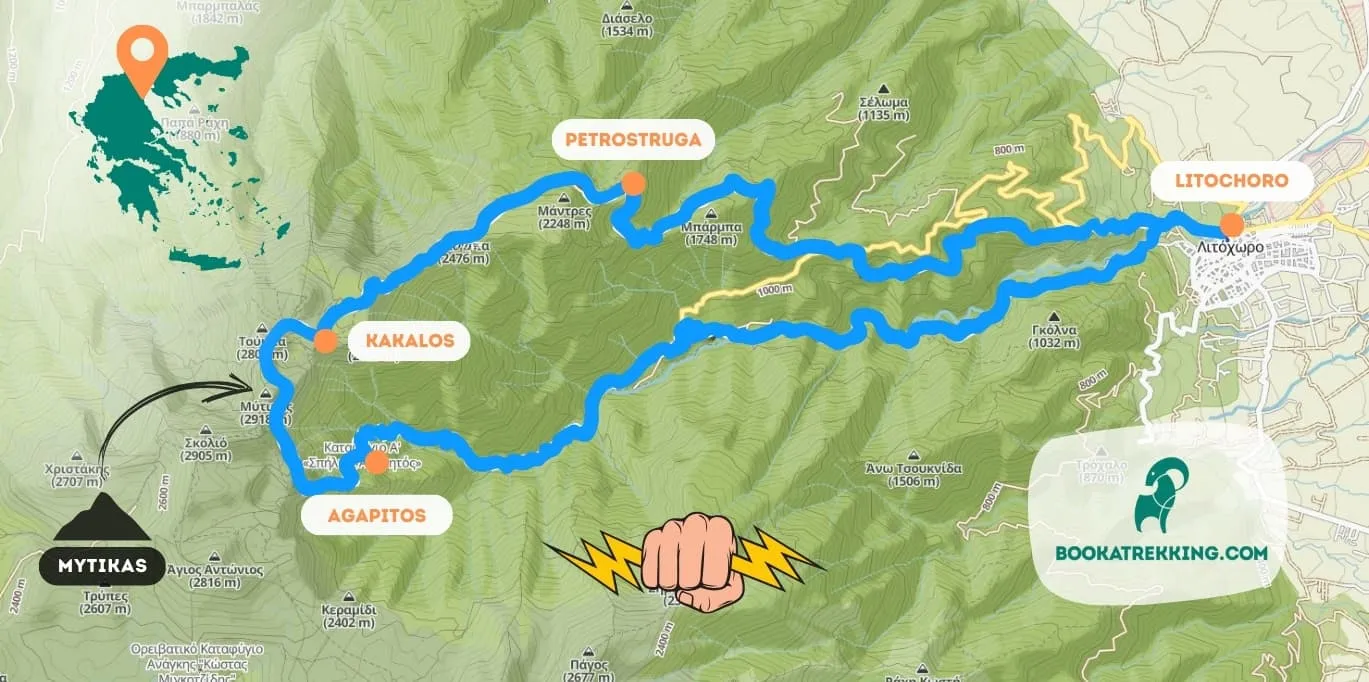
The map on this page shows our four-day loop from Litochoro via Petrostrouga, the Kakalos refuge, Spilios Agapitos and back to Litochoro. Use it to get an overview of the route before you travel.

The main trails on Mount Olympus are well-used and junctions are signposted. In good visibility, navigation is straightforward. On the Plateau of the Muses and around the summits, cloud comes in quickly and orientation becomes harder. Our self-guided trips include the trekking app with offline GPS navigation and hiking maps, so you can check your position on the route, even without a data connection.

Mount Olympus hiking trails: the E4 and the Enipeas Gorge

The E4 is a European long-distance path that passes through the Enipeas Gorge behind Litochoro, continues up to Prionia and then climbs to the Spilios Agapitos refuge. The final day of our self-guided trek follows the E4 from Spilios Agapitos down through the gorge to Litochoro. Parts of the Enipeas Gorge can also be walked as a day hike from Litochoro. The Agios Dionysios monastery (built in 1542) lies higher up, closer to Prionia. Note that the bridges below the monastery collapsed and have not been rebuilt; in summer the river level is low enough to cross on foot. For another Greek multi-day trail at lower altitude, the Menalon Trail in the Peloponnese is a very different walk.

Mount Olympus map, trails and navigation

What Does a Climbing Trip on Mount Olympus Look Like?

Although you could hike to the summits of Mount Olympus in two days, it is worth taking your time and exploring this mountain massif a bit more extensively. A 4-day trek with a comfy guesthouse in Litochoro before and after the trek looks a little bit like this.

Day
1

Arrival in Litochoro

Nestled at the base of the mighty Mount Olympus, Litochoro serves as the ideal gateway for all expeditions to the summit. Divided into two parts, the town offers visitors the chance to explore the charming seaside area or venture into the Enipeas gorge that runs through the foothills of the mountain. The relaxed pace of life in Litochoro encourages travellers to take a leisurely stroll along its quiet streets and discover its tranquil beaches. Once settled in at your guesthouse, you can embark on an unforgettable adventure to witness the stunning rock formations of the Enipeas Gorge.

Alternatively, you can visit the fascinating archaeological site of Dion, the ancient Macedonian Sanctuary of Zeus, and the adjacent museum. During the Hellenistic period, this site held great religious significance for the Macedonians, who revered Zeus and held Olympic games in his honour. In the evenings, indulge in a delicious meal at one of the lively local taverns and soak up the vibrant atmosphere of this charming town.

Mythic Valley (Litochoro)

Info
Mythic Valley (Litochoro)
Day
2

Litochoro - Refuge Petrostruga

Duration: 07:40 h
Distance: 12.3 km / 7.64 mi
Ascent: 1710 m / 5610 ft
Descent: 100 m / 328 ft
The journey kicks off from Litochoro Central Square, the heart of the town. The first 6 km stretch traverses high above the northern edge of the Enipeas Gorge, with magnificant views across this iconic landmark. You'll pass the road and hit the trail at Gourtsia (1100m) into the forest. The ascent is steep at times but this is rewarded with great views across the Mount Olympus mountain range. The refuge is situated at an altitude of 1,940m, in a beautiful spot among age-old Bosnian pine trees, offering you panoramic views to the valley of Katerini, Mount Pelion and the Aegean Sea. You’ll enjoy a delicious warm dinner at the refuge.

Refuge Petrostrouga

Info
Refuge Petrostrouga
Refuge Petrostrouga
Day
3

Refuge Petrostruga - Refuge "C" Kakalos

Duration: 03:20 h
Distance: 5.3 km / 3.29 mi
Ascent: 750 m / 2461 ft
Descent: 40 m / 131 ft

After eating breakfast, you will begin your climb to the Plateau of the Muses on Mount Olympus, which is considered to be one of the most stunning locations. The route will take you to Skourta peak (2,485m), where you will be surrounded by an alpine landscape that offers spectacular 360-degree views. From Skourta peak, you will follow a narrow ridge called Laimos (neck) that leads to the plateau. Walking along this ridge is an incredible experience that allows you to appreciate the remarkable geology of the rock formations on Mount Olympus.

As you climb to higher elevations, you will have many opportunities to observe the endemic wild goats of Mount Olympus, which are rare and endangered. These animals resemble deer more than goats and primarily live in the alpine zone of Mount Olympus. The hike will take approximately four hours and will end at the Kakalos refuge, located at an altitude of 2,650m. This refuge was named after Christos Kakalos, a local hunter who guided Swiss climbers Fred Boissonnas and Daniel Baud Bovy on the first recorded ascent to Mount Olympus' highest peak, Mytikas, in 1913. After taking a short break and having lunch at the refuge, you can explore the magical alpine landscape of the plateau and reach Agios Profitis peak (2,803m) with an easy 40-minute walk. From the top of Profitis Ilias peak, you can enjoy breathtaking views of the northern slopes of Mount Olympus and its neighboring mountains, particularly during sunset. Dinner will be provided at the refuge.

Refuge C Kakalos

Info
Refuge C Kakalos
Refuge C Kakalos
Day
4

Refuge "C" Kakalos - Refuge "A" Spilios Agapitos

Duration: 02:30 h
Distance: 4.7 km / 2.92 mi
Ascent: 120 m / 394 ft
Descent: 700 m / 2297 ft

Following a satisfying breakfast at the refuge, you have the chance to hike to Skolio peak, which stands at 2,911m and is the third highest peak on Mount Olympus. The path to Skolio is relatively easy, and from the top, you'll have stunning views of the mountain's highest peaks: Mytikas (2,918m) and Stefani (2,912m). Experienced climbers may choose to continue on to Mytikas peak via Skala or the steep gully of Mytikas, but these are considered Class III ascents with moderate exposure, so caution is advised.

After taking a snack break at the summit of Skolio, you'll follow a scenic trail through an area known as Zonaria, where the barren rock formations of Mount Olympus are breathtakingly beautiful. After a 2-hour descent, you'll arrive at the Spilios Agapitos Refuge, a charming stone building situated at a lovely location that forms a natural balcony, with an elevation of 2,100m. This cozy refuge is an ideal spot for relaxing and unwinding. Later in the evening, dinner will be served.

Refuge A Spilios Agapitos

Info
Refuge A Spilios Agapitos
Day
5

Refuge "A" Spilios Agapitos - Litochoro

Duration: 07:15 h
Distance: 18.6 km / 11.56 mi
Ascent: 430 m / 1411 ft
Descent: 2170 m / 7119 ft

This route leaves the high slopes above Litochoro and follows a clear downhill line towards town. From Refuge “A” Spilios Agapitos, the trail loses a lot of height, with 2,170 m of descent shown on the profile, so the effort is mainly in your knees rather than your lungs. Expect a long mountain descent through forested terrain, ravines and river sections, with a few short climbs interrupting the downward trend.

The route follows the E4 trail away from the refuge, passing a rocky riverbed, wooden shelter and wooden bridges before continuing through Olympus National Park. Further down, the path reaches the Enipeas River Valley Trail, with marked waterfalls, riverbank sections and viewpoints towards Mount Olympus. You also pass the Old Monastery of Saint Dionysios and the Saint Dionysios Cave, two well-known points on this descent.

Closer to Litochoro, the trail stays near the Enipeas river, passing Kokkinos Stream Crossing, the tributary of the Enipeas, Zeus Bath Waterfall and the Bath of Zeus. The final kilometres lead past the Enipeas riverbed and into Litochoro Town Center. Tonight, you will stay at a charming guesthouse, a well-earned place to rest after the long descent from the mountain.

Mythic Valley (Litochoro)

Info
Mythic Valley (Litochoro)
Day
6

Departure

After a well deserved night in our comfy guesthouse, it's a delight to wake up by the sea. After a lovely Greek style breakfast and a refreshing dip in the Aegean Sea it's time to say goodbye to the Greek Gods of Mount Olympus.

Packing List for the Mount Olympus

It doesn't matter where you are trekking or for how long: carrying the right equipment with you is paramount. For a hiking trip in the mountains, a good is backpack essential. Its size will depend on how many days you will be spending in the mountains, the season, and the clothes you will be taking with you. We have prepared a packing list with some essential clothing that you should include and some extras that you may find useful:
  • Essentials

  • Extras

How much does it cost to climb Mount Olympus?

The four-day self-guided hut-to-hut trek starts from 195 euros per person when two people book together (2027 season, as of October 2026).

Trip Duration Two people Alone Group rate
Self-Guided Hut to Hut 4 days 195 euros p.p. 265 euros 195 euros p.p.
Self-Guided with Litochoro nights 6 days 295 euros p.p. 355 euros 295 euros p.p.
Guided Mount Olympus Ascent 3 days 465 euros p.p. 890 euros 320 euros p.p.

What is included in the self-guided trips: refuge bookings for all nights, a detailed itinerary per stage, directions to the trailhead and access to the trekking app with offline GPS navigation; dormitory beds in the refuges; breakfast at the Petrostrouga and Kakalos refuges. The 6-day version also includes guesthouse nights in Litochoro and breakfast there where possible.

What is included in the guided ascent: English-speaking guide for all three days, helmets, harnesses and a rope for the Mytikas section, transfers within the itinerary, refuge nights, and national park permit costs.

What comes on top for all trips: travel to and from Litochoro, local transport such as taxis, meals and drinks in the refuges (except the two included breakfasts), travel insurance (for the guided ascent it must cover mountain activities), tips on the guided trip, and personal expenses.

Deposit: 30 percent for the self-guided trips, 15 percent for the guided ascent. Free cancellation up to eight weeks before departure.

See prices and dates for the self-guided hut-to-hut trek or the guided Mount Olympus ascent.

Climbing Mount Olympus: frequently asked questions

Can a beginner climb Mount Olympus?

Yes, if you are fit and used to long days of hiking. A fit beginner can complete the hut-to-hut route and reach Skolio (2,911 m) without technical skills. Mytikas is not suitable for beginners unless they go with a guide who provides helmets, harnesses and a rope and makes the safety decisions on the day.

How long does it take to hike up Mount Olympus?

From Prionia, fit hikers reach a summit and return in two days with one night in a refuge. From Litochoro on foot it takes three to four days. Our self-guided hut-to-hut loop takes four days and covers 39.8 km in total, starting and finishing in Litochoro.

Is Mount Olympus a hard climb?

The hut-to-hut route is hard on the legs: long climbs, long descents and 2,770 m of ascent over four days. The terrain is not technical except on Mytikas, where the final section from Skala is a Class III scramble requiring hands, feet, exposure tolerance and, ideally, a helmet.

How much does it cost to hike Mount Olympus?

Our self-guided hut-to-hut trek starts from 195 euros per person for two people (2027 season, as of October 2026), with refuge bookings and two breakfasts included. Meals and drinks in the refuges, travel to Litochoro and insurance come on top.

Has anyone ever reached the top of Mount Olympus?

Yes. The first recorded ascent of Mytikas was on 2 August 1913, when Swiss travellers Frédéric Boissonnas and Daniel Baud-Bovy, guided by the local hunter Christos Kakalos, stood on the summit for the first time. Today many hikers reach the summits of Mount Olympus every summer during the hiking season.

Can tourists climb Mount Olympus?

Yes. The trails are open to everyone during the hiking season from June to the end of October. Mytikas requires scrambling experience or a guide. Book the guided Mount Olympus ascent if you want safety equipment and an expert with you.

Where do you start the Mount Olympus hike?

The two starting points are Litochoro and Prionia. Prionia (about 1,100 m) is the end of the road, reachable by taxi or car, and is the start of the shortest route to the summits. Our self-guided trips start on foot in Litochoro and the guided ascent also starts there, which takes longer but shows more of the mountain.

What should you bring to climb Mount Olympus?

Sturdy hiking boots, multiple warm layers, a waterproof and windproof jacket, sun protection, trekking poles, a sleeping bag liner and a pillowcase for the refuges, and enough water for each day. If you plan to attempt Mytikas, bring a helmet: stones kicked loose by other climbers on the steep upper sections are a genuine hazard.


Where Can I Book the Mount Olympus?

At Bookatrekking.com you can book the self-guided Mount Olympus and many other treks. We take care of all the details for you, including arranging accommodations and providing you with relevant information well in advance of your trek. Find our offers here. Our easy-to-use platform allows you to browse and compare different trekking options and to find the perfect fit for your interests, abilities, and budget.

If you have any questions about a specific trek or need help choosing the right one for you, our team of trekking experts is here to assist you. Simply reach out to us and we will be happy to provide you with personalized recommendations and advice to help you plan the trekking adventure of a lifetime.

About Us

At Bookatrekking.com, you will find the trek that will make your life unforgettable. Whether you want to explore the Inca Trail or climb Kilimanjaro. Bookatrekking.com has a wide and varied range of first-class treks. No false promises are made here. Transparent prices and bookings are fixed instantly. Find, compare, book and trek!
Read more about us
About Us
About Us

Also Interesting