Hiking in Crete: Gorges, the South Coast and the White Mountains

Rintsje Bosch
Rintsje Bosch
Rintsje Bosch
27 Oct 2026 • 14 min read
Hiking in Crete: Gorges, the South Coast and the White Mountains
Trekking experts per destination
Free cancellation up to eight weeks in advance
Quick personal advice

Hiking in Crete is a good way to get to know Greece's largest island beyond its beaches. In the southwest, the White Mountains fall steeply to the sea through deep gorges, so in the space of a few days you walk from a high mountain plateau down to the Libyan Sea and along a coast with villages that have no road access at all. This guide answers the practical questions: where to hike, which gorges are worth it, how hard the walking really is, when to go and how to get there. It also explains our self-guided Short Crete Trail (6 days), a concrete route through the gorges and along the south coast of Crete.

Hiking in Crete: where to go and why?

The best area for hiking in Crete is the southwest, in the region of Chania. Here the Lefka Ori, the White Mountains, rise to more than 2,000 m and then drop directly to the Libyan Sea through a series of dramatic gorges. The three main gorges, Samaria, Aradena and Imbros, are all within a day's walk of each other. Between them you pass through coast villages that you can only reach on foot or by boat: Agia Roumeli and Loutro. That combination of mountains, gorges and sea, with tavernas in every village and a long walking season in spring and autumn, is what makes this part of Crete work so well for walkers.

Other areas on the island have their own appeal. The Akrotiri peninsula near Chania has monastery trails and the Katholiko gorge. The Sougia area offers the Agia Irini Gorge and the coastal path to Lissos. The south coast of the Rethymno region, around Plakias and Preveli, has both beach walks and inland trails. In the centre of the island, Mount Psiloritis (also called Ida) is the highest peak on Crete. Further east are the Lasithi plateau and Mount Dikti. In the far east, the Zakros gorge is known as the Gorge of the Dead, after the ancient burial caves in its walls.

All of these regions are good for walking in Crete, depending on your interests and time.

Is Crete good for hiking?

Yes. Crete hiking is very varied: coast paths, gorges that go down more than 1,200 m, high limestone plateaus and mountain villages. The island is large enough that different regions suit different interests, from archaeology to wildflower walking to serious ridge trekking. For a comparison with other Greek walking destinations, see walking holidays in Greece: the Corfu Trail crosses a whole island from south to north, the Menalon Trail in the Peloponnese follows old paths between mountain villages, and climbing Mount Olympus is the high-alpine option in northern Greece.

Other hiking trails in Crete

Katholiko Gorge and Akrotiri peninsula near Chania: a short gorge walk to an abandoned monastery on the Akrotiri peninsula.

Agia Irini Gorge north of Sougia in the southwest: a green, wooded gorge that is usually quieter than Samaria.

Lissos coastal path from Sougia: an old path along the coast to the remains of the ancient city of Lissos.

Mount Psiloritis (Ida): the highest mountain on Crete, in the centre of the island; the summit is a long day walk on open, stony ground.

Lasithi Plateau and Mount Dikti: a high farming plateau in eastern Crete, with Mount Dikti above it.

Zakros Gorge (Gorge of the Dead): in the far east of Crete; the Minoan palace at Zakros is at the end of the walk.

E4 long-distance path: the European route E4 crosses Crete from west to east, linking many of these areas into one continuous trail.

The route in this guide focuses on the southwest.

Hiking in Crete: where to go and why?

The gorges of Crete: Samaria, Aradena and Imbros

The best-known gorges for hiking in Crete are Samaria, Aradena and Imbros in the southwest, plus Agia Irini further north. Each has a different character and difficulty, and on a walking holiday in Crete you can walk more than one of them in a few days.

Aradena Gorge is a rocky, steep-walled gorge west of Loutro that reaches the sea between Agia Roumeli and Loutro. On our itinerary it is an optional, harder variant on day 3: after the coast path you walk through the rocky gorge before you reach Loutro. It adds about 6 km and doubles the climbing and descending compared with the coastal option.

Imbros Gorge lies east of Samaria: a shorter and greener walk on well-trodden paths through a narrow, rocky riverbed between steep walls. It is usually quieter than Samaria. On our route you walk up through it from the coast to the village of Imbros on day 5: 10.9 km, +800 m, about 3 hours.

Hiking the Samaria Gorge: what to know

The Samaria Gorge is the most famous hike in Crete. It sits inside a national park established in 1962 and is home to the kri-kri, the Cretan wild goat. The walk starts at the Xyloskalo trailhead on the Omalos plateau at about 1,250 m and descends to Agia Roumeli on the Libyan Sea: about 13 km inside the park, plus roughly 2 km of track to the village itself. Our stage from Omalos to Agia Roumeli covers 14.3 km and takes about 3 hours 30 of walking.

The most dramatic section is the Gates (Portes), where the gorge narrows to about 4 m wide with walls rising to almost 300 m on either side. The path is mostly downhill on stones and loose gravel with river crossings on stepping stones: it is hard on knees and ankles rather than on the lungs. After heavy rain the stream can rise, and the park then closes the gorge for safety.

The gorge is generally open from 1 May to 31 October, but the opening date can shift depending on weather and water levels. The entrance for the full walk closes in the early afternoon (around 1 pm); check the official opening times before you travel. There is an entrance fee, paid at the gate. Because there is no road out of Agia Roumeli, the walk is one-way: you continue on foot or by boat. In summer the gorge is busy in the morning with day visitors.

The gorges of Crete: Samaria, Aradena and Imbros

The Short Crete Trail in six days: route and stages

Our self-guided Short Crete Trail covers 53.9 km across four walking days, starting in Chania and ending in Chora Sfakion (Sfakia) on the south coast. It takes 6 days in total, with day 1 as arrival and day 6 as departure.

Day Route Distance Up / Down Walking time
1 Arrival in Chania — — —
2 Omalos to Agia Roumeli (Samaria Gorge) 14.3 km +90 m / −1,230 m ~3 h 30
3 Agia Roumeli to Loutro (with Aradena Gorge) 21.7 km +900 m / −880 m ~6 h
4 Loutro to Chora Sfakion 7.0 km +160 m / −170 m ~2 h
5 Chora Sfakion through Imbros Gorge to Imbros 10.9 km +800 m / −30 m ~3 h
6 Departure after breakfast — — —

On day 3, if you prefer a shorter and less strenuous walk, you can skip the Aradena Gorge variant: this reduces the day by about 6 km and roughly halves the climbing, keeping mainly to the coast path.

The character of each day changes noticeably. Day 2 is a long descent through the Samaria Gorge, from the mountain plateau to the sea. Day 3 is the longest day, combining coast walking and, with the Aradena option, a serious climb into a rocky gorge and back down to the sea. Day 4 is a short and easy coastal walk past Sweet Water Beach (Glyka Nera). Day 5 climbs steadily through the Imbros Gorge to the village of Imbros for lunch; you return to Chora Sfakion by bus or taxi.

The trip is graded Intermediate and costs from 585 euros per person for two people, or 995 euros for one person travelling alone; prices can differ per date.

Lefka Ori: the White Mountains of Crete

The Lefka Ori, also called the Madares, is the mountain range that dominates western Crete. Many peaks rise above 2,000 m; the highest summit is Pachnes at 2,453 m. The high zone is bare limestone with no shade and almost no water, which makes summit trekking a serious undertaking requiring full mountain preparation. Our route does not climb the summits. Instead, you start on the Omalos plateau at 1,250 m and cross the range through the Samaria Gorge, dropping to sea level at Agia Roumeli. You see the White Mountains from the plateau at the start, and from the coast path on days 3 and 4, where the peaks rise directly behind the gorges you have just walked through.

The Short Crete Trail in six days: route and stages

Five Days of Walking on Crete: Gorges, White Mountains, and Beaches

Our put-together walking tour in Crete is a program that has the best of everything. Walk along and through the beautiful highlights of southwest Crete and enjoy true Greek culture on this 5-day walking holiday!

Day
1

Arrival in Crete

Welcome to Greece! Today you arrive in Chania and are expected in a pleasant hotel in Chania. On this sunny island, you need to travel by yourself to the hotel we booked for you. We will provide instructions and help you with directions to and from Heraklion or Chania, but bus tickets or cab costs are not included.

Kriti Hotel (Chania)

Info
Kriti Hotel (Chania)
Day
2

From Omalós to Agia Roumeli

Duration: 03:30 h
Distance: 14.3 km
Ascent: 90 m
Descent: 1230 m
Today you need to travel by yourself to the starting point in Omalós. We will provide instructions and help you with the way there, bus tickets or cab costs are not included. When you arrive at the starting point, a wonderful hike awaits you, featuring one of Crete's most famous highlights: the Samaria Gorge. The gorge is generally open from 1st May to 31st October, and the entrance for the full hike closes at 1 pm. Please make sure to check the opening times before setting out. You can visit the official Samaria Gorge website for the latest information and all details regarding opening hours, entrance fees, and trail conditions. You will pass through a varying landscape from mountain peaks to forests. During the hike, there are plenty of great spots to take a break and recharge. In Agia Roumeli, you are expected in a fine accommodation where you can recover from the first hike.

Hotel Agia Roumeli (Agia Roumeli)

Info
Hotel Agia Roumeli (Agia Roumeli)
Day
3

From Agia Roumeli to Loutro

Duration: 06:00 h
Distance: 21.7 km
Ascent: 900 m
Descent: 880 m
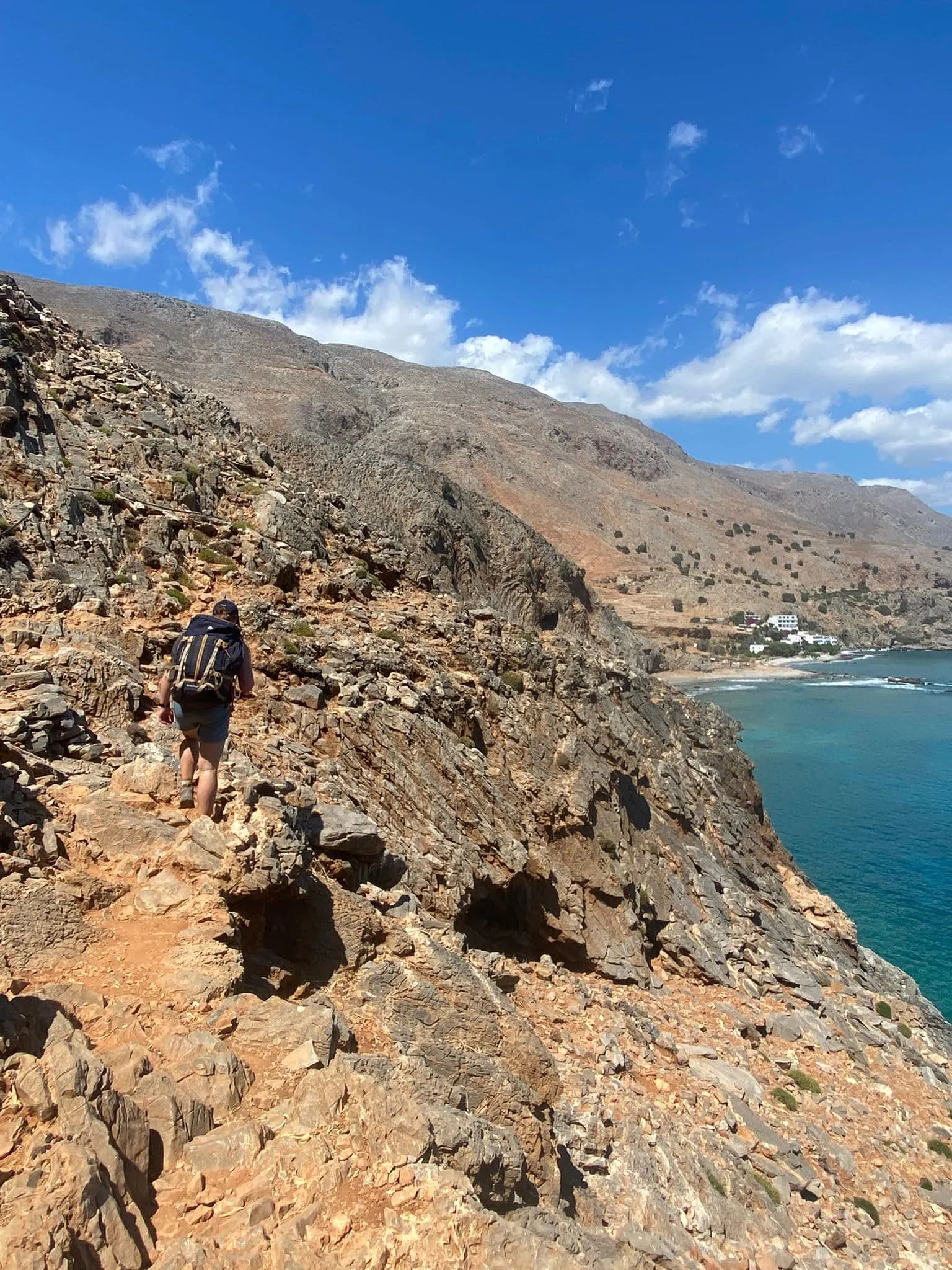
Today, you have two options to choose from. You can choose a more challenging and longer variant by hiking through the Aradena Gorge. If you go for this option, it will add around 6 kilometers and double the ascent and descent. You mainly hike along the beautiful coast in southern Crete. Enjoy the peace of the sea and the long sandy beaches. If you go for the Aradena Gorge option, then after the walk along the beach, you will have a beautiful hike through the rocky gorge back to the seaside town of Loutro. If you prefer to take it a little easier today, you can choose to skip the Aradena Gorge. Your stage will not be any less enjoyable as a result, as you can enjoy a long beautiful walk along the coast to the cosy town of Loutro. We described the metrics of the more challenging route.

Hotel Porto Loutro (Loutro)

Info
Hotel Porto Loutro (Loutro)
Day
4

From Loutro to Sfakia

Duration: 02:00 h
Distance: 7.04 km
Ascent: 160 m
Descent: 170 m
Today day is a short walk mainly along the southern coast. Today the ascent and descent do not exceed 200 meters, allowing you to enjoy the mountains and green surroundings. You walk to the coastal town of Sfakion, a cozy village with enough facilities to fill the rest of your day.

Hotel Sfakian Horizon (Hora Sfakion)

Info
Hotel Sfakian Horizon (Hora Sfakion)
Day
5

From Sfakia to Imbros to Sfakia

Duration: 03:00 h
Distance: 10.9 km
Ascent: 800 m
Descent: 30 m
The last relatively short hiking day takes you via the Imbros Gorge to the village of Imbros. This gorge offers you a green and rocky environment and you hike on well-trodden paths through beautiful nature. Once in Imbros, enjoy a Greek lunch after your final stage. You will then return to the town of Sfakia, where your last overnight stay is booked through us. We will provide instructions and help you with directions, but bus tickets or cab costs are not included.

Hotel Sfakian Horizon (Hora Sfakion)

Info
Hotel Sfakian Horizon (Hora Sfakion)
Day
6

Departure day

After breakfast, you can check out. This is the end of your adventure in Crete. We hope to see you again soon!

How difficult is hiking in Crete?

Most gorge and coast walks in Crete are moderate in character: not technical, but stony, hot and with long descents that put sustained pressure on the knees. Our Short Crete Trail is graded Intermediate, which means it suits experienced day walkers who are comfortable on rough paths for 4 to 6 hours.

For walking in Crete you do not need climbing skills. The two hardest sections of our route are the descent through the Samaria Gorge (−1,230 m on our 14.3 km stage) and the climb up the Imbros Gorge (+800 m on day 5). Day 3, with the Aradena option, is the longest day at 21.7 km and about 6 hours of walking with 900 m of climbing as well. Day 4 is short and easy.

What makes hiking in Crete demanding is not altitude but surface and heat. The gorge paths are loose gravel, rocks and stepping-stone river crossings; the coast path above the sea requires sure footing. In summer the sun is intense and there is little shade between villages. Carry enough water: there are few springs between villages, and it can get very hot in July and August.

For preparation: walk for several hours on consecutive days in the weeks before, wearing the shoes you will use on the trip and carrying a loaded backpack. This reduces the risk of blisters and helps your body adapt to the weight. Good walking shoes with firm grip are important on loose stone; walking poles are useful on the long downhill stretches.

This route suits walkers who regularly hike 4 to 6 hours on rough terrain.

How difficult is hiking in Crete?

Where to stay on a walking holiday in Crete

On a walking holiday in Crete, you sleep in small hotels and guesthouses in the villages along the route. Our itinerary overnights in Chania, Agia Roumeli, Loutro and Chora Sfakion, with two nights in Chora Sfakion at the end. All rooms are private, with en-suite bathrooms where available.

Agia Roumeli and Loutro are different from the other stops on the route: both villages sit on the south coast with no road access. You arrive on foot from the gorge or the coast path, and you leave the same way or by ferry. In the evenings these villages are quiet, with a handful of tavernas along the waterfront. In summer, particularly in July and August, demand for beds is high across the south coast; book well ahead.

Walking holidays in Crete: what is included

Included: - 5 nights in hotels, inns and guesthouses (private rooms, en-suite where possible) - Breakfast where available at the accommodation - Our trekking app as your digital travel guide, with route descriptions, offline hiking maps (your Crete hiking map on your phone) and GPS navigation

Not included: - Travel to Chania at the start and travel home from Chora Sfakion at the end - Buses, taxis and boats during the trip (for example, the transfer to Omalos on day 2 and the bus back from Imbros on day 5) - Lunch and dinner - Travel insurance - Samaria Gorge entrance fee - Luggage transport: you carry your own bag on all walking days, so pack light; Agia Roumeli and Loutro have no road and no luggage service

A deposit of 30 percent is due at booking. Cancellation is free up to eight weeks before your departure date. You choose your own start date from the calendar: there are no fixed group departures.

Where to stay on a walking holiday in Crete

Food and hospitality on the south coast

You eat in tavernas in every village on the route: Agia Roumeli, Loutro and Chora Sfakion all have restaurants within a short walk of your accommodation. Cretan cooking is built around olive oil, seasonal vegetables, local cheese, and fresh fish from the Libyan Sea. Dishes you will find on most menus include dakos (a barley rusk topped with tomato, olive oil and soft cheese), Greek salad, grilled fish and meat, and horta (wild greens sautéed in olive oil). Mountain tea, made from dried ironwort or other local herbs, is a staple at breakfast and after walks.

Breakfast is provided at the hotel where this is available on the route. Lunch and dinner are at your own cost and not included in the package price. On day 5, after the Imbros Gorge, you reach the village of Imbros itself for lunch before returning to Chora Sfakion. The evenings in Loutro in particular are relaxed: a small waterfront with tavernas, no cars, and the sea directly in front.

Food and hospitality on the south coast

Not sure yet or want to discuss your plans for the Crete Trail with one of our trekking experts? Get in touch today and turn your dreams into memories!

What is the best time for hiking in Crete?

The best time for hiking in Crete is spring, from April to early June, and autumn, in September and October. The Samaria Gorge is generally open from 1 May to 31 October, which shapes the main walking season for the southwest.

Spring (April to early June): the island is green, wildflowers cover the hillsides, and the paths are quiet compared with summer. April can have occasional rain, and the Samaria Gorge normally opens on 1 May.

Summer (July and August): hiking in Crete is possible but requires planning. It is hot, particularly inside the gorges where there is no shade and little wind. Start walking as early in the morning as possible and carry more water than you think you need. The Samaria Gorge is at its busiest with day visitors in these months.

Autumn (September and October): the sea is warm from the summer, midday temperatures are lower than in July, and the south coast is noticeably quieter. October is a good month: the Samaria Gorge is still open (generally until 31 October), the light is clear, and the crowds have thinned.

Winter (November to March): the Samaria Gorge is closed, and there can be snow on the high peaks of the White Mountains. Shorter day walks in the coastal areas and on the Akrotiri peninsula remain accessible, but the main gorge routes in the southwest are not reliably passable.

How to get to Crete and to the start of the walk

For Crete hiking in the southwest, fly to Chania (CHQ) if possible: it is the closest airport to the start of the walk and to the Omalos plateau. From Chania airport to the centre of Chania is about 45 minutes by bus or 15 minutes by taxi. Your first night is in a hotel in Chania, so you can arrive at any time on day 1. If you fly to Heraklion (HER), allow 2 to 3 hours to reach Chania by car, bus or transfer. Ferries run year-round from Piraeus (Athens) to Heraklion; the crossing takes 8 to 9 hours, with more sailings in summer.

On day 2 of the Short Crete Trail, you travel from Chania to Omalos by taxi or bus. We provide directions; the transfer cost is not included. At the end of the trip, you return from Chora Sfakion to Chania by taxi in just over an hour, by KTEL bus depending on the season and day, or by car in about 1 hour.

What is the most famous hike in Crete?

The Samaria Gorge is the most famous hike in Crete. It runs through a national park established in 1962 inside the White Mountains, from the Omalos plateau down to Agia Roumeli on the south coast. Our stage covers 14.3 km and takes about 3 hours 30 of walking. The gorge is generally open from 1 May to 31 October.

How difficult is the Samaria Gorge walk?

The Samaria Gorge is moderate in difficulty: the walk is mostly downhill, losing 1,230 m over 14.3 km in about 3 hours 30, on stones and loose gravel with stream crossings on stepping stones. It is hard on knees and ankles rather than technically demanding. Good grip on your shoes and enough water matter more than aerobic fitness.

Which Greek island is best for hiking?

There is no single answer. Crete has the highest mountains and the most dramatic gorges; the Corfu Trail crosses a whole island; on the mainland, the Menalon Trail in the Peloponnese links mountain villages. See our overview of walking holidays in Greece for a full comparison.

Can you walk the Samaria Gorge in winter?

No. The national park is generally open only from 1 May to 31 October, and it can close on other days within the season because of high water levels or adverse weather. Always check the official opening times before you plan your day around the gorge.

Is the Short Crete Trail self-guided?

Yes. You walk on your own with our trekking app, which has route descriptions, hiking maps and GPS navigation that also works offline. Your hotels and breakfast are arranged for you in advance. There is no tour guide and no luggage transport.

How do I get back from Chora Sfakion to Chania?

By taxi in a little over an hour, by KTEL bus on a timetable that varies by season and day, or by car in about 1 hour.

Do I need hiking boots for Crete?

Yes, or sturdy trail shoes with firm grip. The paths in the gorges are stony and often loose; the coast path above the sea requires stable footing. Walking poles are useful on long descents such as the Samaria Gorge, where the sustained downhill puts pressure on the knees over several hours.

Are there guided walking holidays in Crete?

Yes, guided walking holidays in Crete exist, usually as group tours with fixed departure dates and a walking guide. Our Short Crete Trail is self-guided instead: you choose your own start date, walk at your own pace with the route and maps in our app, and your hotels with breakfast are booked for you. There is no guide on this trip.

How much does a walking holiday in Crete cost with Bookatrekking?

The Short Crete Trail costs from 585 euros per person for two people, and 995 euros for one person travelling alone, including 5 hotel nights and breakfast where available. Prices can differ per date. Travel to and from Crete, transport during the trip, lunch and dinner and the Samaria Gorge entrance fee are not included.


How to get to Crete and to the start of the walk

Packing List for the Crete Trail

No matter where you go hiking or for how long, bringing the right equipment is of utmost importance. For your hike, the first thing you need is a good backpack. The size of it will depend on the number of days you will be trekking, the season and the clothes you take with you. If you have luggage transport, the comfort level of your daypack is most important. We have compiled a packing list with a few essential items of clothing you should bring and some extras you might find useful:
  • Essentials

  • Extras

Safety tips for the Crete Trail

Although this is far from being a trek in the Himalayas, unexpected things can always happen and you might also find obstacles on the hiking trails along the way. The Crete Trail is safe, the trails are quite straight forward and there is not an extreme difference in altitude. However, for your safety, every hike deserves a level of respect; respect for the terrain, the trails, wildlife and vegetation, local rules and regulations, and above all, your physical capabilities and safety. Therefore, for an unforgettable and safe hiking memory, please keep the following safety recommendations in mind:

  • Know your limits

    Always prepare each stage carefully to use your energy wisely, respect your physical and mental limitations, and avoid taking unnecessary risks. When ascending or descending, if applicable, always use the aids provided, such as handrails and ropes. Is this trek suitable for you? Well, familiarize yourself with the grading system and figure out if this trek matches your capabilities. If you still need professional advice you can always contact Bookatrekking.com experts.

  • Stay on marked trails

    The most important thing is to never leave the marked paths. For easy navigation, most of our treks come with the Bookatrekking app: it shows your route for each day and your own position on the map, and once downloaded, everything also works offline. As a backup, make sure to bring a hiking guide or a paper map with you.

  • Fully equipped

    Make sure you have the necessary gear for the conditions you'll be facing, including appropriate clothing, footwear, and any necessary equipment for the terrain you'll be hiking on. Always wear clothing adapted to the weather of Crete Trail and protect yourself from cold and wetness or heat and sun. Besides, make sure you carry enough food and water for the duration of your trek. On the way, you might (or might not) be able to buy snacks.

  • Stay reachable

    If you are hiking solo or in small groups it is advisable to inform people back home about your plans, what route you are taking and when you plan to return. Even small incidents can lead to unpleasant emergencies so make sure you are available at all times. Bring a charged phone containing at least the phone numbers of immediate family members, your accommodations en route and the emergency phone numbers operating in the Crete Trail.

  • Respect for nature

    Do not litter, prevent noise, stay on the marked trails, do not disturb wildlife or grazing animals, and respect protected areas.

Where Can I Book the Crete Trail?

At Bookatrekking.com you can book the self-guided Crete Trail and many other treks. We take care of all the details for you, including arranging accommodations and providing you with relevant information well in advance of your trek. Find our offers here. Our easy-to-use platform allows you to browse and compare different trekking options and to find the perfect fit for your interests, abilities, and budget.

If you have any questions about a specific trek or need help choosing the right one for you, our team of trekking experts is here to assist you. Simply reach out to us and we will be happy to provide you with personalized recommendations and advice to help you plan the trekking adventure of a lifetime.

About Us

At Bookatrekking.com, you will find the trek that will make your life unforgettable. Whether you want to explore the Inca Trail or climb Kilimanjaro. Bookatrekking.com has a wide and varied range of first-class treks. No false promises are made here. Transparent prices and bookings are fixed instantly. Find, compare, book and trek!
Read more about us
About Us
About Us

Also Interesting