



Carros de Foc: Everything About Hiking in Aigüestortes

Sierd van der Bij
Sierd van der Bij
Sierd van der Bij
28 Feb 2024 16 min read
Carros de Foc: Everything About Hiking in Aigüestortes
Trekking experts per destination
Free cancellation up to eight weeks in advance
Quick personal advice

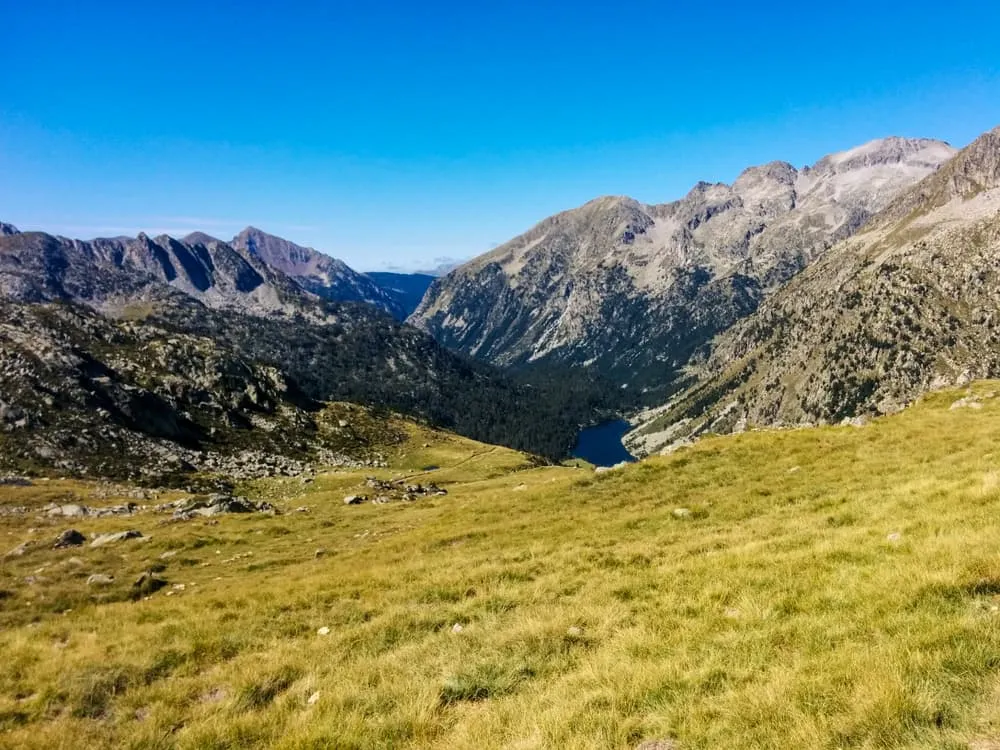
There are plenty of opportunities for hiking in the Spanish Pyrenees, but does it get any better than the Carros de Foc? To be fair, it's also one of the best-known multi-day hut-to-hut hikes in the area. And for good reason, because with 65 kilometers, over 3,500 meters of elevation gain, and 9 welcoming huts, an epic adventure awaits you on the Carros de Foc. Hiking in, quite a mouthful, Parc Nacional d'Aigüestortes i Estany de Sant Maurici doesn't get any better than this. Are you ready to discover the wild and adventurous side of Catalonia?

What started as a joke among local hut wardens, visiting each other’s huts, the Carros de Foc has now grown into a world-renowned multi-day mountain trek that is mentioned in many a guidebook as one of the most beautiful multi-day hut-to-hut treks in Europe. What makes the Carros de Foc so special? Why is it called "Chariots of Fire" in Catalan? Where do you start? Is the Carros de Foc something for you? Although well-known, one can still have a lot of unanswered questions about this epic trek. In this blog post, we'll answer them all for you!
What and Where Is Carros de Foc?

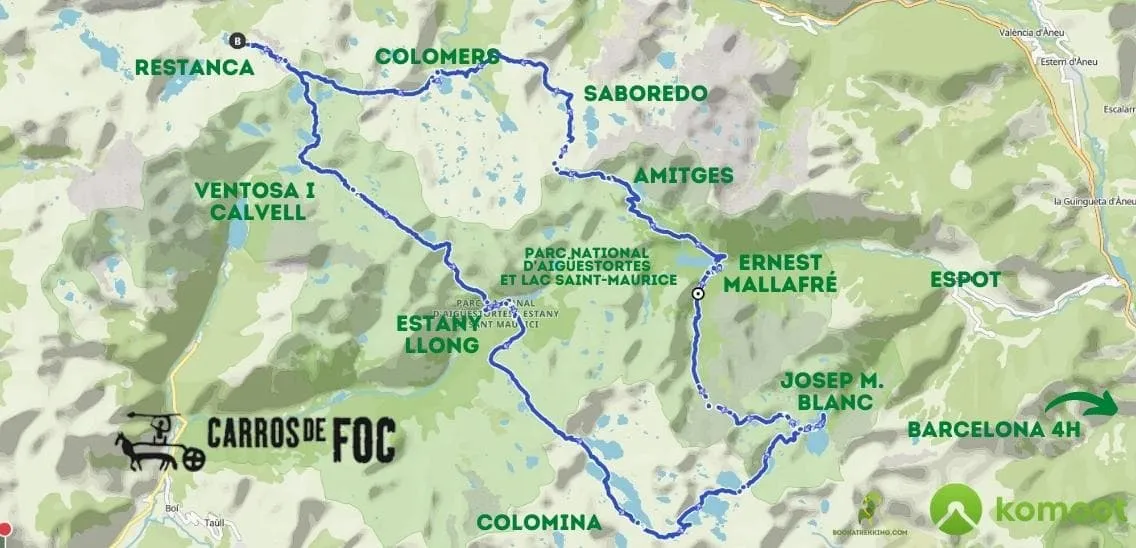
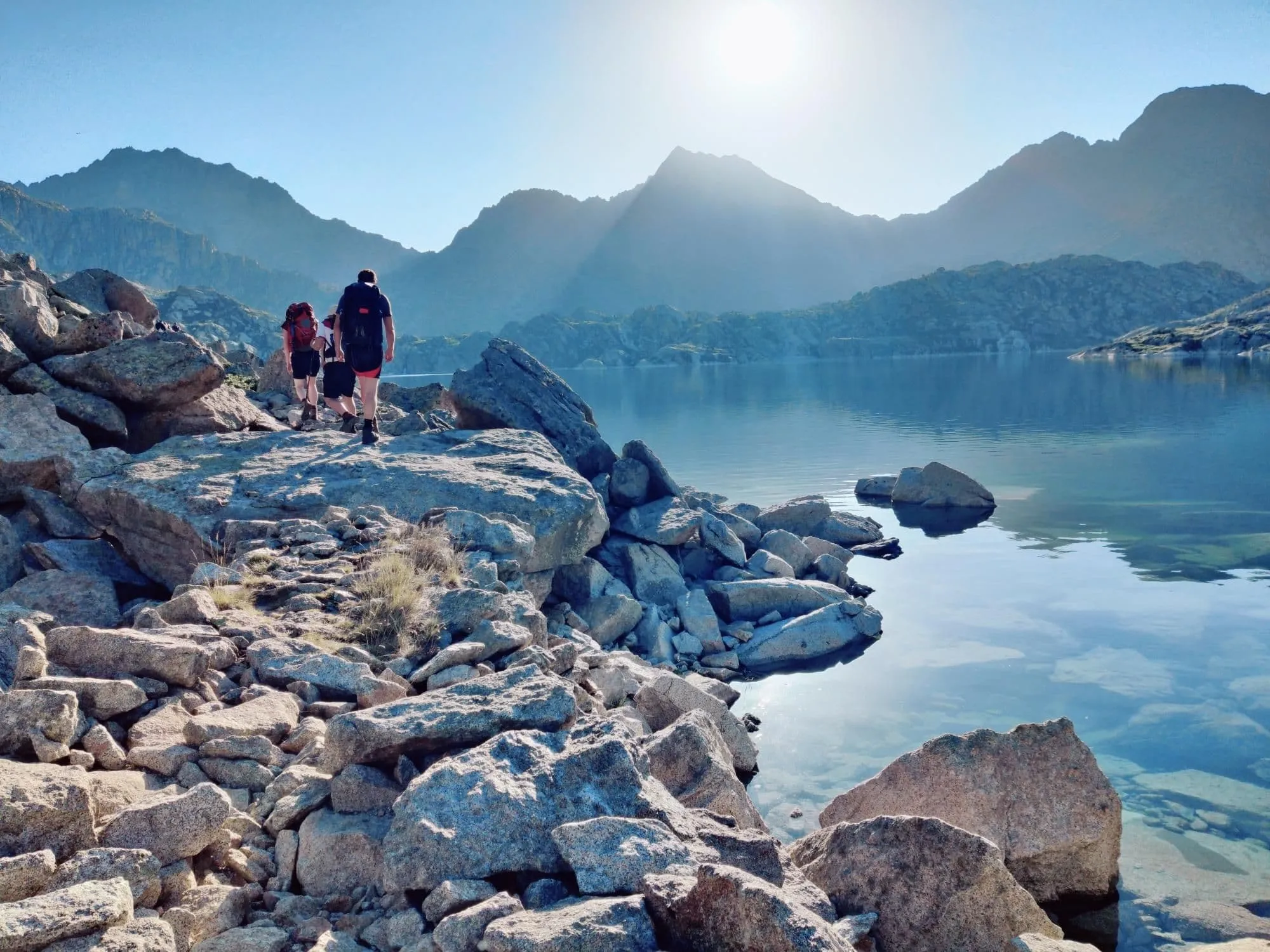
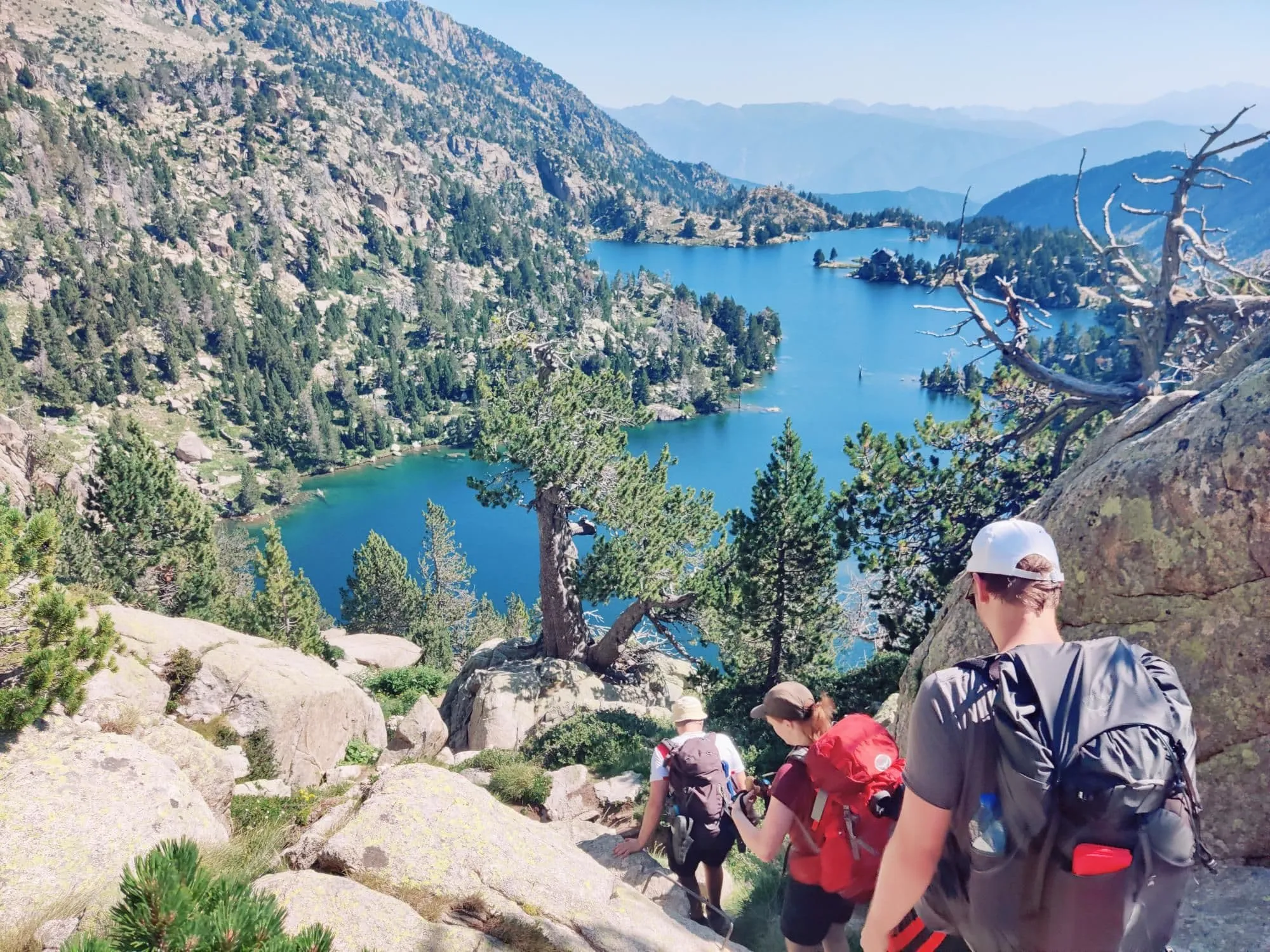
Carros de Foc is that epic hut-to-hut hiking tour that may not have been on your bucket list yet but will be after reading this blog post. No exaggeration, there is no better way to discover the Catalonian Pyrenees. That answers one of your questions: You can find Carros de Foc in the Pyrenees, about 4 hours northwest of Barcelona, and because they are the Pyrenees after all, right on the border with France. Carros de Foc is Catalan for Chariots of Fire and although no one knows why the trek carries this curious name, we dig it. The route was created in 1987 when the caretakers of the refuges in Aigüestortes i Estany de Sant Maurici Park decided to visit each other's huts, resulting in a beautiful circular hike, connecting all the mountain huts, "Refugi" in Catalan, in the area.

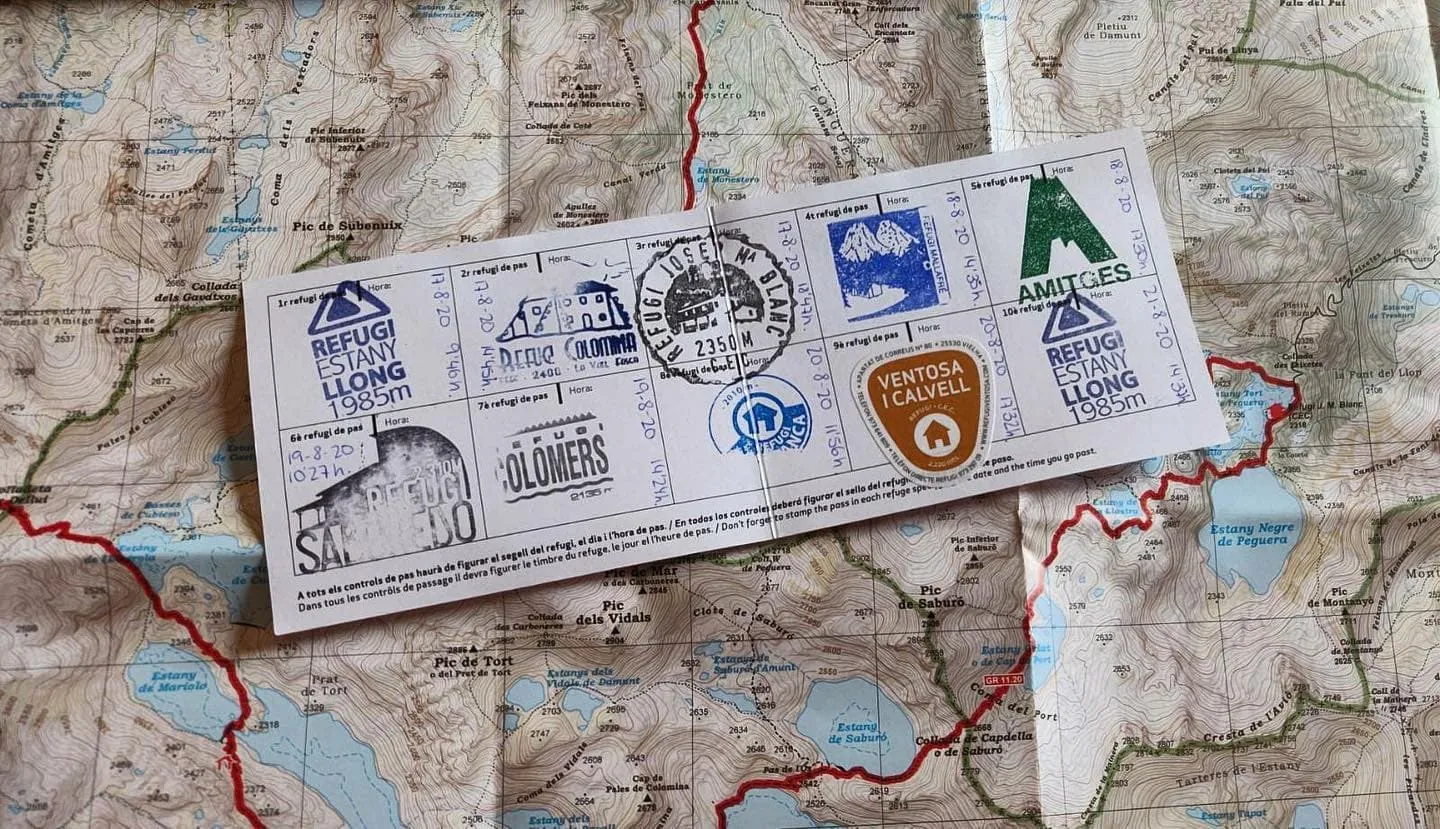
A great takeaway for Carros de Foc is that there is still this bond between the different refugis. The 9 huts are not only connected by 65 kilometers of trails, hikers are also able to collect stamps from each and every refugi, allowing for a great tangible memory to take home. The hike can be started at any of the participating refugis and you can choose your own pace and decide to stay in as many or few refugis as you wish. Having said that, it is of course always helpful to have some sort of plan. If you keep reading, you will find one of the better self-guided itineraries for the Carros de Foc.

Is The Carros de Foc For Me?

Traversing from hut to hut in the Pyrenees on the Carros de Foc may not be for everyone. This is a high mountain hike that requires a bit of experience and respect for the mountains. Having said that, because you are staying at refugis, you will have more comfort than, for example, when hiking the the GR11 in the Pyrenees. The refugis offer you a chance to recharge your mental and physical batteries and you will never have to stay in a tent. Also, since the Carros de Foc is a circular hike, you can take it as fast or slow as you want. It is recommended to do the Carros de Foc in at least five days, but it is also possible to do it in six. You could even only do half of the route.

It is important to know that although the Carros de Foc is a well-known route, it is not a perfectly marked one. Reason for this is that the route is that the park authorities of Aigüestortes i Estany de Sant Maurici have their own trail marking policy which does not include marking for the Carros de Foc. However, the directions to the independent huts are marked and with maps and/or a guidebook you can easily find your way. Is the Carros de Foc for you? If you are looking for an epic adventure in the Catalonian Pyrenees, this is totally for you!

Is The Carros de Foc For Me?

Carros de Foc Accommodation: Staying in Refugis

At Bookatrekking.com we like to do things properly and when it comes to accommodation on treks in the Alps and the Pyrenees, this means you should stay in mountain huts. Refugi is the Catalonian name for a hut where mountaineers can enjoy a bed, a meal, and in, most cases, even a fresh draught beer or a good glass of wine. In Carros de Foc you can find 9 Refugis and what all these have in common is their fantastic locations. In the most remote spots in the Pyrenees, you can check into these safe havens.

On the Carros de Foc, not every Refugi offers the same standard. All of the huts have showers but only about half of them offer hot showers (against a small fee), only two can process card payments and not every refugi can be reached by car. Well, since you are on foot anyway, that's no problem. Now, in contrast to for example the Tour du Mont Blanc or the Alta Via 1, it is possible to not only have breakfast and dinner, but also lunch. This makes the Carros de Foc one of the few hut-to-hut trekking options with full board. This will save you a few extra grams in your backpack.

One clever way to both keep track of your visits and have a tangible memory is the stamp card. For 30 Euros you get a high-quality map of Carros de Foc and a stamp card. Find a stamped example below.

Carros de Foc Accommodation: Staying in Refugis

What Is The Best Season for The Carros de Foc?

The Refugi on the Carros de Foc are open between June and October. However, not all refugis operate throughout this period. Some are only open between mid-July and mid-September, in line with huts in France, Austria, Italy, and Switzerland. No surprise then, that this is the best season for hiking in Aigüestortes. Outside of these months, there are no open huts or refreshment options, so you’ll be on your own. The best months are typically July and August, these are also the busiest. It’s peak season, so be sure to book as far in advance as possible. If you decide to go trekking in September, you’re still in for a treat and it’s not as busy on the trail. But this could also mean that some accommodations might be closed for the season already. Also, the days are shorter and the weather is significantly colder. If you want to set out on a long hike in a warmer area during this period, check out the GR221 in Mallorca.

Carros de Foc and Aigüestortes Hiking Map

There are plenty of maps and guidebooks that can help you do the Carros de Foc or any other trek in Aigüestortes. Below you can find a map with an overview of the Carros de Foc and Aigüestortes. If you’re looking for a high-quality guidebook for the route, we highly recommend the Cicerone guide for the Carros de Foc. At Bookatrekking.com we make use of Cicerone guidebooks for the majority of our self-guided treks.

Carros de Foc and Aigüestortes Hiking Map

6-day Carros de Foc Itinerary: From Day to Day

On the Carros de Foc, you can find 9 huts and thus you can easily do a 10-day hut-to-hut-trek. We have designed a 6-stage Carros de Foc itinerary that allows you to make the most of your experience without having to spend more than a week on the trails. This itinerary was designed for hikers who are comfortable hiking for at least 6 hours per day. There is no need to rush your time on the Carros de Foc. Find some longer options here. 

Day
1

Espot - Refugi d'Amitges

Duration: 04:20 h
Distance: 11.8 km
Ascent: 1040 m

This stage is one long climb, gaining 1,030 m from the start to the hut with no meaningful descent. The first section follows an asphalted road before the route continues onto forest paths. If you want to make the start a little easier, you can shorten the first kilometres by taking a taxi. The first part feels controlled and steady, with easier ground through the forest and a gradual rise that lets you find your rhythm. The highest point is reached near 2,340 m, so treat this as a demanding climb rather than a warm-up. The character of the route changes clearly as you go higher.

After the asphalted start, you continue on relatively easy forest paths, gaining height without much technical difficulty underfoot. After about 4.8 km, the trail changes to boardwalks and bridge sections, giving the route a different feel while the climb continues. At around 7.5 km, you reach the first lake. Follow the water for roughly 800 m and take your time here, especially if the surface is calm enough for reflections across the lake.

After about 8.3 km, the route bends right and the climb becomes more serious. Boardwalks return, but the terrain gradually turns rougher, rockier and more uneven, so sturdy footing matters. Around Lake Ratera, the route eases for a while, giving you space to slow down and enjoy the view. Beyond the lake, a steeper section leads past two small sister lakes before the final approach opens into broader mountain terrain.

The last stretch to the hut feels more remote, with open ground, wide views and continued rocky terrain underfoot. Arrive steadily rather than rushing the final climb, then settle in at the mountain hut after a full uphill effort.

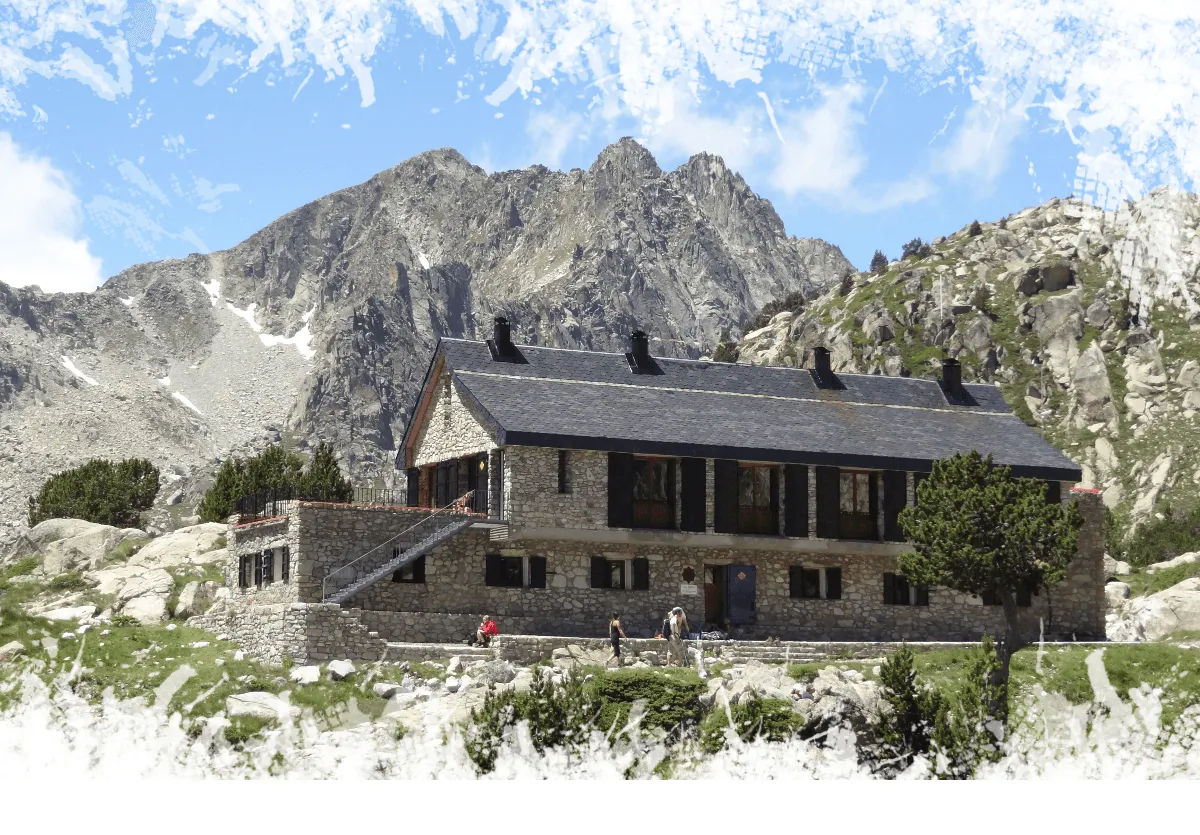
Refugi d'Amitges

Info
Refugi d'Amitges
Refugi d'Amitges
Day
2

Refugi d'Amitges - Refugi Colomèrs

Duration: 04:45 h
Distance: 10.7 km
Ascent: 520 m
Descent: 740 m

You continue across the same broad, open terrain as the previous section, moving over rocky ground and occasional rubble fields. Our app is useful here, especially where the path is less obvious among stones and slabs. After about 2.8 km, a small lake makes a good place for a short break. From there, keep right and begin descending into a wide, almost moonlike landscape that feels remote and quiet.

Near Lago de Naut, the descent becomes more hands-on, with a short scrambling section where you may need to use your hands for balance. After this, the route gives you an easier stretch, with around 2 km of flatter walking and very little climbing or descending. After a total of about 5.1 km, you pass Saboredo Regue in the middle of this flatter valley before the path starts climbing again towards Tuc Gran de Sedrosa.

The route does not go all the way to Tuc Gran de Sedrosa, but after the climb the descent becomes slightly more technical again. Prepare for a short T3 section. The final kilometres lead past a few more beautiful mountain lakes and across the rocky, uneven terrain that you have likely grown accustomed to over the past two days on the Carros de Foc. Before long, you arrive at your next mountain refuge, Refugi Colomèrs, located next to Lake Colomèrs.

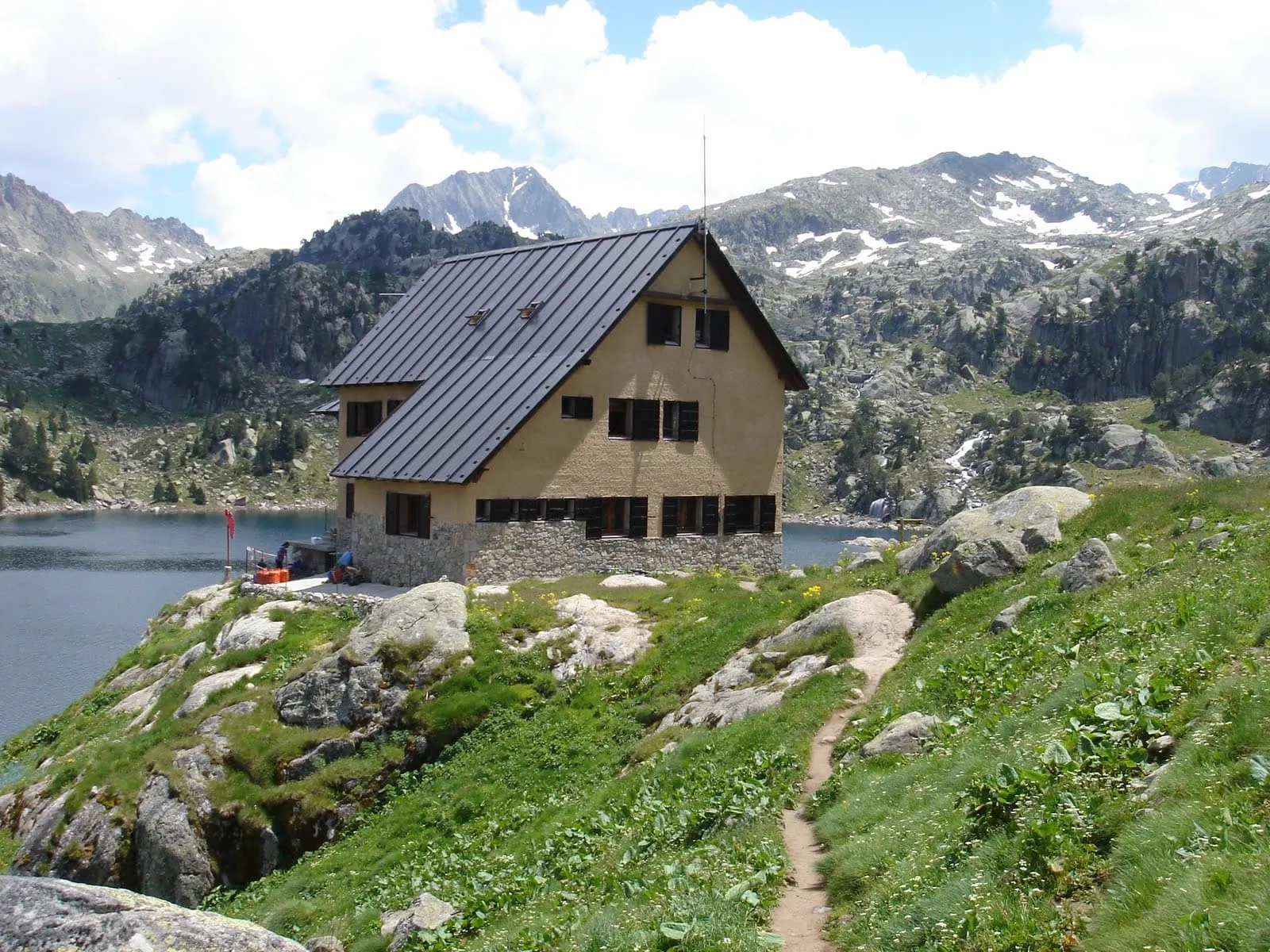
Refugi Colomèrs

Info
Refugi Colomèrs
Refugi Colomèrs
Day
3

Refugi Colomers - Refugi Ventosa i Cavell

Duration: 03:40 h
Distance: 7.9 km
Ascent: 520 m
Descent: 460 m

You start directly from the lake with a steady climb that gradually becomes steeper. It is worth looking back early on for the panorama behind you before the route turns rougher. With 520 m of ascent over a relatively short distance, this is a compact but active mountain stage. The path moves from greener surroundings into a higher, rockier landscape, where the walking becomes more uneven and you need to keep your rhythm.

After around 3 km, you reach the highest point of the route close to Tuc deth Cap deth Pòrt de Caldes. This is a good place to pause briefly before starting the descent. The open, stony terrain gives the stage a more lunar feel here, with less vegetation and rough ground underfoot. About a kilometre after the high point, one final climb asks for another push before the route settles into a longer descent.

From there, you continue on a T2 path as the surroundings gradually become greener again. Lakes return along the route, and you weave through this quieter landscape towards the mountain hut.

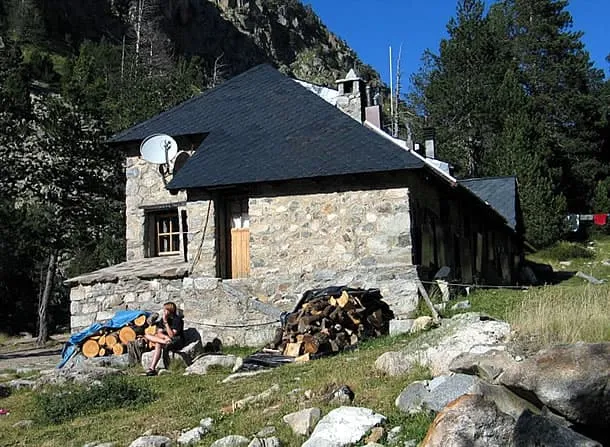
Refugi Ventosa i Calvell

Info
Refugi Ventosa i Calvell
Day
4

Refugi Ventosa i Cavell - Refugi de l'Estany Llong

Duration: 05:00 h
Distance: 8.8 km
Ascent: 650 m
Descent: 850 m

The stage starts calmly, with about 1.5 km of relatively easy walking and views towards Estany Gran de Colieto. Do not let this opening fool you. With 650 m of ascent and a T4 section ahead, this is a serious high mountain stage. The route soon changes completely, becoming steep, rocky and technical. This part asks more from your legs, balance and concentration than the previous stages, so start early and keep enough energy in reserve.

The hardest section lasts roughly 3 km and moves through broken rock, steep ground and unclear trail lines. In places you need to use your hands for balance or short scrambling moves, and the path is not always obvious. Follow the app carefully, take your time and avoid rushing. If you are not used to this kind of terrain, calculate extra time here, as every step needs attention and the rough surface can be tiring both physically and mentally.

After passing lake Estany de Contraix, the toughest part of the route is behind you. The surroundings become more familiar again, with narrow paths, greener patches and some stone fields still to cross. From here, the final 4 km are mainly downhill, which can be demanding on tired knees after the technical climb. Take it steadily all the way to the mountain hut. This is a stage to be well prepared for, and arriving at the hut will feel like a proper job well done.

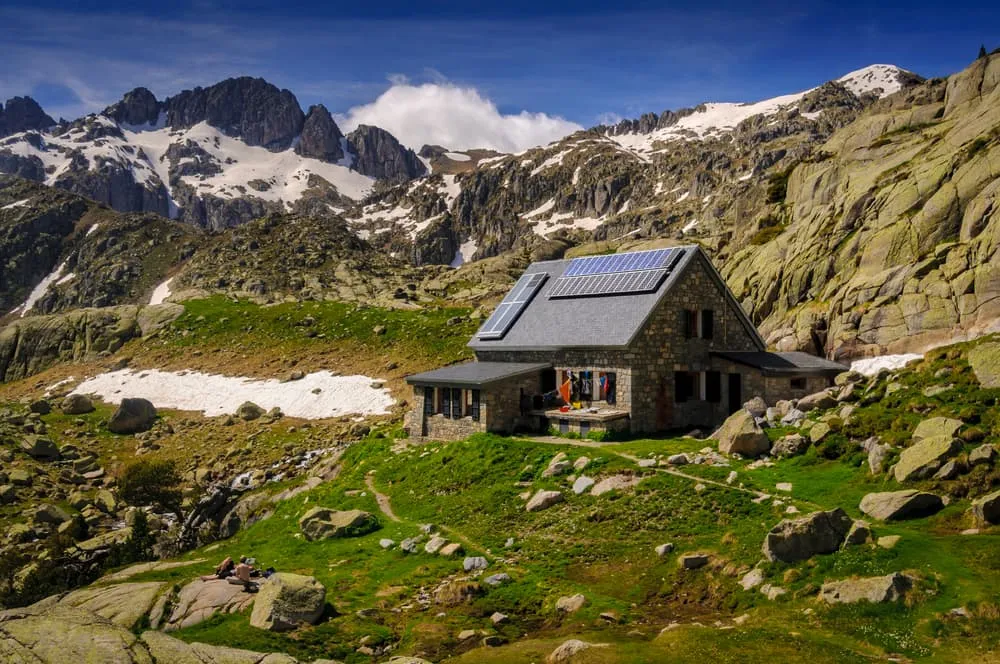
Refugi del Estany Llong

Info
Refugi del Estany Llong
Day
5

Refugi de l'Estany Llong - Refugi Colomina

Duration: 04:55 h
Distance: 11.3 km
Ascent: 750 m
Descent: 340 m

After the previous, more demanding sections, this route feels more manageable physically, but it is not a rest day. With 750 m of ascent, you still need to work steadily for the height you gain. The first 6 km are mainly uphill on narrow mountain paths, climbing gradually from the hut into higher terrain. Take your time after breakfast, keep a comfortable pace and enjoy the fact that the walking is less technical than before.

Once the main climb is behind you, the watery landscape returns. Lakes, streams and open mountain views become part of the route again, especially after the short descent of less than a kilometre. From there, the trail eases into a slightly flatter section across the mountain. Along Lake Estany Tort, you follow an old railway track that guides you further in the direction of Refugi Colomina, with water and rock shaping much of the scenery.

The final stretch brings you towards Refugi Colomina, set beside another lake and high in the mountains. It is a fine place to arrive after a steady climbing day. Settle in, take in the views and enjoy your last evening of the route, with the sunset over the surrounding water and peaks.

Refugi Colomina

Info
Refugi Colomina
Refugi Colomina
Day
6

Refugi Colomina - Refugi Josep Maria Blanc - Espot

Duration: 05:30 h
Distance: 13.8 km
Ascent: 250 m
Descent: 1340 m

This final stage brings you close to the end of the Carros de Foc, but it still asks for care and patience. The main challenge is the long descent, with 1,340 m of elevation loss before reaching Espot. The paths are generally easier to follow than on the rougher high sections, but they still cross large stone blocks in places. Watch your footing, especially when your legs are already tired from the previous days.

The first 2 km are relatively flat across the mountainside, before two short climbs bring you higher again. After the second climb, around 3 km into the route, you reach Collada de Saburó. From here the descent begins properly, with sections that vary in steepness. The route leads down through a stony mountain landscape where the line is clearer, but the terrain still requires attention and steady steps.

Stop at the Estany Negre de Peguera Dam for a break and take a look at its striking, staircase-like structure. You can also continue a little further to Refugi Josep Maria Blanc, set beside the same lake, for a break. After this, the route turns clearly towards the end of the circuit, with about 5 km left on a wider path down to Espot.

Arriving in Espot marks the end of your Carros de Foc. After the long descent and the final kilometres out of the mountains, you can properly let the route sink in. Well done, you have completed the circuit.

Packing List for the Carros de Foc

It doesn't matter where you are trekking or for how long: carrying the right equipment with you is paramount. For a hiking trip in the mountains, a good is backpack essential. Its size will depend on how many days you will be spending in the mountains, the season, and the clothes you will be taking with you. We have prepared a packing list with some essential clothing that you should include and some extras that you may find useful:
  • Essentials

  • Extras

Getting To and From Aigüestortes for the Carros de Foc

You can get to Aigüestortes i Estany de Sant Maurici National Park in different ways. Also, you can start the Carros de Foc at every connected refugi. Not every refugi is easy to reach though. Also, Aigüestortes can not be accessed from every side. The easiest entry point is from the Espot side. This will bring you to Josep Maria Blanc and onto the Carros de Foc route.

By plane:

Espot is about 4 hours from Barcelona and 3.5 hours from French Toulouse. Both these towns have an international airport and are well connected with other key cities in Europe. Here you can either rent a car and drive to Espot, or use public transport.

By bus:

From Barcelona, you can first take a bus to La Pobla de Segur. From here you can take another bus to Espot. It's not easy, but if you plan at least half a day for traveling and want to travel on a shoestring, it is worth it.

By car:

The easiest way to get to Aigüestortes and Espot is to go by car. From Barcelona, it's about 4 hours and 260 kilometers. From Toulouse, you can count 3.5 hours. In Espot you can find various options for long-term parking.

Getting To and From Aigüestortes for the Carros de Foc

How Much Does Hiking The Carros de Foc Cost?

The prices for hut-to-hut tours in the Pyrenees are quite varied. There are several variables to take into account when it comes to how much this trek costs: the type of accommodation, which can be in a shared dormitory or a private room in a hut, or also at a hotel in a town; How many days you will be spending on the mountain and whether you will be doing the full circuit or only a section; whether you will be doing it self-guided or with a guided group. The price of the trek will depend on your expectations for the tour.

Safe Hiking Tips for the Carros de Foc

When hiking, it is wise to be aware of a few points. Even if this is not your first time, you should never underestimate the mountains. Good tour planning and compliance with the regulations in the mountains will significantly increase safety. To ensure that your hiking adventure is a safe and enjoyable experience, here below you can find a list of 8 recommendations for safe hiking in the mountains:
  • Know your limits

    Hiking the Carros de Foc is the perfect outlet to escape from daily life. It is an endurance sport along with a beautiful nature experience with a positive effect on body and mind —as long as one is in good shape and has a realistic picture of one's possibilities and limits—. Never overestimate yourself or underestimate the route. Don't overdo it! Always choose the slower option and take more time for your plans. Hiking under time pressure is not fun and at too fast a pace it can be dangerous. Be wise!

  • Plan carefully

    Good planning is half the work! Hiking maps, literature, the Internet and expert advice are invaluable when planning the route of the Carros de Foc and enable you to determine the length, altitude difference, difficulty and conditions of the hike. When planning group treks, the itinerary should always be planned for the weakest member of the group! The weather in the mountains can change incredibly quickly and rain, wind and cold all increase the risk factor. For this reason, always check the weather forecast beforehand and contact our trekking experts to find your way before you start.

  • Be fully equipped

    Equipment is everything. In the most extreme case, it makes the difference between life and death, and in any case, it definitely makes the difference between having fun and having a bad time. Food and water, sunscreen and waterproof and warm clothes must always be in your backpack, as well as a first aid kit and a mobile phone with a full battery (in case there is an emergency). However, packing light makes hiking easier, so don't take too much extra luggage with you. Your equipment should always be suitable for the terrain you'll be hiking on in the Carros de Foc.

  • Wear suitable footwear

    Good walking shoes protect your feet and provide a better fit. Shoes with a good fit, with non-slip soles, water-resistant and lightweight are a must for additional walking pleasure during the Carros de Foc. Trail running shoes are great for a weekend in the mountains, but on longer hikes or more technical trails, you'll want at least A/B hiking boots. That means it is recommended wearing high mountain shoes that are water-repellent with extra ankle support to prevent sprains.

  • Stay on marked trails

    Carros de Foc has endless marked hiking trails, which are controlled and maintained and should not be deviated from. It may be tempting, but it's not a good idea to take shortcuts or alternative routes through unmarked terrain. It increases the risk of disorientation and you're more likely to get lost and have accidents or fall in the mountains. Even steep slopes of packed old snow are often underestimated and dangerous. Are you in doubt? Better don't do it. For easy navigation we work with our trusted partner Komoot, whose interactive maps, also available offline, provide you with the necessary digital means to get from A to B. As a backup, make sure to bring a hiking guide or a paper map with you. FYI, 75% of stumbles occur due to carelessness on marked paths or roads, not in open terrain!

  • Take regular breaks

    Remember you're on a hiking trip. Timely and regular breaks not only provide welcome relaxation but also make it possible to enjoy the Carros de Foc. The body needs a regular food and drink intake to maintain performance and concentration. Our advice is that if you have little time, it's better to follow the short itinerary than to speed up the long one.

  • Stay reachable

    If you are hiking solo or in small groups it is advisable to inform people back home about your plans, what route you are taking and when you plan to return. Even small incidents can lead to unpleasant emergencies so make sure you are available at all times. Bring a charged phone containing at least the phone numbers of immediate family members, your accommodations en route and the emergency phone numbers operating on the Carros de Foc.

  • Respect nature

    Leave no rubbish behind, prevent noise, stay on the marked trails, do not disturb wildlife or grazing animals, and respect protected areas.

Where Can I Book the Carros de Foc?

At Bookatrekking.com you can book the self-guided Carros de Foc and many other treks. We take care of all the details for you, including arranging accommodations and providing you with relevant information well in advance of your trek. Find our offers here. Our easy-to-use platform allows you to browse and compare different trekking options and to find the perfect fit for your interests, abilities, and budget.

If you have any questions about a specific trek or need help choosing the right one for you, our team of trekking experts is here to assist you. Simply reach out to us and we will be happy to provide you with personalized recommendations and advice to help you plan the trekking adventure of a lifetime.

About Us

At Bookatrekking.com, you will find the trek that will make your life unforgettable. Whether you want to explore the Inca Trail or climb Kilimanjaro. Bookatrekking.com has a wide and varied range of first-class treks. No false promises are made here. Transparent prices and bookings are fixed instantly. Find, compare, book and trek!
Read more about us
About Us
About Us

Also Interesting