Dachstein hut to hut: hiking the Dachstein Rundwanderweg circuit in Austria

Dachstein hut to hut: hiking the Dachstein Rundwanderweg circuit in Austria
Trekking experts per destination
Free cancellation up to eight weeks in advance
Quick personal advice

The Dachstein hut to hut circuit — properly called the Dachstein Rundwanderweg — is one of the most rewarding multi-day walks in Austria. The route loops around the Dachstein massif where Upper Austria, Styria and Salzburgerland meet, threading together the jagged Gosaukamm ridge, the cathedral-shaped Bischofsmütze, the turquoise Gosausee lake and the rolling alpine pastures above Filzmoos. Day stages run from 4 to 10 km, which makes this the ideal first hut to hut hiking Austria experience — manageable for fit beginners and families alike.

With Bookatrekking you get the huts reserved on half board, an offline navigation app with GPX and a live weather feed per hut. This guide covers every stage of our western Gosau-to-Filzmoos route, the family variant, the full five-to-eight-day circuit, the three huts, difficulty, best season and both bookable packages — everything you need to plan your Dachstein hike with confidence.


What is the Dachstein hut to hut circuit (Dachstein Rundwanderweg)?

The Dachstein Rundwanderweg (the name translates literally as Dachstein circular hiking trail) is a marked long-distance loop that circles the entire Dachstein massif. In the hiking world you will find it described as the Dachstein circuit, the Dachstein circular trail or simply the Hüttenrunde — all names for the same route.

The massif sits at the triple border of Upper Austria, Styria and Salzburgerland, rising to just under 3,000 m at the Hoher Dachstein summit. The northern face above Gosau is defined by the serrated Gosaukamm ridge, with the freestanding pillar of the Bischofsmütze as its most recognisable landmark. The southern face drops steeply towards the Ramsau plateau and Schladming. In between you find a mosaic of limestone karst, glacier remnants, larch forests and alm pastures.

The complete Rundwanderweg circles the whole massif and typically takes five to eight days. Our two bookable packages walk the western section only, from Gosau to Filzmoos, which captures the finest scenery of the north side while staying within reach of fit beginners and families. If you want the full picture before choosing, the sections below walk you through every option.


Where are the Dachstein mountains and how do you get there?

The Dachstein mountains straddle the boundary between the Salzkammergut and the Styrian Alps, roughly equidistant between Salzburg and Graz. The starting point of our hut-to-hut route is Gosau, a village on the shore of the Gosausee in the Salzkammergut. The finish is Filzmoos, a quiet mountain village in Salzburgerland just west of the Bischofsmütze.

Getting there by train and bus: Salzburg is the most convenient hub. From Salzburg Hauptbahnhof, take the train to Bischofshofen (about 45 minutes) and connect by regional bus to Gosau or Filzmoos. The journey takes roughly two to two-and-a-half hours in total. Schladming and Ramsau am Dachstein — gateways to the south side of the massif — are reached by train from Salzburg via the Ennstal line.

Flying in: Salzburg Airport has direct flights from many UK airports, making it the easiest entry point. Munich and Vienna work as alternatives if you find better connections.

Returning from Filzmoos: Bus services from Filzmoos connect back to Bischofshofen and the main rail network, so the logistics of a point-to-point walk are straightforward. Our Bookatrekking app includes travel notes for arrival and departure so you are not left guessing.


Dachstein hut to hut stages: our beginner route from Gosau to Filzmoos

This is the heart of the Bookatrekking Dachstein trek: three days, three distinct landscapes, two overnight huts and a total of 28.4 km on well-marked trail. Below you will find the stage-by-stage breakdown with honest numbers.

Day 1: Gosau to Gablonzerhütte — 10.2 km, +810 m, about 4¼ hours

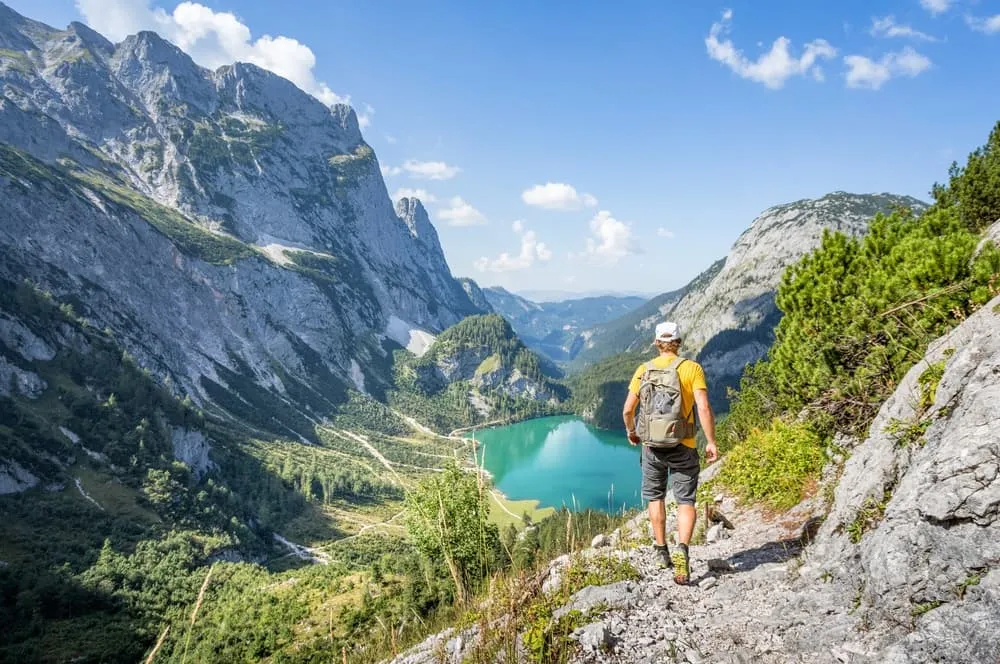
The day begins in the village of Gosau, with the Gosausee lake and the glacier-dusted peaks of the Gosaukamm already visible before you take your first step. The trail climbs steadily westward through forest and open alm land, passing small waterfalls before the gradient steepens towards the end. The reward for the 810 m of ascent comes just before arrival: a sweeping view of both the Vordere and Hintere Gosausee with the Dachstein massif as a backdrop. The Gablonzerhütte sits in a prime position above the lake and serves as a warm introduction to alpine hut culture.

Day 2: Gablonzerhütte to Hofpürglhütte — 10.2 km, +510 m / −350 m, about 4¼ hours

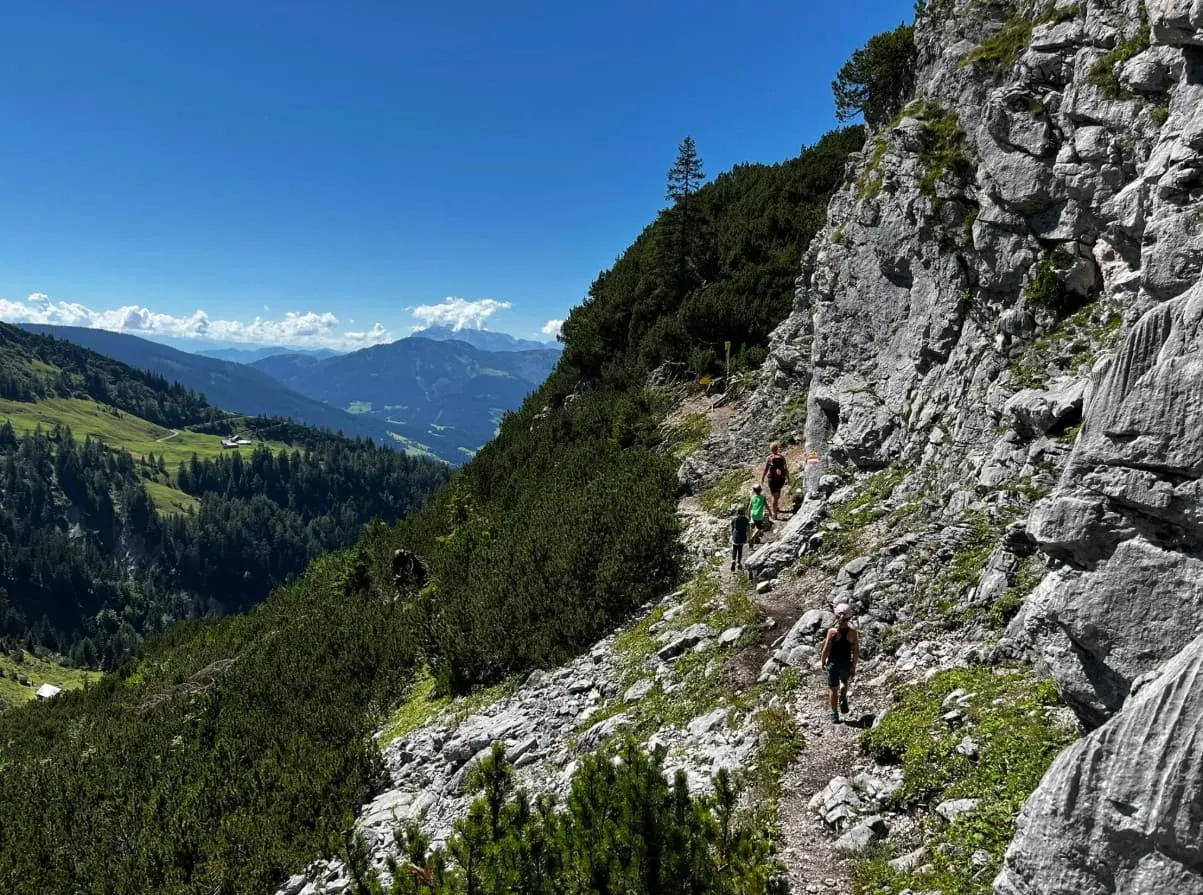
This is the most characterful day of the Dachstein Rundwanderweg. From the Gablonzerhütte the trail works its way below the Gosaukamm, traversing rocky ground that requires sure footing in places — there is one exposed section that demands concentration but no technical climbing. After that section the route eases and rewards you with successive viewpoints: the Rötelstein, the Bischofsmütze growing larger with every kilometre, and finally the Hofpürglhütte itself, framed beneath the vertical south face of the Torstein. Arriving here feels like earning something.

Day 3: Hofpürglhütte to Filzmoos — 8.0 km, +120 m / −750 m, about 3½ hours

A gentle finale. The trail descends south from the Hofpürglhütte through larch forest and open pasture, passing the legendary Schwarze Lacke mountain pond (said to hide a golden chariot guarded by a dragon) before the village of Filzmoos comes into view. The spire of the 15th-century Gothic pilgrimage church of St Peter and St Paul signals the end of your Dachstein circuit — a fittingly atmospheric full stop. The descent of 750 m is gradual and legs rarely complain.

You can book the full three-day package as the Beginner Dachstein Rundwanderweg (3 days), which includes hut reservations, half board where available, offline navigation and weather updates per hut.



Dachstein hut to hut stages: our beginner route from Gosau to Filzmoos

The family variant in four days: shorter stages, the same huts

Spreading the same 28.9 km across four days makes a significant difference for children and anyone who prefers a more relaxed pace. The key change is an extra overnight at the Theodor-Körner-Hütte between the Gablonzerhütte and the Hofpürglhütte, which splits the longest walking day in two.

Day 1: Gosau to Gablonzerhütte — 10.2 km, +810 m

Identical to the beginner route. Day one is the longest day in both variants — there is no shortcut — but finishing at the Gablonzerhütte with a view of the Gosausee makes it feel well worth every metre of ascent.

Day 2: Gablonzerhütte to Theodor-Körner-Hütte — 4.0 km, +140 m / −240 m, about 2 hours

A short, relaxed morning stage through the Gosaukamm pastures. Arriving by midday leaves the afternoon free for exploring around the hut, cloud-watching or simply doing nothing at altitude — which children invariably enjoy once they realise no one is in a hurry.

Day 3: Theodor-Körner-Hütte to Hofpürglhütte — 6.7 km, +390 m / −130 m, about 3½ hours

The trail continues around the northern flank of the Gosaukamm, crossing the exposed section with more time and less fatigue than in the three-day version. The Bischofsmütze reveals itself in stages, and arriving at the Hofpürglhütte with energy to spare makes the evening genuinely enjoyable rather than a race to bed.

Day 4: Hofpürglhütte to Filzmoos — 8.0 km, mostly downhill

The same descent to Filzmoos as in the three-day version, but without tired legs. The Schwarze Lacke legend reads differently when your nine-year-old is doing the reading.

The Family Dachstein Rundwanderweg (4 days) is built for exactly this kind of trip. For more ideas on Dachstein hiking with children, see our detailed account of the four-day family route, or browse the full hut-to-hut hiking in Austria with children overview.


The complete Dachstein trek: the full hut to hut circuit in five to eight days

The official Dachstein Rundwanderweg is a full loop around the entire massif, typically completed in five to eight days depending on how the stages are split. Where our two packages focus on the scenic western section from Gosau to Filzmoos, the complete Dachstein circuit continues along the sunny southern side via Ramsau am Dachstein, crosses to the east and eventually returns to the starting point.

The full Dachstein high altitude circuit is a step up in every respect: more total ascent, longer daily stages, more exposed high-alpine terrain and a need for solid mountain experience. The south-side stages cross terrain above 2,000 m and involve sections where route-finding requires attention. It suits hikers who have already completed several multi-day mountain walks and are comfortable on rocky, unmarked ground.

The Dachstein circuit in five or more days also brings in the cultural riches of the Salzkammergut — Hallstatt on the northern shores of the Hallstätter See is on many variants of the route, along with the UNESCO-listed salt mines and the famous ice caves on Krippenstein. These are highlights that our western-section packages do not include, and rightly so: they belong to a different kind of Dachstein trekking journey.

If the full loop appeals, treat our three- or four-day variant as the foundation — a way to learn how Austrian mountain huts work, to calibrate your pace and to test your kit before committing to the longer adventure.


Dachstein mountain huts: sleeping, eating and reservations on the hut-to-hut

Three huts feature across our two Dachstein packages. All three are staffed mountain huts affiliated with the Austrian Alpine Club (ÖAV) and open from roughly mid-June to mid-September each year.

Gablonzerhütte occupies a spectacular shelf above the Gosausee on the first night of both variants. The views from the terrace in the evening light are among the best on any hut-to-hut route in Austria. Accommodation is in dormitories (Lager) by default, with a limited number of smaller shared rooms and private rooms subject to availability. Note that dinner at the Gablonzerhütte is not included in the half-board arrangement and must be paid in cash on the night — bring enough notes.

Theodor-Körner-Hütte is the extra overnight stop in the four-day family variant, a smaller hut perfectly placed for a short second day. Half board (dinner and breakfast) is included where possible.

Hofpürglhütte is the highlight hut of the route, sitting directly below the south face of the Torstein with the Bischofsmütze dominating the view. Half board applies, and the hut atmosphere on a clear summer evening is hard to beat.

Across all three huts: bring a sleeping-bag liner, respect quiet hours (usually 10 pm), carry some cash for beverages and incidentals, and do not assume a private room will be available on arrival. In July and August these huts fill quickly with day-visitors as well as trekkers. Pre-reserving your beds, which is exactly what Bookatrekking does when you book a package, removes the single biggest source of anxiety on a hut-to-hut walk in Austria.


Dachstein mountain huts: sleeping, eating and reservations on the hut-to-hut

How hard is the Dachstein hut to hut? Fitness, sure-footedness and ascent

Honest assessment: this is a beginner hut trek, not a beginner day walk. The distinction matters.

Daily distances range from 4 to 10 km — modest on paper — but the biggest climb is 810 m on day one, which is a solid half-day of uphill in mountain terrain. The Dachstein hike does not require technical climbing, crampons or glacier experience. There is no via ferrata and our route does not cross the Dachstein glacier. What it does ask for is that you are comfortable on uneven, rocky ground, can handle a steep path without anxiety about the exposure, and have reasonably broken-in boots with ankle support.

The section below the Gosaukamm on day two includes rocky and occasionally exposed passages that require attention. Hiking Dachstein Austria means dealing with limestone rock, which can be slippery when wet. Walking poles are genuinely useful, particularly on the descents.

For children, the four-day family variant is appropriate from roughly 8 to 10 years old with prior mountain-walking experience — treat this as a guideline rather than a rule, as you know your children's fitness and confidence better than any guide can. The three-day version suits fit adults and teenagers who are comfortable with a full day's mountain walking.

If you want to prepare: spend a few weekends walking in hilly terrain with a loaded rucksack, and practise descending on stony paths. The knees take more punishment on the way down than on the way up.


Best time for the Dachstein hut to hut

The hut season on the Dachstein Rundwanderweg runs from roughly mid-June to mid- or late September, though opening dates vary slightly by hut and by year.

June is beautiful but demands some respect. Old snow lingers on the north-facing slopes above the Gosaukamm into early June, and some passages can be icy in the morning. The flowering alpine meadows more than compensate, and the trails are quiet. If you go in June, check current conditions before you set off.

July and August are the warmest and most popular months. Afternoon thunderstorms build frequently above 1,500 m, especially in August — start walking by 7 or 8 am to reach the next hut before the weather breaks. The huts are busy and pre-booking is essential.

September is the connoisseur's choice: crisp air, clear visibility, fewer people on the trail and the larch forests beginning to turn gold. The risk of early snowfall above 2,000 m increases from mid-September onwards, and some huts begin closing between the 15th and 20th of the month.

Our Bookatrekking departures for 2027 run from 20 June to 16 September. The Bookatrekking app shows the current weather forecast anchored to the coordinates of each hut, which means you get a meaningful mountain forecast rather than a valley reading — particularly useful when planning your start time each morning.


Hiking around Schladming and Ramsau am Dachstein: Sonnenrunde, glacier and day hikes

The south side of the Dachstein mountains offers a completely different character to the northern Gosaukamm. Ramsau am Dachstein, a high plateau village at around 1,100 m above sea level, is one of the most pleasant hiking bases in Austria. Schladming, 20 minutes down the valley by bus or car, adds a lively town centre with good transport connections on the Ennstal rail line.

Schladming hiking tends to centre on the Planai and Hochwurzen peaks, while Ramsau am Dachstein hiking reaches further into alpine terrain. The Dachstein Sonnenrunde (Sunny Side Circuit) is a multi-day loop on the southern flank of the Dachstein mountains that complements the Rundwanderweg nicely — it covers terrain that our western-section packages do not include and suits hikers returning to the area for a second visit.

The Hoher Dachstein summit and the glacier world above Ramsau are accessible via cable car from the Dachstein Gondelbahn valley station. This is a spectacular day trip in its own right, giving you close views of crevassed glacier ice and the famous Sky Walk viewing platform. It is worth being clear: our hut-to-hut packages do not cross the glacier or go to the summit. They follow the northern flanks at lower altitudes, which is exactly the right level for a first or family hut trek. The glacier excursion is something to add on either side of the walk if the weather plays ball.


Hiking around Schladming and Ramsau am Dachstein: Sonnenrunde, glacier and day hikes

Which Dachstein hut to hut variant suits you — and what does it cost?

Variant Days Distance Best for From p.p.
Beginner Dachstein Rundwanderweg 3 days 28.4 km Fit adults and teenagers, first hut trek, limited time From €180
Family Dachstein Rundwanderweg 4 days 28.9 km Families with children from ~8–10, relaxed hikers From €290

Prices as of September 2026, per person based on two travellers, huts with half board included where available.

Decision help: If you have three days and are comfortable with a full mountain day, the three-day version delivers the full experience efficiently. If you are travelling with children or simply prefer arriving at each hut with time to breathe, the four-day split is worth the extra night — the Theodor-Körner-Hütte overnight turns what would be a demanding middle day into two enjoyable stages.

Navigation: The Dachstein Rundwanderweg is waymarked throughout with red-white-red Austrian trail markers. After booking, you get access to the Bookatrekking app, which includes an offline map with your exact route, GPX track, stage-by-stage elevation profiles and a weather forecast pinned to the coordinates of each hut. You do not need mobile signal for navigation; the app works offline. This is the practical core of our all-in package.

For all 3-day hut-to-hut hikes in Austria or 4-day hut-to-hut hikes in Austria beyond the Dachstein, our dedicated pages list every bookable option by duration.


Frequently asked questions about the Dachstein hut to hut

  • How long is the Dachstein Rundwanderweg?

    The complete Dachstein Rundwanderweg circles the entire massif over a far longer distance than our variants, typically split over eight or more stages. The western section covered by our packages — Gosau to Filzmoos — is 28.4 km over three days or 28.9 km over four days, making it an accessible entry point to the full circuit.

  • How many days do you need for the Dachstein hut to hut?

    Our western-section route takes three days in the beginner version or four days in the family version, with daily distances of 4 to 10 km. The complete circuit around the whole Dachstein massif requires five to eight days depending on how stages are arranged and how much time you spend in villages along the way.

  • Is the Dachstein circuit suitable for beginners?

    Yes, with the right expectations. The route is graded for fit, adventurous beginners with some prior mountain-walking experience. Daily distances are modest, but the 810 m ascent on day one and the rocky passages below the Gosaukamm require sure-footedness and proper footwear. It is not a walk in the park, but it is well within reach of anyone who has done a few hilly days out in the hills.

  • Can you hike the Dachstein hut to hut with children?

    Yes — the four-day family variant is specifically designed for this. Shorter stages on days two and three (4 km and 6.7 km respectively) keep the days manageable. As a general guideline, children from around 8 to 10 years old with previous mountain-walking experience cope well. The huts are welcoming and the sense of achievement at each one is something children remember.

  • Where does the Dachstein circuit start?

    Our route starts in Gosau, a village in the Salzkammergut on the northern side of the Dachstein massif, accessible by train to Bischofshofen and bus onwards from Salzburg. The full Dachstein Rundwanderweg is sometimes walked starting from Ramsau am Dachstein or Filzmoos on the southern side.

  • How high is the Dachstein?

    The Hoher Dachstein, the highest point of the massif, reaches 2,995 m above sea level. Our hut-to-hut route does not go to the summit. The highest point you pass on the beginner or family route is on the col above the Gosaukamm, well below the glacier zone.

  • Is there a cable car that goes to Dachstein?

    Yes. The Dachstein Gondelbahn on the south side (above Ramsau) takes you up to the Hunerkogel mountain station at around 2,700 m, giving access to the Dachstein glacier, the Sky Walk viewing platform and the ice caves. Our hut-to-hut packages do not use this cable car — the route is entirely on foot from Gosau to Filzmoos — but the gondola is a worthwhile day-trip addition if you build time around the trek.

  • What are the best towns for hiking in Austria?

    The Dachstein region has several excellent bases. Gosau is the gateway to the northern Rundwanderweg stages and offers direct access to the Gosausee. Filzmoos is a quiet, uncommercialised village ideal for walkers. On the south side, Ramsau am Dachstein provides a high-altitude plateau with direct trail access, and Schladming adds town amenities and good public transport. Hallstatt, on the northern shore of the Hallstätter See, is the most famous village in the broader area, though it sits on the longer eastern section of the full circuit.


    Planning a hut-to-hut trip beyond the Dachstein? The Hut to Hut Hiking Austria pillar page covers every region and route we offer across the country. For more ideas at a similar level of challenge, the most beautiful hut-to-hut hikes in Austria for beginners is a good next read.

Packing List for the Dachstein Rundwanderweg

It doesn't matter where you are trekking or for how long: carrying the right equipment with you is paramount. For a hiking trip in the mountains, a good is backpack essential. Its size will depend on how many days you will be spending in the mountains, the season, and the clothes you will be taking with you. We have prepared a packing list with some essential clothing that you should include and some extras that you may find useful:
  • Essentials

  • Extras

Safe Hiking Tips for the Dachstein Rundwanderweg

When hiking, it is wise to be aware of a few points. Even if this is not your first time, you should never underestimate the mountains. Good tour planning and compliance with the regulations in the mountains will significantly increase safety. To ensure that your hiking adventure is a safe and enjoyable experience, here below you can find a list of 8 recommendations for safe hiking in the mountains:
  • Know your limits

    Hiking the Dachstein Rundwanderweg is the perfect outlet to escape from daily life. It is an endurance sport along with a beautiful nature experience with a positive effect on body and mind —as long as one is in good shape and has a realistic picture of one's possibilities and limits—. Never overestimate yourself or underestimate the route. Don't overdo it! Always choose the slower option and take more time for your plans. Hiking under time pressure is not fun and at too fast a pace it can be dangerous. Be wise!

  • Plan carefully

    Good planning is half the work! Hiking maps, literature, the Internet and expert advice are invaluable when planning the route of the Dachstein Rundwanderweg and enable you to determine the length, altitude difference, difficulty and conditions of the hike. When planning group treks, the itinerary should always be planned for the weakest member of the group! The weather in the mountains can change incredibly quickly and rain, wind and cold all increase the risk factor. For this reason, always check the weather forecast beforehand and contact our trekking experts to find your way before you start.

  • Be fully equipped

    Equipment is everything. In the most extreme case, it makes the difference between life and death, and in any case, it definitely makes the difference between having fun and having a bad time. Food and water, sunscreen and waterproof and warm clothes must always be in your backpack, as well as a first aid kit and a mobile phone with a full battery (in case there is an emergency). However, packing light makes hiking easier, so don't take too much extra luggage with you. Your equipment should always be suitable for the terrain you'll be hiking on in the Dachstein Rundwanderweg.

  • Wear suitable footwear

    Good walking shoes protect your feet and provide a better fit. Shoes with a good fit, with non-slip soles, water-resistant and lightweight are a must for additional walking pleasure during the Dachstein Rundwanderweg. Trail running shoes are great for a weekend in the mountains, but on longer hikes or more technical trails, you'll want at least A/B hiking boots. That means it is recommended wearing high mountain shoes that are water-repellent with extra ankle support to prevent sprains.

  • Stay on marked trails

    Dachstein Rundwanderweg has endless marked hiking trails, which are controlled and maintained and should not be deviated from. It may be tempting, but it's not a good idea to take shortcuts or alternative routes through unmarked terrain. It increases the risk of disorientation and you're more likely to get lost and have accidents or fall in the mountains. Even steep slopes of packed old snow are often underestimated and dangerous. Are you in doubt? Better don't do it. For easy navigation we work with our trusted partner Komoot, whose interactive maps, also available offline, provide you with the necessary digital means to get from A to B. As a backup, make sure to bring a hiking guide or a paper map with you. FYI, 75% of stumbles occur due to carelessness on marked paths or roads, not in open terrain!

  • Take regular breaks

    Remember you're on a hiking trip. Timely and regular breaks not only provide welcome relaxation but also make it possible to enjoy the Dachstein Rundwanderweg. The body needs a regular food and drink intake to maintain performance and concentration. Our advice is that if you have little time, it's better to follow the short itinerary than to speed up the long one.

  • Stay reachable

    If you are hiking solo or in small groups it is advisable to inform people back home about your plans, what route you are taking and when you plan to return. Even small incidents can lead to unpleasant emergencies so make sure you are available at all times. Bring a charged phone containing at least the phone numbers of immediate family members, your accommodations en route and the emergency phone numbers operating on the Dachstein Rundwanderweg.

  • Respect nature

    Leave no rubbish behind, prevent noise, stay on the marked trails, do not disturb wildlife or grazing animals, and respect protected areas.

Where Can I Book the Dachstein Rundwanderweg?

At Bookatrekking.com you can book the self-guided Dachstein Rundwanderweg and many other treks. We take care of all the details for you, including arranging accommodations and providing you with relevant information well in advance of your trek. Find our offers here. Our easy-to-use platform allows you to browse and compare different trekking options and to find the perfect fit for your interests, abilities, and budget.

If you have any questions about a specific trek or need help choosing the right one for you, our team of trekking experts is here to assist you. Simply reach out to us and we will be happy to provide you with personalized recommendations and advice to help you plan the trekking adventure of a lifetime.

About Us

At Bookatrekking.com, you will find the trek that will make your life unforgettable. Whether you want to explore the Inca Trail or climb Kilimanjaro. Bookatrekking.com has a wide and varied range of first-class treks. No false promises are made here. Transparent prices and bookings are fixed instantly. Find, compare, book and trek!
Read more about us
About Us
About Us