The walkable Moselle covers roughly 240 kilometers of river, and the character and the views change sharply from one sub-region to the next. Here is the tour from Perl to Koblenz.
The Upper Moselle: Perl, Saarburg and the Luxembourg border
The Upper Moselle has a wider valley and gentler slopes than the stretches downstream. The landscape is more open and the trails are quieter. At Perl you stand at the three-country corner of Germany, Luxembourg and France — this is the westernmost point in Germany. The Römische Villa Borg has been fully reconstructed and gives you an immediate sense of how deeply Roman this valley is. Saarburg, a little downstream, has a picture-book center with a waterfall running right through the middle of town. This is the calmest part of the Moselle and the obvious choice if you want to avoid the crowds of the wine high season.
Trier and its surroundings
Walking around Trier means culture and scenery in the same day. Trier is the oldest city in Germany, with the Porta Nigra, the Kaiserthermen and the cathedral all on the UNESCO World Heritage list. The slope trails around the city are steeper than they look: the Römerpfad near Igel takes you past caves, Roman remains and under a suspension bridge in well under ten kilometers. If you want city and trail in one trip, base yourself in Trier — a morning on the paths, then back into town in the afternoon for a glass of Riesling on a terrace on the Hauptmarkt. It is also the finish of the quietest multi-day walk on the river, the Upper Moselle stages that end here.
The Middle Moselle around Bernkastel-Kues and Traben-Trarbach
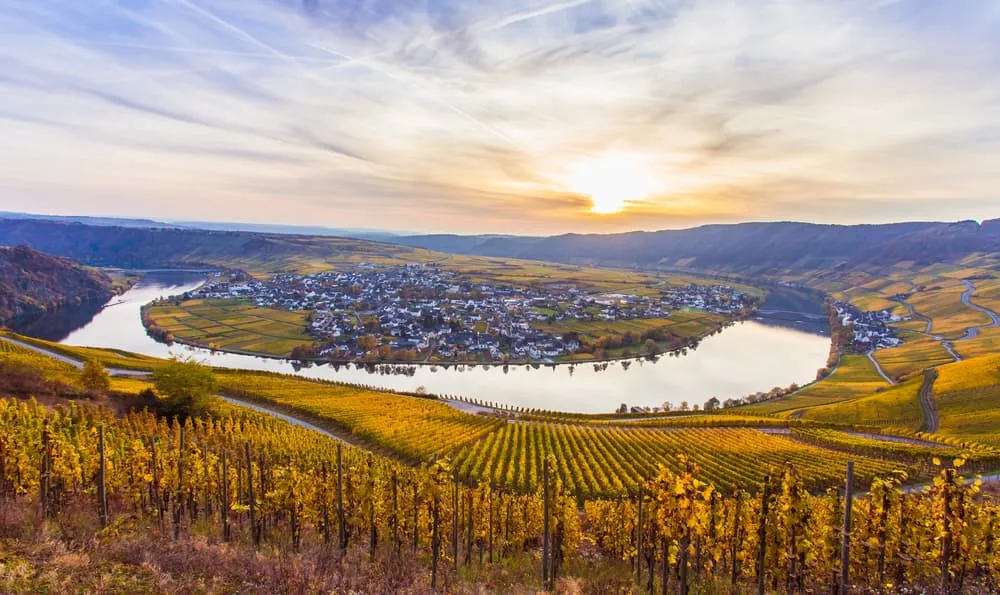
Bernkastel-Kues is the postcard Moselle: half-timbered houses, the ruins of the Landshut high above the valley and an unbroken line of wine houses along the quay. The trails above town alternate open vineyard with stretches of woodland and keep opening new windows onto the river's hairpin bends. Traben-Trarbach, a little further on, surprises people with its Art Nouveau architecture and an entirely different atmosphere. This part of the river draws the biggest crowds in high season; in early fall, when the vineyards turn color, it is at its absolute best. Ideal for walkers who want the classic Moselle landscape and village life.
The Calmont and the great bends at Bremm, Neef and Beilstein
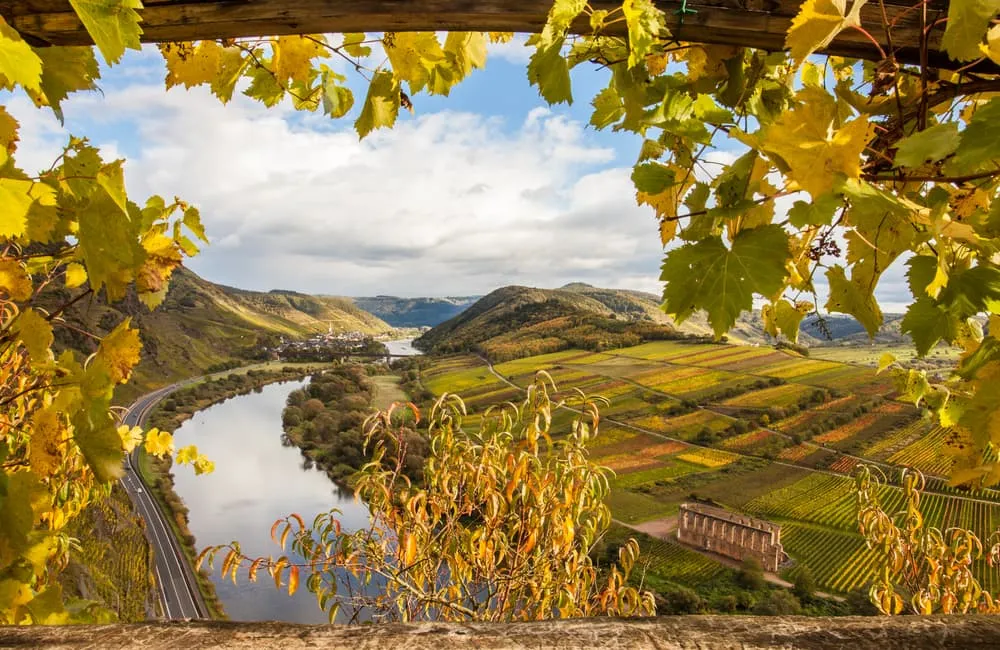
This is the most spectacular and the most demanding sub-region. The Calmont above Bremm is the steepest registered vineyard in Europe and offers walkers two options: a high path that runs along the top edge of the slope with dizzying views, and a via ferrata variant with steps and cables that goes straight through the vines. The second is magnificent but asks for some agility and a head for heights; anyone who would rather keep a little distance takes the alternative path and misses almost none of the view. The river throws its most dramatic bends here, and from the high valley rim you sometimes see the Moselle in four separate stretches at once — the so-called Vierseenblick. Beilstein, the "Sleeping Beauty of the Moselle," is one of the best-preserved wine villages in the region.
Cochem, Löf and the Lower Moselle to Koblenz
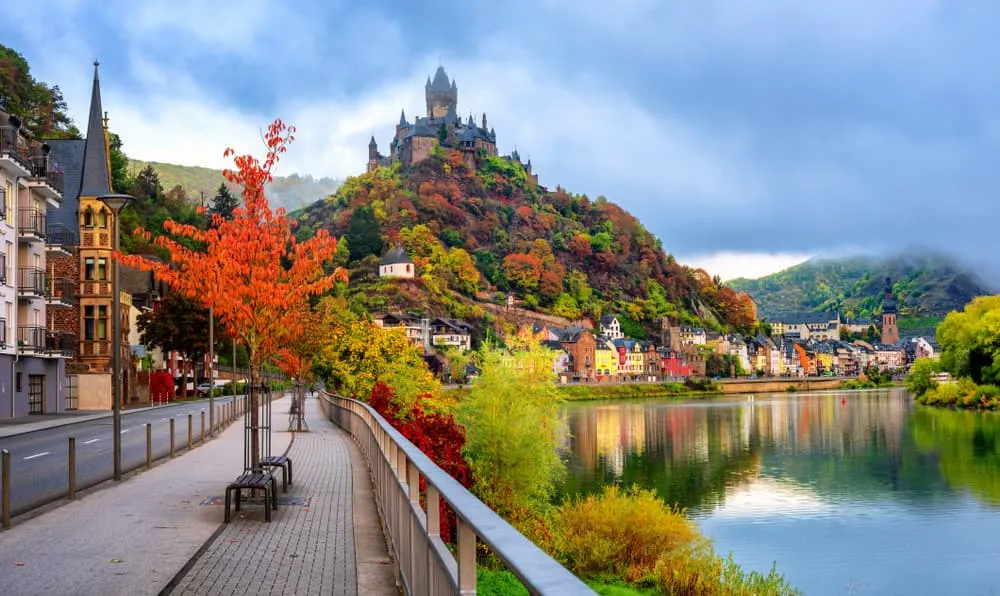
Cochem opens with the Reichsburg standing spectacularly above the town. The town itself is lively and easy to reach, which makes it a good starting point for a multi-day route or a base for day walks. Downstream the route passes Burg Thurant near Alken and — in a side valley away from the river — Burg Eltz, one of the most beautiful medieval castles in Germany. The Lower Moselle is less busy than the middle stretch but has just as many highlights: the largest vineyard terraces on the river are here, around Winningen, and they shelter rarities like the Apollo butterfly. The stretch finishes at the Deutsches Eck in Koblenz, where the Moselle merges into the Rhine.