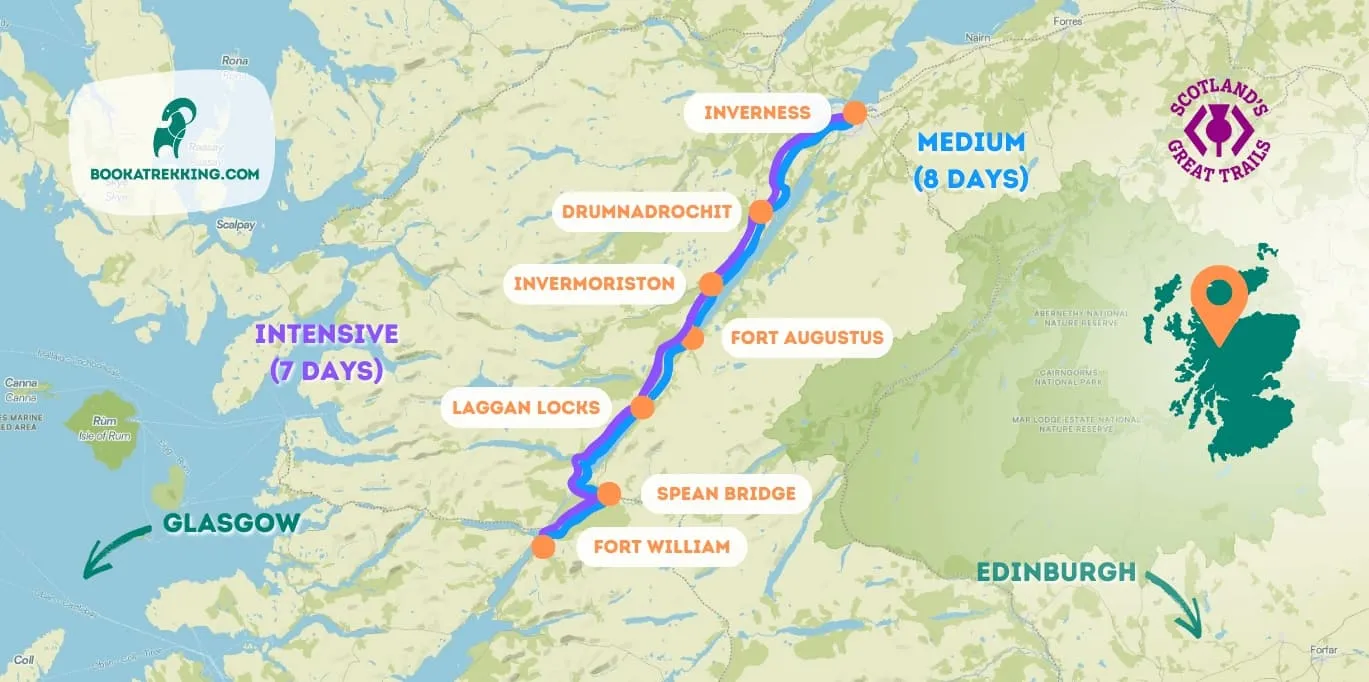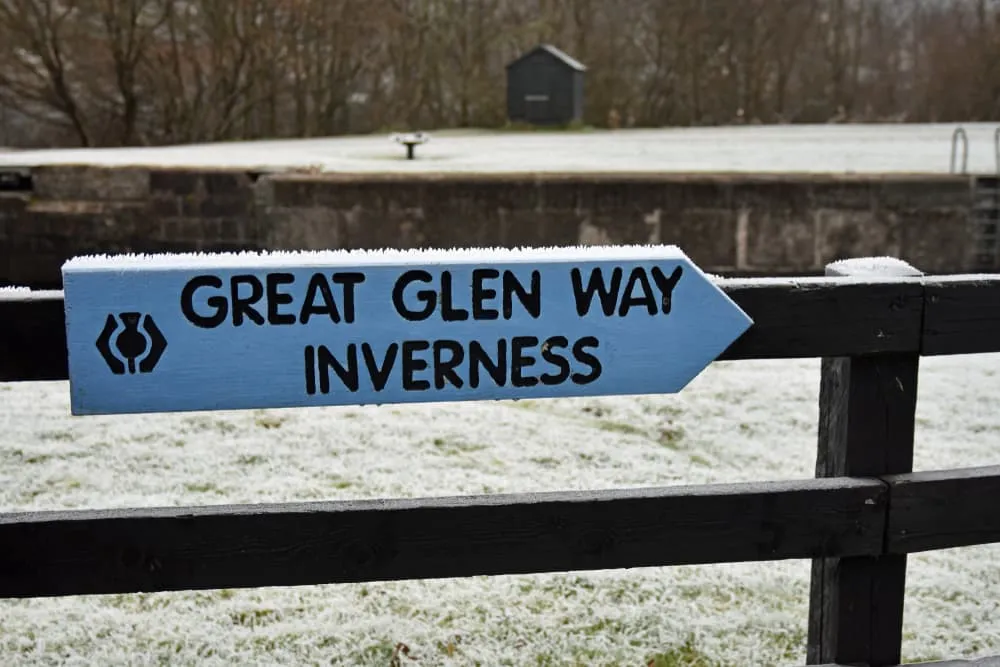




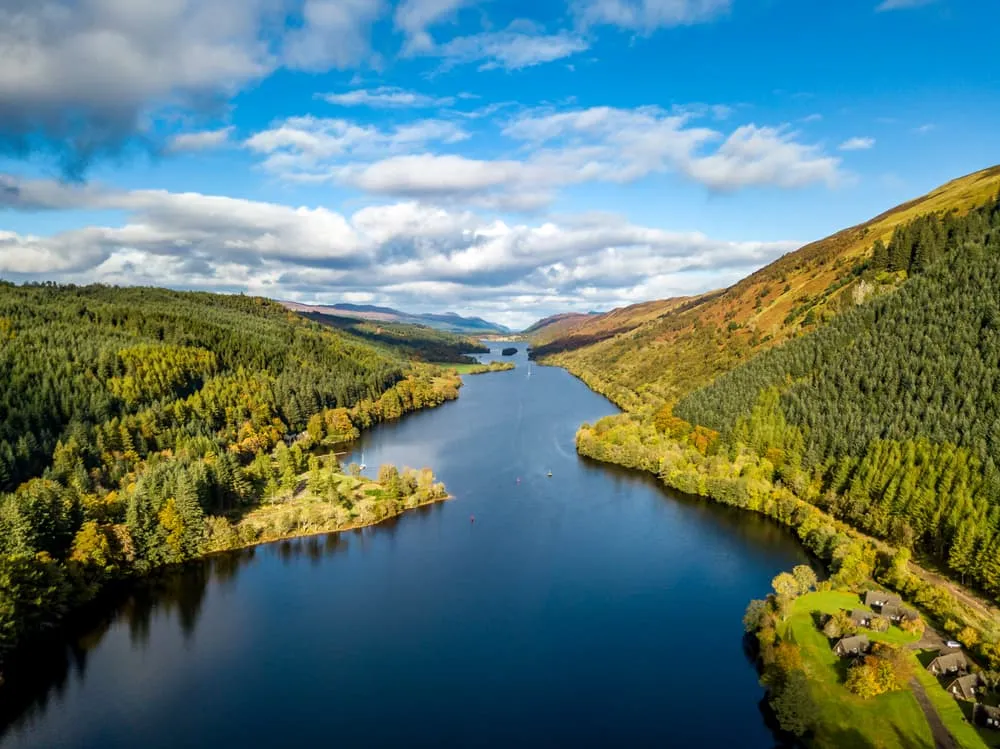
The Great Glen Way is Scotland's gentlest long-distance trail, running 127 km (79 miles) coast to coast from Fort William to Inverness along the Caledonian Canal and the legendary shore of Loch Ness. It follows the Great Glen, the geological fault line that splits the Highlands in two, and links three magnificent lochs through a landscape of forest tracks, canal towpaths and open moorland. For anyone looking at walking holidays in Scotland, it is the most accessible of the classic long-distance routes. At Bookatrekking we book every night's accommodation, load your GPX into our app with offline navigation, and show you the live weather forecast per stage. You focus on the walk.
What and where is the Great Glen Way?
The Great Glen Way follows the line of the Great Glen, one of Europe's most dramatic geological features: a long, straight fault that runs from the Atlantic coast at Fort William all the way to the North Sea coast near Inverness. Walk it and you cross Scotland diagonally, passing through country that feels properly remote even though the path is well maintained and the villages are never far away.
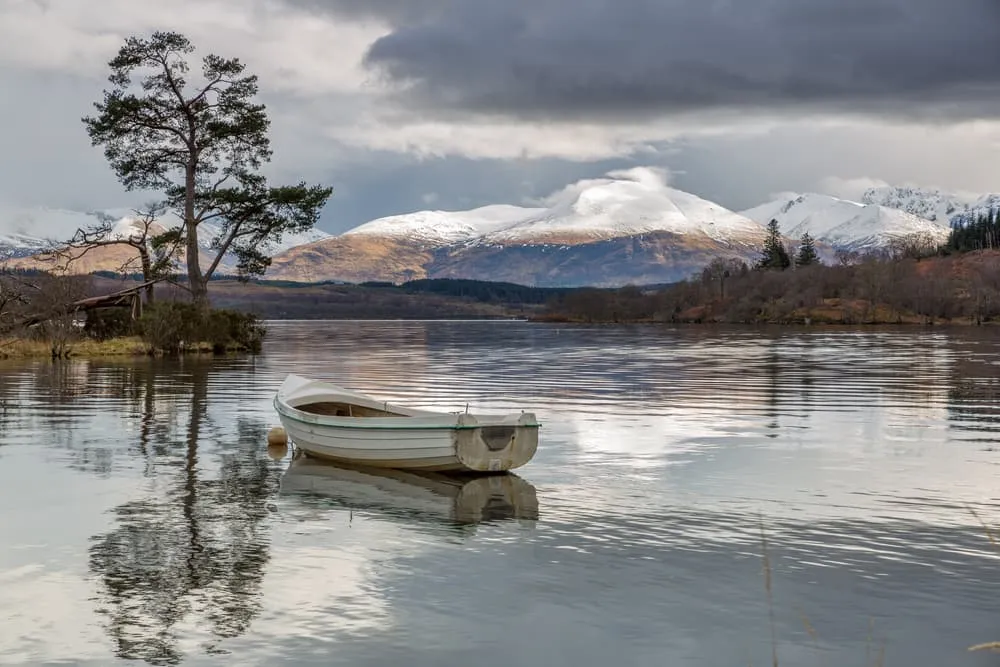
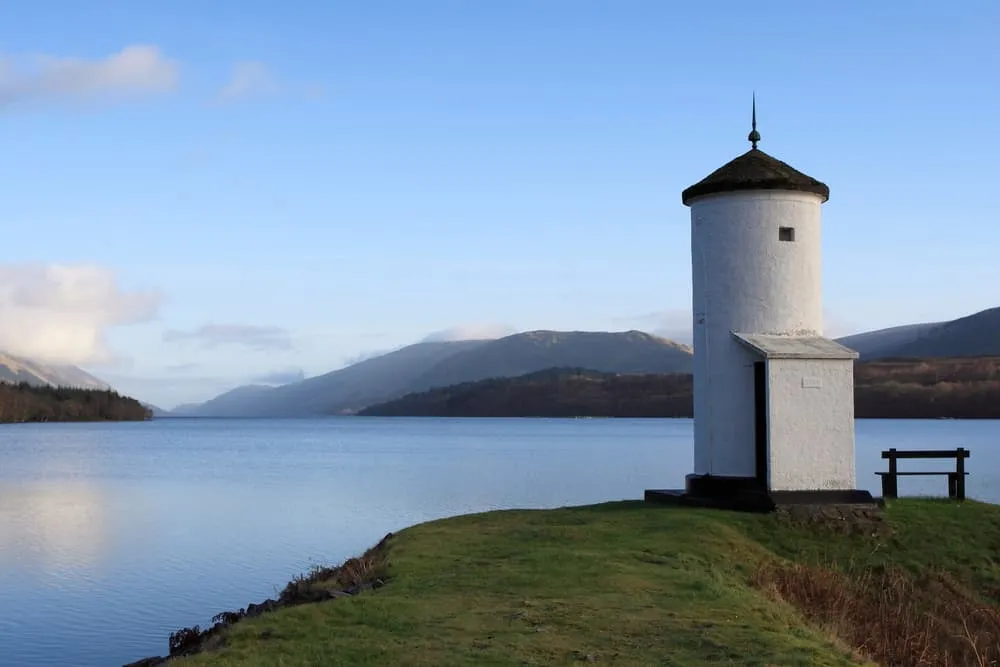
The route begins at the ruins of the Old Fort in Fort William, at the foot of Ben Nevis, the highest mountain in the British Isles. From there it heads north-east, mostly on the towpath of the Caledonian Canal as far as Fort Augustus, then along the western shore of Loch Ness to finish at Inverness Castle. Along the way you pass beside Loch Lochy and Loch Oich before Loch Ness opens up on your left for the second half of the walk. The Caledonian Canal itself is a feat of early 19th-century engineering, designed by Thomas Telford to allow ships to cross Scotland without rounding Cape Wrath, and walking its towpath gives the first half of the route a distinctive, almost leisurely character.
Historically the Great Glen was a corridor for armies, drovers and clans. You walk past Achnacarry House, the wartime home of the Commandos, past the remnants of General Wade's military roads, and through Fort Augustus, where a Benedictine abbey once occupied the site of an 18th-century fort. Scotland's turbulent past is present at every stage.
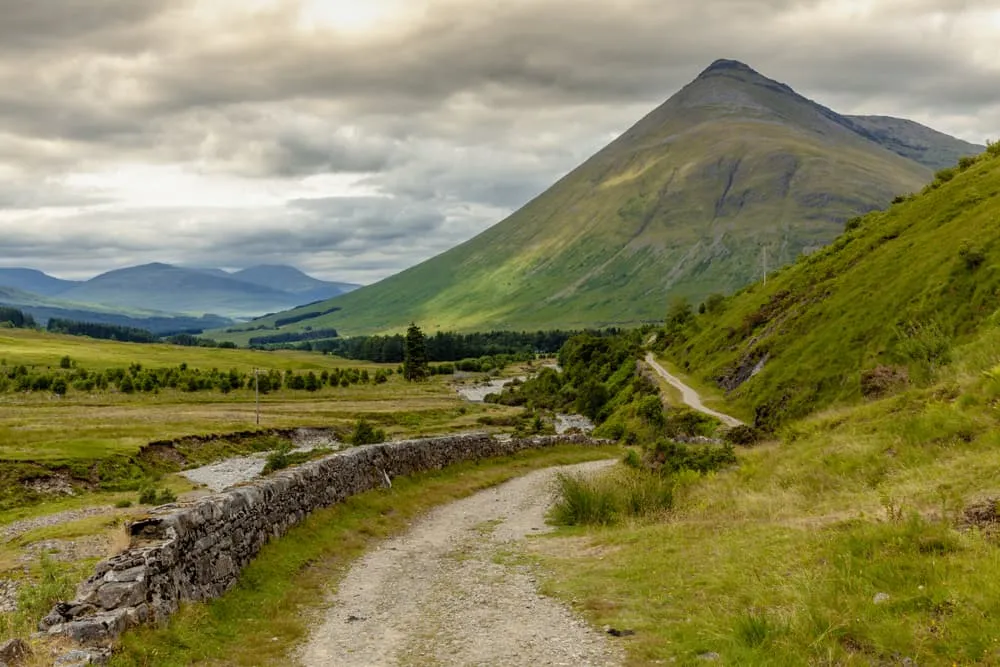
What makes the Great Glen Way different from other Scottish long-distance routes is its low elevation profile. Most of the path sits below 200 m and the terrain is either canal towpath, forest track or lochside path. There is no rough mountain terrain and no navigation challenge on the main route. It is ideal as a first multi-day walk in Scotland. If you have already done the West Highland Way, the Great Glen Way makes a natural sequel, more relaxed in character but no less rewarding in scenery. If you want to do both in one trip, Fort William is the connecting point.