Hiking in the Eifel: The Best Walking Areas, Trails and Multi-Day Routes

Hiking in the Eifel: The Best Walking Areas, Trails and Multi-Day Routes
Trekking experts per destination
Free cancellation up to eight weeks in advance
Quick personal advice

Hiking in the Eifel is the quietest way to walk a real upland trail in Germany without ever touching alpine terrain. The Eifel is a volcanic upland in western Germany, spread between Aachen, Trier and Koblenz and running right up to the Belgian border, and it has four distinct faces: Nationalpark Eifel with its reservoirs and old-growth beech forest in the north, the Vulkaneifel with its deep blue crater lakes in the center, the half-timbered town of Monschau and the Belgian High Fens along the western edge, and the sandstone cliffs of the Ferschweiler Plateau in the southern Eifel toward Trier. At Bookatrekking we arrange the hotels, move your luggage between overnight stops and give you our app with an offline map, a GPX track and a daily weather forecast for each location. This guide covers the sub-regions, the multi-day routes, day hikes, the best season to come, where you sleep and which trip fits you.


What makes hiking in the Eifel special?

Eifel Germany hiking is a different proposition from the Alps, and that difference is exactly what makes it worth the trip. This is a volcanic upland with summits between 600 and 750 meters, cut through by deep river valleys, beech woods, peat bogs, basalt crags and half-timbered villages. You climb and descend seriously every day, but you never need an ice axe, a head for heights or any technical skill at all.

For walkers who want a genuine long-distance route without altitude, the Eifel offers a rare combination: full walking days with constant up and down, a compact and logistically simple region, and a landscape that changes character completely from season to season. The waymarking is excellent. The official long-distance trails carry the "Premiumweg" certification from the Deutsches Wanderinstitut, which guarantees a well-balanced route and properly maintained paths. You do not have to go to Bavaria for a walking holiday in Germany: the Eifel delivers everything that matters, with far fewer people on the trail.


Where is the Eifel and how do you get there?

The Eifel covers roughly the area between Aachen in the north, Koblenz in the east, Trier in the south and the Belgian border in the west. Administratively it falls into two federal states: the northern part in North Rhine-Westphalia, the southern part in Rhineland-Palatinate.

The gateways are varied. In the north, Aachen/Kornelimünster and Monschau are the most used starting points. If you want the volcanic heart of the region as your base, you choose Gerolstein or Daun. In the south, Trier is the obvious rail gateway. On the eastern side, Bad Münstereifel and the Ahr valley make an attractive alternative entry. Arriving from abroad, Cologne and Frankfurt are the practical airports and rail hubs: from there you reach Aachen, Trier or Koblenz on the national rail network, and regional trains and local buses carry you on to the villages themselves. A car is useful but not necessary, and on our trips it is not needed at all.


The best hiking areas in the Eifel

The Eifel is not one continuous walking area with a single character, but a series of clearly distinct sub-regions, each with its own atmosphere. These are the five worth knowing as a walker.

Nationalpark Eifel and the Rur reservoirs

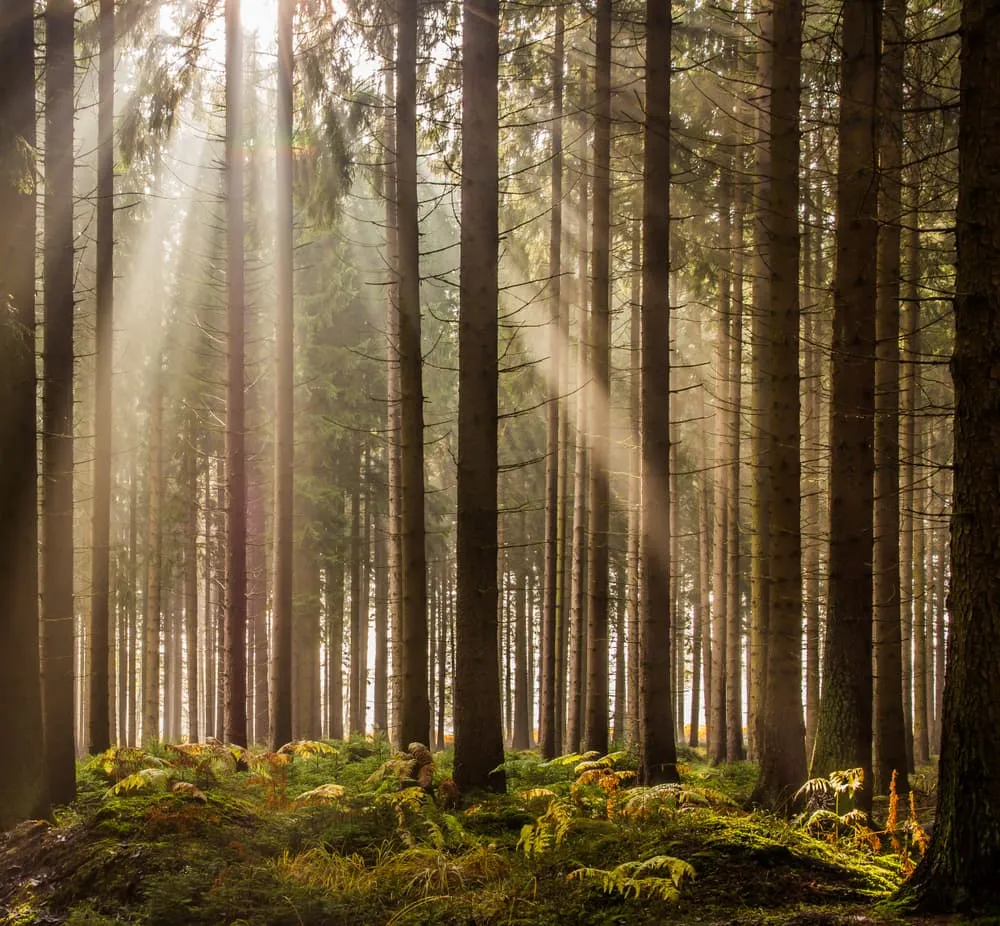
Nationalpark Eifel in the northwest is the greenest and quietest part of the region. Ancient beech forest in the Wilder Kermeter, boardwalks across peat bog, the broad Rursee and the former military complex at Vogelsang together make a walking area of real substance. The park has 240 kilometers of waymarked paths and counts among the darkest night skies in Germany. Among the Eifel National Park hiking trails, the Wildnis-Trail and the Wilder Kermeter loop are the two people walk most. It suits anyone looking for quiet, nature and ecological richness without any technically demanding sections.

The Vulkaneifel: maars and craters

The Vulkaneifel in the heart of the region is the most spectacular and most photographed part. Thousands of years ago volcanic activity filled the Eifel with craters that have since become deep blue lakes, known as maars. The Gemündener, Weinfelder and Schalkenmehrener Maar near Daun lie within walking distance of one another and are the best known. The Pulvermaar near Gillenfeld is the deepest maar in Germany. Around Gerolstein the Gerolsteiner Dolomiten rise as rocky walls above the valley, formed in part by a 390 million year old coral reef. This is also the backbone of our multi-day trips.

Monschau and the High Fens

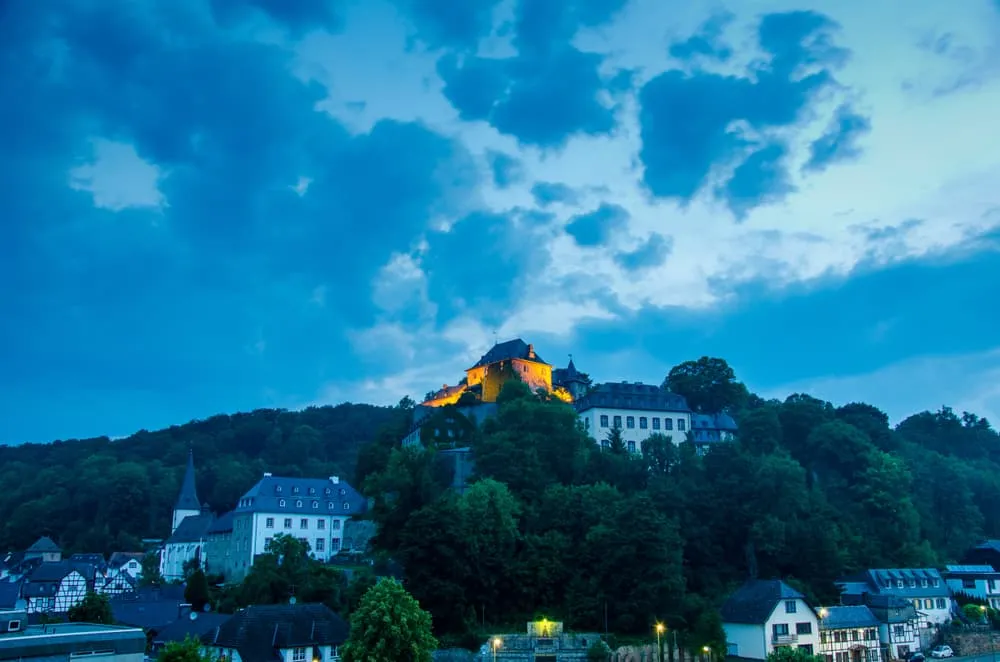
Hiking in the Eifel around Monschau combines two entirely different landscapes. Monschau itself is a half-timbered town deep in the Rur valley, with narrow lanes, an imposing castle ruin and a compact historic feel you find nowhere else in the region. Just to the west, across the Belgian-German border, the High Fens begin: a broad plateau of raised bog with boardwalks, an open horizon and a peculiar stillness. Monschau is at its best in May, when the wild daffodil meadows are in flower, and in September, when the bog turns reddish brown. It suits walkers who want nature and culture in a single day.

The Ahr valley

The Ahr valley on the eastern side of the Eifel is rockier and more wine-focused than the rest. Steep terraced vineyards, a narrow deeply incised valley and the red Spätburgunder the area is famous for give this sub-region a character of its own. In fairness: part of the valley was hit hard by the floods of 2021. Many paths have been repaired since, but check locally which routes and facilities are open before you set out. Visiting the Ahr valley means combining walking, history and wine in a very compact area.

The southern Eifel toward Trier

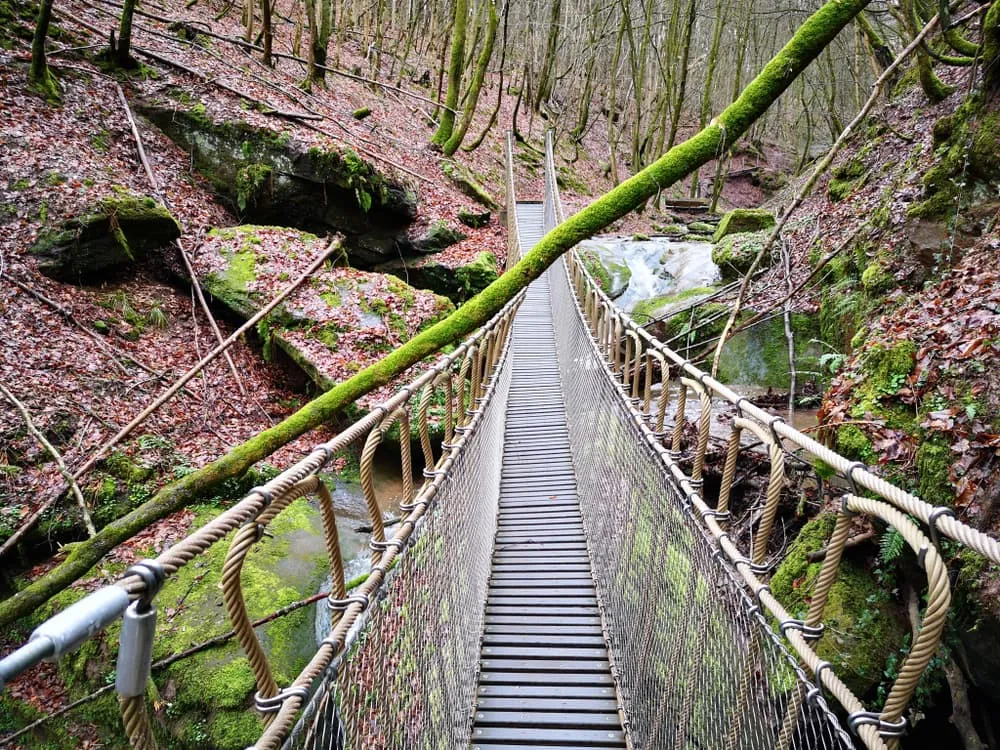
The southernmost part of the Eifel surprises people with sandstone cliffs and a landscape that feels increasingly Mediterranean the closer you get to Trier. The Ferschweiler Plateau has striking rock formations and deep ravines, and the area known as German-Luxembourg Switzerland borders the Grand Duchy here, giving the paths an unexpectedly wild feel. The descent toward the Mosel is the closing act of the Eifelsteig and rewards walkers with vineyards, suspension bridges and long views over the Kyll valley.



Multi-day hiking in the Eifel: from long weekend to full week

A multi-day walk in the Eifel means a different village every day, a different hotel or guesthouse every evening, and walking all day with nothing but a day pack. Your suitcase travels by road and is waiting in your room when you arrive. That sounds like a small thing, but it makes an enormous difference when you are climbing the last ridge of the afternoon on tired legs.

Bookatrekking offers two versions. The 5-day Eifelsteig is the right choice if you want a long weekend or a short trip without taking two weeks off. You walk the most scenic and most varied section of the trail, from Blankenheim via Kerpen and Hillesheim to Gerolstein, and get the full character of the northern and central Eifel. The 7-day Eifelsteig covers more ground through the volcanic heart of the region and carries on via Daun to Manderscheid, so you actually watch the landscape change from one day to the next. Both follow part of the region's major long-distance trail and work extremely well as a first multi-day walk in Germany.

If you would rather travel hut to hut than hotel to hotel, our guide to hut-to-hut hiking in Germany explains what is available. For the full range of bookable walking trips in the country, see our walking holidays in Germany page.


The Eifelsteig in brief

The Eifelsteig runs 313 kilometers in 15 stages from Kornelimünster near Aachen to Trier, passing through every sub-region described above. It is regarded as one of the best waymarked long-distance trails in Germany and carries the official Premiumweg certification. Most walkers do a section of four to seven days and pick the part that matches their arrival point or their interests.

The full stage-by-stage description with distances, elevation gain and starting points is in our detailed Eifelsteig trail guide. Here we keep it to the introduction.


Day hikes and shorter loops in the Eifel

Not every visitor wants to walk several days back to back. For day walkers the Eifel has a large choice of well-marked loops, both through the Premiumweg system and through the Traumpfade: short circular routes of eight to sixteen kilometers built around a single standout feature.

Some of the finest: the maar loop near Daun, taking in several crater lakes in one circuit; an Eifelsteig loop around Monschau and the Rur valley, with half-timbered houses, riverside paths and viewpoints; the Wilder Kermeter boardwalk route in Nationalpark Eifel, flat and wide enough for a stroller or a wheelchair; the Ahr valley slopes near Altenahr, rocky and steep with views over the vineyards; and the cliff walk across the Ferschweiler Plateau in the southern Eifel.

Waterfalls: the Eifel has no alpine waterfalls, but it does have picturesque stream valleys with small cascades. The Dreimühlen waterfall near Üxheim-Ahütte is the best known, a wide, low fall that is at its most impressive after a wet spell. The Butzerbachtal near Blankenheim offers a quiet stream valley walk with several smaller falls along the way. Expect upland scale: no dramatic hundred-meter drop, but an appealing, intimate water world in a green ravine.

Hiking with kids: the Eifel is excellent for families, provided you pick the right route. The boardwalks across the bog, the maar loops near Daun and themed trails such as the Löwenzahn adventure path near Nettersheim all work with small children. Short loops of five to ten kilometers with a reward built in, a lookout tower, a crater lake or a playground, keep children going. On our multi-day trips the daily distance varies; the shortest walking day suits active children from roughly ten years old.

Hiking with a dog: dogs are welcome on the vast majority of trails in the Eifel. Do note the leash requirement in Nationalpark Eifel, which applies year-round, and during the nesting season, roughly March to July, on other protected paths. There is little shade on the open plateaus and drinking water points are scarce, so always carry water for your dog. Most Gasthöfe and hotels along the route are dog-friendly; always mention the dog when you book.


How hard is hiking in the Eifel and who is it for?

The honest summary: the Eifel is an upland region, not a mountain sport. You need no technical skills, no climbing gear and no experience on steep ground. But do not underestimate it either.

Daily stages on our trips generally run between fifteen and thirty kilometers, with constant short climbs and descents along the valley rims. Elevation gain can reach five hundred meters or more in a day, spread across dozens of small ascents. That takes the legs apart in a way a long flat day never does. If you are used to a twenty-kilometer day on flat terrain, a few preparatory walks on hilly ground will get you there.

Things to watch: mud and slick roots on forest tracks after rain, exposed plateaus with wind, and the simple fact that the kilometers feel heavier here than at home because of the constant change in elevation. The trails themselves are superbly marked, there are no dangerous sections, and there is always a village or a Gasthof nearby. That makes the Eifel a strong destination for anyone walking their first multi-day route, for families with children from roughly ten years old on the shorter stages, and for experienced walkers looking for a shoulder-season trip that gives up nothing in landscape quality.


Best time to go hiking in the Eifel

The Eifel is walkable year-round, but every season gives the trails a different character.

April and May are the season of flowering slopes. Wild daffodils in the Perlenbach and Fuhrtsbach valleys, golden broom on the plateaus, known locally as Eifel gold, and fresh green in the beech woods make this one of the loveliest windows. The days are already long and the trails are quiet.

June through August is the warmest and also the busiest season. It pays off: the beech woods give shade on hot days and the small river valleys stay pleasantly cool. Expect afternoon thunderstorms, particularly on the open plateaus.

September and October are the best season for most walkers. The weather is settled, the fall color in the beech forest is remarkable, and the Ahr valley is in the middle of the grape harvest. The trails are noticeably quieter than in summer. Our multi-day trips run most comfortably in the summer half of the year, with the best combination of weather odds and opening hours.

November through March gives you a silent, intimate version of the Eifel. Short days, the chance of snow and ice on the plateaus and limited places to eat make this less suitable for a multi-day trip. For a day walk or a weekend in the snow it is a fine option if that appeals to you. Check the live forecast per stage in the Bookatrekking app before you set out, so nothing catches you by surprise.


Where you sleep and how your luggage moves in the Eifel

The Eifel has no hut system like the Alps. Each night you stay in the nearest village or small town, in a hotel, a Gasthof, a guesthouse or an apartment. The Gasthöfe are typically family businesses with their own restaurant and bar, and they play a central role in village life. They serve breakfast and are the most authentic way to get to know the region. In the wine villages toward Trier you can count on a local bottle with dinner.

If you prefer something simpler and more communal, our guide to hut-to-hut hiking in Germany explains how staying in huts works in Germany and which regions have a hut network.

The biggest practical advantage of an organized multi-day walk in the Eifel is the luggage transfer. On our trips your suitcase goes by road to the next accommodation every morning. You walk with a five-kilo day pack instead of a fully loaded fifteen-kilo trekking pack. On a route that climbs and drops all day along the valley rims, that difference is very noticeable by day three. Our trips include overnight stays with breakfast, luggage transfer between stages, route notes and access to the Bookatrekking app with an offline map, a GPX track and a live weather forecast for each location.


Which Eifel hike suits you?

Route Days Best for Price
Eifelsteig long weekend 5 days A first multi-day walk, or a short trip See the trip page
Eifelsteig full week 7 days Watching the landscape change day by day See the trip page
Current prices and departure dates are on the trip page.

The decision is straightforward. Short on time, or walking your first multi-day route, choose the five-day version. With a full week free and the fitness for longer stages, the seven-day route gives the most complete picture of the Eifel, including the volcanic maars and the castles at Manderscheid. If you would rather do day walks only, base yourself in Monschau, Daun or Gerolstein: from each of those three villages you can walk several day loops without a car.

On navigation: the Eifelverein keeps the waymarking on the Eifelsteig and the regional trails in excellent condition. On our trips you use the Bookatrekking app with an offline map and a GPX track for every stage, so you never have to navigate for yourself, even where there is no phone signal. For the full range of walking trips in the country, see our walking holidays in Germany page.


Frequently asked questions about hiking in the Eifel

  • What is the most beautiful hiking area in the Eifel?

    Most walkers rate the Vulkaneifel around Daun and Gerolstein as the most spectacular part of the region, with deep blue crater lakes, basalt crags and volcanic cones. If you prefer quiet and old-growth forest, Nationalpark Eifel in the north is the better fit. The two areas are within an hour's drive of each other.

  • What are the best hiking trails in the Eifel?

    The best trails for hiking Eifel Germany depend on what you want. The Eifelsteig is the best-known long-distance route and runs straight through every sub-region. For day walkers, the maar loop near Daun, the monastery route near Monschau and the Wilder Kermeter route in Nationalpark Eifel are the most popular choices. Multi-day walkers usually pick a continuous section of four to seven days.

  • What is the prettiest village in the Eifel?

    Monschau is named most often as the prettiest village in the Eifel. The half-timbered town sits deep in the Rur valley, has a well-preserved historic center, a castle ruin and direct access to the trails of the High Fens and Nationalpark Eifel. Gerolstein and Manderscheid also come up regularly for their rocky surroundings and historic castles.

  • What are the best hikes in Eifel National Park?

    For many walkers the finest of the Eifel National Park hiking trails is the Wildnis-Trail: 85 kilometers straight through the park past meandering rivers, reservoirs, flower meadows and untouched beech forest. With less time, take the Wilder Kermeter loop, a shorter circuit on boardwalks through the oldest woodland in the park, accessible to wheelchairs and strollers.

  • What is the best section of the Eifelsteig?

    Many walkers name the stretch from Daun to Manderscheid as the highlight: volcanic maars, the quiet Lieser valley and a spectacular arrival high above the river with two castle ruins in view. The full stage-by-stage description with every highlight is in our Eifelsteig trail guide.

  • What is the most beautiful waterfall in the Eifel?

    The Dreimühlen waterfall near Üxheim-Ahütte is the best-known waterfall in the Eifel. It is a wide, low cascade that is particularly impressive after rain. Do not expect an alpine drop of tens of meters, but a picturesque stream-valley fall on an upland scale, surrounded by greenery and easy to reach on a short walk from the village.

  • Where can you hike with children in the Eifel?

    The Eifel is excellent for families. Child-friendly choices are the Wilder Kermeter boardwalk route in Nationalpark Eifel, the maar loop near Daun and the Löwenzahn adventure path near Nettersheim with its interactive stations. Shorter loops of six to ten kilometers with a lookout tower or a crater lake as the reward work best for children who are not yet used to a full day on the trail.


    Want to compare every walking trip we run in Germany? See the full range on our walking holidays in Germany page, or start with our broad guide to hiking in Germany for inspiration by region. If you want more after the Eifel, our Rheinsteig guide covers everything about walking along the Rhine.

Packing List for the Eifelsteig

It doesn't matter where you are trekking or for how long: carrying the right equipment with you is paramount. For a hiking trip in the mountains, a good is backpack essential. Its size will depend on how many days you will be spending in the mountains, the season, and the clothes you will be taking with you. We have prepared a packing list with some essential clothing that you should include and some extras that you may find useful:
  • Essentials

  • Extras

Safe Hiking Tips for the Eifelsteig

When hiking, it is wise to be aware of a few points. Even if this is not your first time, you should never underestimate the mountains. Good tour planning and compliance with the regulations in the mountains will significantly increase safety. To ensure that your hiking adventure is a safe and enjoyable experience, here below you can find a list of 8 recommendations for safe hiking in the mountains:
  • Know your limits

    Hiking the Eifelsteig is the perfect outlet to escape from daily life. It is an endurance sport along with a beautiful nature experience with a positive effect on body and mind —as long as one is in good shape and has a realistic picture of one's possibilities and limits—. Never overestimate yourself or underestimate the route. Don't overdo it! Always choose the slower option and take more time for your plans. Hiking under time pressure is not fun and at too fast a pace it can be dangerous. Be wise!

  • Plan carefully

    Good planning is half the work! Hiking maps, literature, the Internet and expert advice are invaluable when planning the route of the Eifelsteig and enable you to determine the length, altitude difference, difficulty and conditions of the hike. When planning group treks, the itinerary should always be planned for the weakest member of the group! The weather in the mountains can change incredibly quickly and rain, wind and cold all increase the risk factor. For this reason, always check the weather forecast beforehand and contact our trekking experts to find your way before you start.

  • Be fully equipped

    Equipment is everything. In the most extreme case, it makes the difference between life and death, and in any case, it definitely makes the difference between having fun and having a bad time. Food and water, sunscreen and waterproof and warm clothes must always be in your backpack, as well as a first aid kit and a mobile phone with a full battery (in case there is an emergency). However, packing light makes hiking easier, so don't take too much extra luggage with you. Your equipment should always be suitable for the terrain you'll be hiking on in the Eifelsteig.

  • Wear suitable footwear

    Good walking shoes protect your feet and provide a better fit. Shoes with a good fit, with non-slip soles, water-resistant and lightweight are a must for additional walking pleasure during the Eifelsteig. Trail running shoes are great for a weekend in the mountains, but on longer hikes or more technical trails, you'll want at least A/B hiking boots. That means it is recommended wearing high mountain shoes that are water-repellent with extra ankle support to prevent sprains.

  • Stay on marked trails

    Eifelsteig has endless marked hiking trails, which are controlled and maintained and should not be deviated from. It may be tempting, but it's not a good idea to take shortcuts or alternative routes through unmarked terrain. It increases the risk of disorientation and you're more likely to get lost and have accidents or fall in the mountains. Even steep slopes of packed old snow are often underestimated and dangerous. Are you in doubt? Better don't do it. For easy navigation we work with our trusted partner Komoot, whose interactive maps, also available offline, provide you with the necessary digital means to get from A to B. As a backup, make sure to bring a hiking guide or a paper map with you. FYI, 75% of stumbles occur due to carelessness on marked paths or roads, not in open terrain!

  • Take regular breaks

    Remember you're on a hiking trip. Timely and regular breaks not only provide welcome relaxation but also make it possible to enjoy the Eifelsteig. The body needs a regular food and drink intake to maintain performance and concentration. Our advice is that if you have little time, it's better to follow the short itinerary than to speed up the long one.

  • Stay reachable

    If you are hiking solo or in small groups it is advisable to inform people back home about your plans, what route you are taking and when you plan to return. Even small incidents can lead to unpleasant emergencies so make sure you are available at all times. Bring a charged phone containing at least the phone numbers of immediate family members, your accommodations en route and the emergency phone numbers operating on the Eifelsteig.

  • Respect nature

    Leave no rubbish behind, prevent noise, stay on the marked trails, do not disturb wildlife or grazing animals, and respect protected areas.

Where Can I Book the Eifelsteig?

At Bookatrekking.com you can book the self-guided Eifelsteig and many other treks. We take care of all the details for you, including arranging accommodations and providing you with relevant information well in advance of your trek. Find our offers here. Our easy-to-use platform allows you to browse and compare different trekking options and to find the perfect fit for your interests, abilities, and budget.

If you have any questions about a specific trek or need help choosing the right one for you, our team of trekking experts is here to assist you. Simply reach out to us and we will be happy to provide you with personalized recommendations and advice to help you plan the trekking adventure of a lifetime.

About Us

At Bookatrekking.com, you will find the trek that will make your life unforgettable. Whether you want to explore the Inca Trail or climb Kilimanjaro. Bookatrekking.com has a wide and varied range of first-class treks. No false promises are made here. Transparent prices and bookings are fixed instantly. Find, compare, book and trek!
Read more about us
About Us
About Us