Hiking in Salzburgerland: Alpine Pastures, Hochkönig and the Best Multi-Day Routes

Hiking in Salzburgerland: Alpine Pastures, Hochkönig and the Best Multi-Day Routes
Trekking experts per destination
Free cancellation up to eight weeks in advance
Quick personal advice

"Salzburgerland" sounds like a single destination. In reality, you'll find five quite different landscapes here, and your first decision when hiking in Salzburgerland is: which one? The Hochkönig, with its limestone plateau and the alpine pastures at its feet. The Salzburger Sportwelt in the Pongau, with gentle grassy mountains between Altenmarkt, Flachau and Wagrain. The Pinzgau, with views into the glacier world of the Hohe Tauern. The rugged Tennengebirge above Werfen and the Lammertal. And the lake landscape on the Salzkammergut side. Nowhere else in the Alps do you find so many working alpine huts (Almen) so densely packed together that you can walk from pasture to pasture for days on end without needing a glacier or a via ferrata. The high-alpine Dachstein on the eastern border provides the contrast for anyone wanting to go higher. On our tours, accommodation is booked in advance, your case travels by luggage transfer from place to place, and the Bookatrekking app shows you an offline map, GPX track and the current weather forecast for each stage location. This guide will help you find the right sub-region and the right tour length for your walking holiday in Austria.


What defines hiking in Salzburgerland

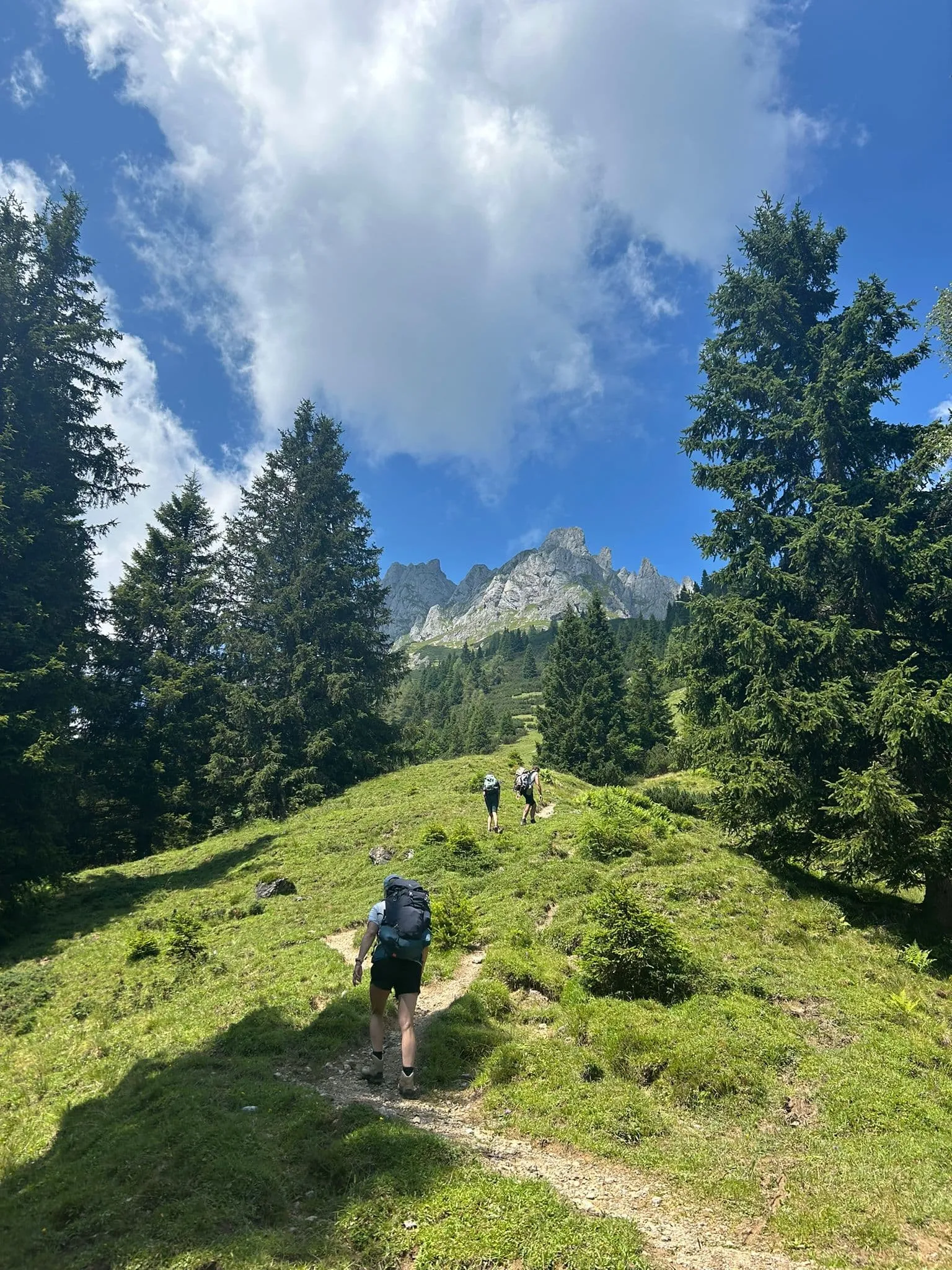
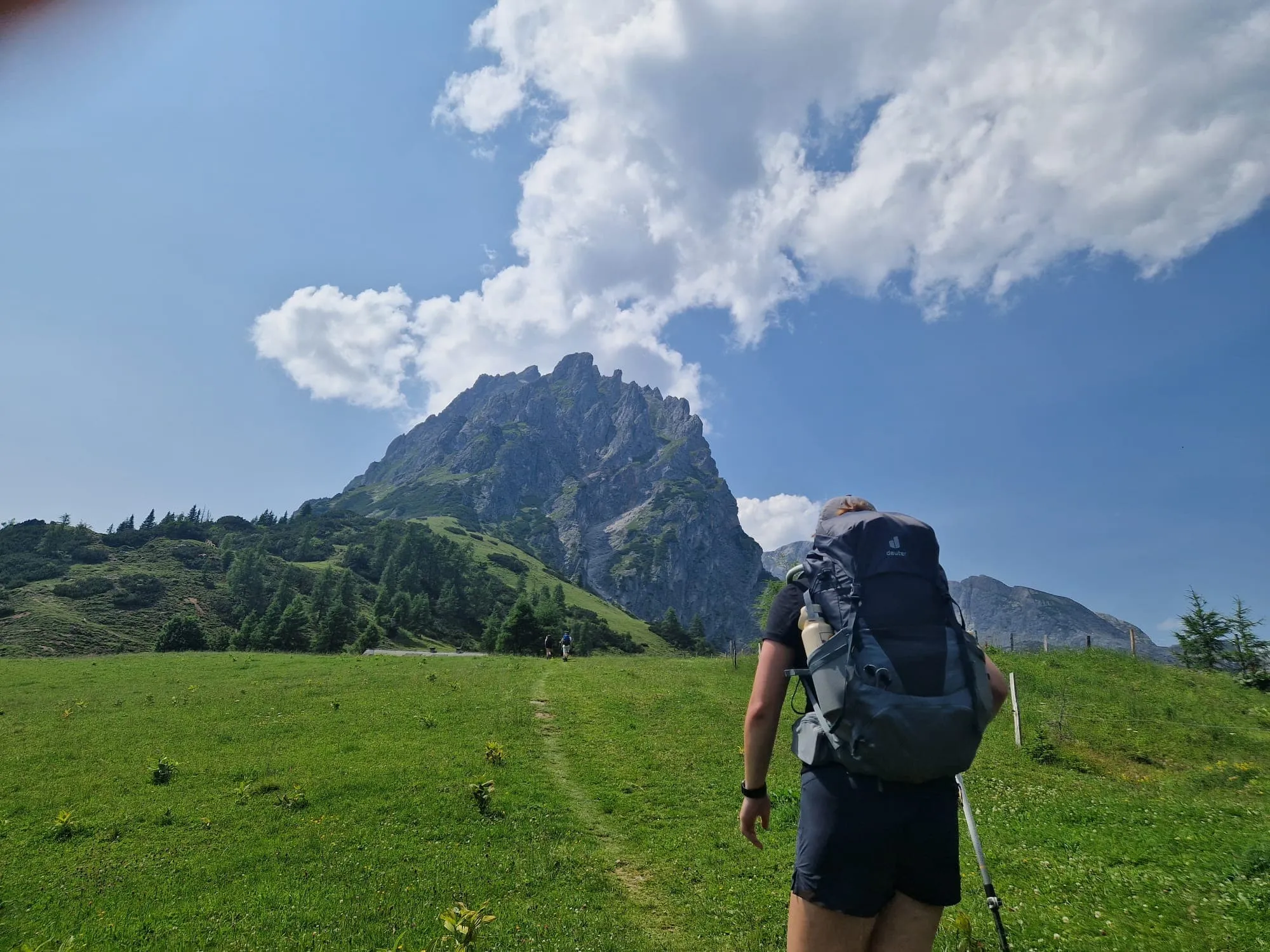
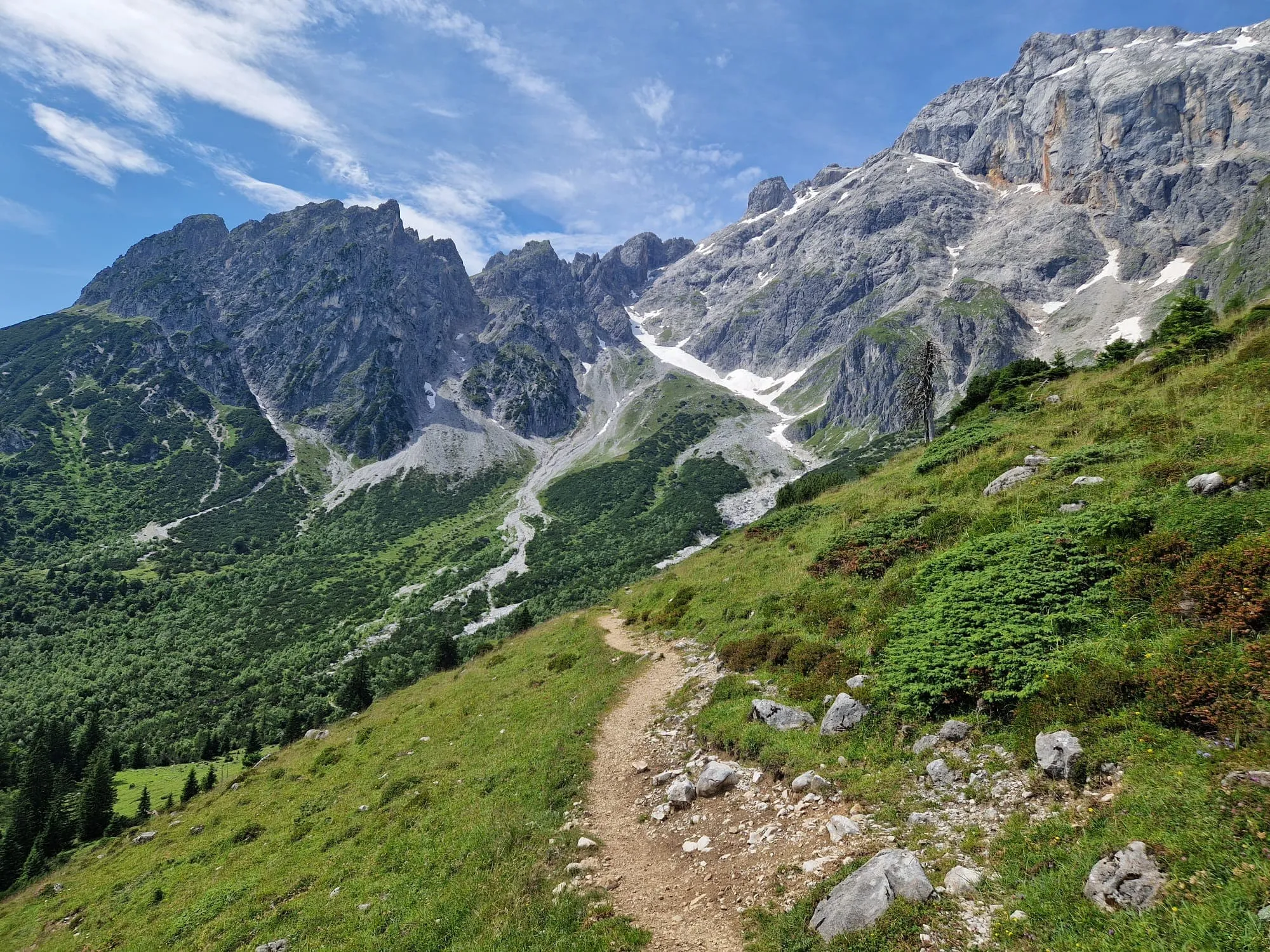
The character of the region can be summed up in one sentence: alpine pasture walking without alpine technicality. That means you move through working alpine meadows, larch forests, karst plateaus and grassy summits without needing a rope, crampons or a head for heights. Yet the backdrop is still thoroughly alpine: in the Hochkönig area, limestone walls tower above the pasture meadows; in the Sportwelt, rolling green hills run from summit to summit; in the Pinzgau, waterfalls sparkle down rock steps; and on the Salzkammergut side, lakes mirror the peaks.

What makes hiking in Salzburgerland so special is the density: hardly anywhere else can you find so many working alpine huts in such a small area, meaning you can stop for refreshments and stay overnight from one pasture to the next without ever having to return to the valley. This is Alm walking as a culture: an evening on the pasture, a chat with the hut keeper, a homemade platter of local specialities, and a view down into the valley.

Compared with Tyrol, the first difference is obvious: greener, richer in Almen, more relaxed technically. If you're planning a walking holiday in Salzburgerland, you don't need to wait for the next via ferrata. The Dachstein on the eastern edge keeps the high-alpine option open for anyone still drawn to the glacier world. But the broad middle ground between an easy pasture round and a serious high mountain tour is what really defines this region.


Pongau, Pinzgau, Tennengau or Flachgau: which side do you start from?

The city of Salzburg is the natural gateway: an international airport, a station on the Tauern railway line, and easy access from Munich, Vienna and Frankfurt. From here, the network branches out into the various sub-regions.

Towards the Hochkönig: the Tauern railway takes you to Bischofshofen, from where you continue to Mühlbach am Hochkönig or to St. Johann im Pongau. The three Hochkönig villages of Mühlbach, Dienten and Maria Alm lie north of the massif and are connected by postbus.

Towards the Salzburger Sportwelt: St. Johann im Pongau and Bischofshofen are the key railway stations, with Wagrain, Flachau and Kleinarl reachable by bus. If you want to walk the Pongau, this is where you get off.

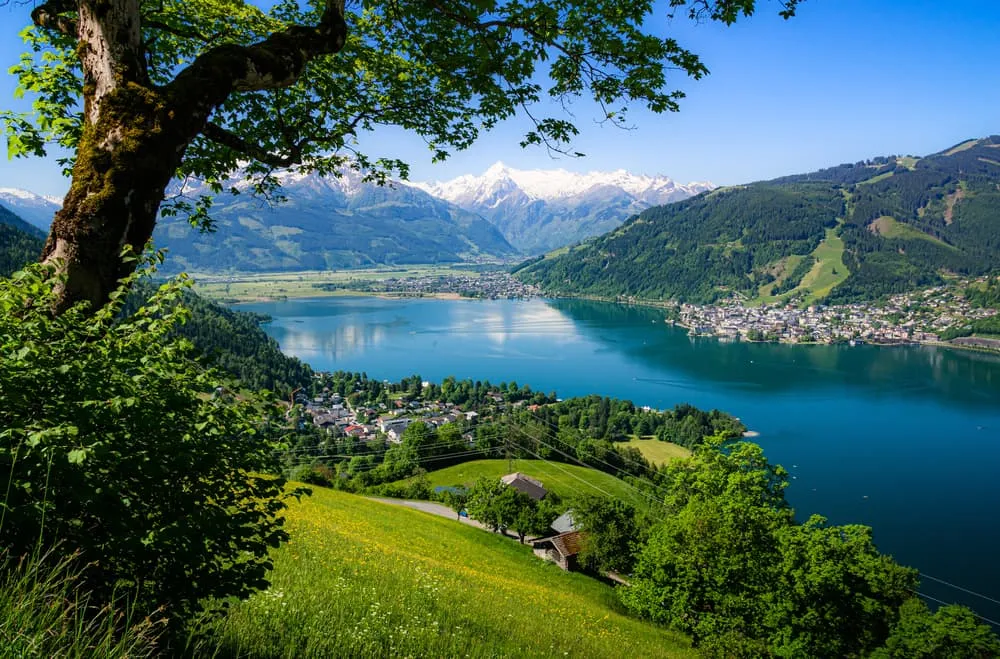
Towards the Pinzgau: Zell am See and Kaprun are reachable by train and serve as the gateway to the glacier world of the Hohe Tauern. Rauris and the Rauris valley are connected by postbus.

Towards the Tennengebirge: Werfen, on the Tauern railway, is the natural starting point, with Abtenau and Annaberg reachable via the Lammertal.

Towards the Salzkammergut: Fuschl, St. Gilgen and the Wolfgangsee lie east of Salzburg and are quickly reached from the city.

Berchtesgaden is the nearest German neighbour, north of the Hochkönig, while Styria lies beyond the Dachstein. Both border the region directly but offer their own distinct hiking world. If you're planning point-to-point routes, you'll quickly notice that having your own car is more of a hindrance than a help, since you end up somewhere other than where you started. On our guided tours, the rail and bus connections solve exactly this problem.


Hiking in Salzburgerland: the best sub-regions compared

Hochkönig: alpine pastures beneath the limestone plateau

The Hochkönig is the best-known landmark in this region and, at the same time, the sharpest contrast within it: pasture walking below, a high mountain tour above. Walking the Hochkönig gives you two very different experiences to choose from.

The lower world begins in the starting villages of Mühlbach, Dienten and Maria Alm. From here, well-marked paths lead through alpine meadows with direct views of the steep walls of the limestone plateau. The Arthurhaus, at around 1,500 metres, is the classic starting point for multi-day tours and pasture circuits. If you're after easier Hochkönig routes, the pasture paths below the walls are exactly right: wide trails, reliable signposting, and refreshment stops within just a few hours.

The upper world begins at the Arthurhaus and continues as a high mountain tour to the Matrashaus near the summit. The Übergossene Alm is a glacier remnant on the plateau that shrinks a little more each year. Anyone heading up there needs alpine experience, fitness and stable weather. For leisure walkers, the best of the Hochkönig lies in the zone in between.

Compared with the grassy mountains of the Sportwelt: more rugged, more limestone, more dramatic scenery. Families with children are very welcome on the pasture paths, but not on the summit tour.

Salzburger Sportwelt and Pongau: grassy mountains and alpine villages

Between Altenmarkt, Flachau, Wagrain, St. Johann im Pongau, Radstadt and Filzmoos lies the gentlest pasture-walking area in the region. The summits are grassy mountains, the crossings wide and full of views, and the villages in the valley easy to reach. If you want to walk from St. Johann im Pongau, you'll find a network of paths ranging from a relaxed pasture circuit to a long panoramic route.

Walking the Pongau essentially means: up to the Alm in the morning, hours along the high-level path, and a stop for refreshments in an alpine village in the evening. The area is particularly well suited to multi-day tours, because the stage locations lie close together and moving from one pasture area to the next rarely requires any alpine technique.

Filzmoos, to the south, already has the Dachstein in view. If you want to step into the high-alpine world from there, you'll find the circuit around the Dachstein described in our Dachstein circular route guide.

Compared with the Hochkönig: greener, calmer, technically simpler. The Pongau is the heart of pasture walking in Salzburgerland.

Pinzgau and Hohe Tauern: waterfalls, gorges and glacier views

If you want to swap the pastoral idyll for the glacier world, head to Zell am See and Kaprun. The Pinzgau opens up views of the Hohe Tauern: peaks over three thousand metres, glacier tongues, and broad valleys with waterfalls. The Krimml Waterfalls in the western Pinzgau are among the most impressive natural spectacles in the Alps and can be reached along a long valley path, with no head for heights required.

The Rauris valley is quieter and less well known. Mountain meadows, marmots, views of glaciated peaks. If you're looking for nature without the crowds, this is the place.

Compared with the Hochkönig and the Sportwelt: more expansive, more alpine, for anyone wanting more wilderness and altitude. Bookatrekking's current multi-day tours are based in the Hochkönig area and the Pongau; the best way to explore the Pinzgau is with a base in Zell am See or Kaprun.

Tennengebirge and Lammertal: karst and rock faces

The Tennengebirge is the wildest of the five faces of this region: a karst plateau with rugged north faces, deep gorges, and the Eisriesenwelt ice caves near Werfen as the best-known visitor attraction. Walkers here find fewer alpine villages and more solitude. The paths are often steeper and less frequented than those on the Hochkönig or in the Sportwelt.

Abtenau and Annaberg in the Lammertal offer quieter starting points. The Tennengebirge plateau is intended for experienced walkers seeking a more alpine experience without needing glacier technique.

Compared with the Salzkammergut side: more rugged, quieter, for anyone who prefers wild terrain over green idyll.

The Salzkammergut side: lakes, the Schafberg and the Postalm

East of Salzburg lies the Salzkammergut side, with the Fuschlsee, the Wolfgangsee and the Osterhorn mountains. Walking here is pre-alpine: gentler, with lakes as a backdrop, on soft high plateaus such as the Postalm. The Schafberg above St. Wolfgang is a classic, with a cog railway up to the summit and a rewarding descent back down into the valley.

Compared with the Hochkönig: lower, greener, more family-friendly. Ideal for anyone wanting to combine walking with lake swimming, or looking for a gentle introduction to pasture walking.



Multi-day tours in Salzburgerland: from a long weekend to a week among the Almen

The principle is simple: every morning you set off with your day pack, while your case travels by luggage transfer to the next overnight stop. You walk; the logistics happen in the background. In the evening, pre-booked accommodation awaits you, either on an Alm or in a village.

Alm trail around the Hochkönig in 4 days: the ideal first pasture tour, or a long weekend in the Hochkönig area. You circle the region's best-known mountain along pasture paths, without needing to reach the summit. Starting in Pfarrwerfen, four stages each with a different character: from dense forest paths to open alpine meadows to wide panoramic views. The route follows a section of the larger Alm circuit, not the full route.

Intensive Salzburger Sportwelt in 5 days: the Pongau variant for anyone who prefers longer days and the gentle grassy mountains between Wagrain, Flachau and Zauchensee. Five stages, with the longest day covering 20 km, rewarded with views across the entire Salzburg mountain panorama. This tour demands somewhat more fitness than the Hochkönig circuit but rewards you with a different alpine-village atmosphere.

Alm trail around the Hochkönig with accommodation in 6 days: the same Hochkönig circuit as above, but with one night in the valley before the tour and one after. This gives more flexibility for arrival and departure and a more relaxed rhythm overall. Ideal for anyone who doesn't want to start the very first day carrying full luggage.

For a comparison with the other major trekking routes in Austria, see our overview of the best walking routes in Austria.


The Salzburger Almenweg in brief

The Salzburger Almenweg is Austria's best-known Alm trail and the basis for our Hochkönig circuits. On one long circular route, it links the 25 valley villages of the Pongau via working alpine pastures and high-level paths. Most walkers don't attempt the full route but choose a section lasting four to six days, typically around the Hochkönig or through the Sportwelt.

This guide gives you the regional overview. For the full description with stages, distances, elevation gain and the Almen along the way, see our route blog: the Salzburger Almenweg from pasture to pasture.


Day walks and pasture circuits in Salzburgerland

Not every day out needs to include an overnight stay on an Alm. If you have a fixed base, or are only out for a day or two, you'll benefit from a system that works throughout the region: cable car up, a pasture circuit at the top, then back to your starting point. This is the main reason so many people search for "easy Hochkönig walks", since the cable car takes care of the first long climb, and the pasture paths above are technically undemanding.

A few examples of day walks, with no invented distances or times: the pasture circuit from the Arthurhaus beneath the Hochkönig walls, with views of the limestone plateau; panoramic paths in the Salzburger Sportwelt from Flachau or Wagrain, taking you from pasture to pasture without any climbing sections; the walk to the Krimml Waterfalls in the Pinzgau, a classic valley path suitable for the whole family; a lakeside circuit on the Salzkammergut side with the Wolfgangsee as a backdrop; and a plateau tour in the Tennengebirge from Werfen for anyone seeking a bit of solitude.

Hiking to the Hochkönig summit: the summit tour to the Matrashaus is not a pasture walk. It crosses karst terrain and snowfields to reach the plateau, demands a good head for heights and alpine experience, and many people split it over two days with an overnight stay at the Matrashaus. If you only know the summit from photos, walk the lower pasture circuits first to get a realistic sense of the conditions.

Hiking in Salzburgerland with children: cable car up, pasture circuit at the top, refreshments as a reward. This works well on the Hochkönig from the Arthurhaus, in the Sportwelt from Flachau, and on the Salzkammergut side with lakeside circuits as an added incentive. Themed trails in the Sportwelt make walking with children more varied still, with rope bridges, climbing stations and adventure trails. The 4-day circuit around the Hochkönig is also a good introduction to multi-day tours for experienced families.

Hochkönig hiking maps: the local tourist boards produce printed maps, available in the villages on the ground. On our tours, you also receive a GPX track and an offline map via the Bookatrekking app, so you can navigate without signal at any time. The app also shows the current weather forecast, pulled for the exact coordinates of each stage location.


How difficult is hiking in Salzburgerland — and who is it for?

An honest assessment first: pasture walking is not mountaineering. You don't need climbing skills or a head for heights on the pasture paths, and most of the routes below the Hochkönig and in the Sportwelt are technically straightforward.

The difficulty comes from elsewhere. Long ascents and descents between the valley and the Alm add up over several days, and even experienced lowland walkers feel this from day two onwards. Mountain weather can change quickly: a sunny morning can turn into an afternoon thunderstorm. After rain, alpine meadows and root-covered paths become slippery. Patches of snow can linger on shaded sections of path well into early summer. And the line on the Hochkönig is clear: walking below, a high mountain tour above.

Who is hiking in Salzburgerland suited to? Newcomers to alpine multi-day tours will find an ideal starting point here, since the demands are predictable. Families with children are well catered for on the pasture paths from around the age of ten as a guideline. Leisure walkers who prefer to go slowly, with plenty of stops for refreshments, have more options here than almost anywhere else in the Alps. Experienced alpine walkers use the area for a relaxed week between more demanding tours.

The three tours ranked by difficulty: the 4-day Hochkönig circuit is the easiest introduction, with the shortest days and the most compact route. The 6-day Hochkönig circuit with accommodation has the same level of difficulty but a more relaxed rhythm thanks to the extra arrival and departure days. The 5-day Sportwelt tour, with a longest day of up to 20 km, has the highest fitness demands.


Best time to visit Salzburgerland

The Alm season is the benchmark here, not the calendar.

May and early June: valley paths and lake circuits are already good, but patches of snow still linger on shaded slopes higher up, and many Almen have not yet opened. Too early for multi-day tours from pasture to pasture.

Mid-June to early July: the Almen open gradually. Flower meadows at their peak, long days, few crowds. If you want peace and fresh greenery, this is the best time for you. A few Almen may still be closed.

July and August: peak season, everything open, the warmest time of year, accommodation fully booked at weekends. Afternoon thunderstorms are more frequent than in spring. Starting early pays off.

September to early October: for many, the best walking season: more stable weather, clear long-distance views, larches turning colour, and quieter paths. The Almabtrieb (the traditional bringing down of the cattle) begins and marks the end of the season. Some Almen close earlier.

Mid-October to April: no multi-day tours from pasture to pasture are possible. Snow, avalanche risk, and huts and Almen closed.

Our multi-day tours run only during the Alm season. The Bookatrekking app shows you the current weather forecast for each stage location, so you can set off each morning fully informed.


Accommodation and luggage transfer in Salzburgerland

Salzburgerland offers the whole spectrum: working Almen with dormitory beds or rooms, guesthouses and hotels in the valley villages, and, at higher elevations, the occasional pension or mountain hut. Sleeping on an Alm is a different experience from a hut-to-hut tour: you have a kitchen, a shower and often your own room, while still being right in the middle of alpine life.

This makes Salzburgerland one of the most comfortable multi-day regions in the Eastern Alps, though it does increase the planning effort: small Almen have few beds, are quickly booked up in peak season, and a different place every night means arriving and settling in differently each time. This is exactly why we book everything in advance.

Luggage transfer means your main case travels by car or shuttle from your starting point to that day's destination, while you walk with just a day pack. You'll notice the benefit at the latest on the second long climb. Our package includes overnight stays with breakfast, luggage transfer between stage locations, detailed route descriptions, and the Bookatrekking app with offline map, GPX track and weather forecasts for each location.

If you'd rather go hut-to-hut in the high alpine style, and are happy to do without the extra comfort, you'll find an alternative in the Dachstein circular route.


Which tour suits you? Hiking in Salzburgerland by time budget

Tour Days Who it's for Character Book
Hochkönig circuit, compact 4 days first pasture tour or a long weekend around the region's best-known mountain, without the summit View tour
Salzburger Sportwelt, intensive 5 days those wanting longer days and grassy mountains Pongau, from alpine village to alpine village View tour
Hochkönig circuit with accommodation 6 days those wanting a relaxed arrival and departure the same circuit plus nights in the valley before and after View tour

Current prices, dates and included services can be found on the relevant trip page.

A quick guide to choosing: if you only have a long weekend, choose the four-day Hochkönig circuit. If you want longer days and to get a feel for the Pongau, the five-day Sportwelt tour is the right choice. If a relaxed arrival day matters to you, go for the six-day variant. If you prefer day walks from a fixed base, Maria Alm, Flachau or Zell am See make good bases. If you're drawn to high-alpine terrain, take a look at the Dachstein and read our Dachstein circular route guide.

Waymarking on all paths is reliable, with signposts at every junction showing route number, difficulty grade and walking time. On our tours, you also get a GPX track and offline map in the app, so you never have to navigate on your own. You'll find the full range of Bookatrekking's Austrian walking holidays on our overview page for walking holidays in Austria.


Frequently asked questions about hiking in Salzburgerland

  • Which high-level trail is suitable for beginners in Salzburgerland?

    The pasture circuits around the Hochkönig are the best introduction for beginners to alpine multi-day tours. On working alpine pasture paths, Alm walking takes on the role of a classic high-level route: no technicality, but a genuine mountain backdrop. The 4-day circuit around the Hochkönig is ideal for a first attempt.

  • Which walk in Salzburgerland is the most beautiful?

    There's no objective ranking, but there are clear favourites depending on what you're after: the pasture circuit beneath the Hochkönig walls from the Arthurhaus for dramatic scenery, the Krimml Waterfalls in the Pinzgau for natural drama, and the Schafberg above the Wolfgangsee for panoramic views over the lakes. The most beautiful walk depends on what matters most to you: Alm atmosphere, waterfalls, or lake views.

  • Which are the most beautiful walks in the Pongau?

    The Salzburger Sportwelt offers the widest choice: panoramic paths from Flachau and Wagrain, pasture circuits near St. Johann im Pongau, and the extensive network of paths around Radstadt. If you want to walk the Pongau, you'll find the guided version of these highlights in the 5-day Sportwelt tour.

  • Which walk on the Hochkönig is the most beautiful?

    For leisure walkers, the pasture circuit from the Arthurhaus is the highlight: well-marked paths, views of the limestone walls, and refreshment stops on the Alm. For experienced alpine walkers, the summit tour to the Matrashaus is the goal, though this is a different category altogether and requires alpine experience and stable conditions. The two experiences aren't directly comparable.

  • How difficult is the walk to the Hochkönig summit?

    The ascent to the summit across the limestone plateau is a high mountain tour, not a pasture walk. The route crosses karst terrain and snowfields, requiring a good head for heights and good fitness. If your only experience is on pasture paths, walk the pasture circuits first and only attempt the summit with an experienced companion and in perfectly stable weather.

  • What are some hidden gems in Salzburgerland?

    The Tennengebirge and the Lammertal are considerably quieter than the Hochkönig and the Sportwelt, yet offer equally impressive karst landscapes and steep rock faces. The Postalm on the Salzkammergut side is an expansive high alpine plateau where walkers spread out easily. The Rauris valley in the Pinzgau scores highly for wildness and solitude.

  • How long does it take to walk up to the Hochkönig summit?

    The summit tour is a long day walk, which many people split over two days: up to the Matrashaus on the first day, back down on the second. The exact duration depends heavily on your starting point, the weather and your own fitness. For a more concrete estimate, see the stage information around the Hochkönig massif in the Salzburger Almenweg route blog.

  • How can I experience the Hochkönig as a beginner?

    Not via the summit. The best introduction for beginners is the pasture circuits on the well-marked paths around the mountain, starting from the Arthurhaus or from the villages of Mühlbach, Dienten and Maria Alm. Only attempt the summit with alpine experience and an experienced companion. The stage descriptions in the Almenweg blog will help with your planning.


    Salzburgerland is one of the most walker-friendly regions in Austria, because it keeps both within easy reach: the relaxed pasture circuit with plenty of stops for refreshments, and the serious alpine tour. For the full overview of walking holidays in Austria, from the Hohe Tauern to the Vienna Woods, visit our overview page for walking holidays in Austria. For a comparison with other classic Austrian trekking routes, it's worth taking a look at our overview of the 7 best trekking routes in Austria. And if you'd like to experience the high mountains of the Dachstein after your pasture walking, you'll find the right route in our Dachstein circular route guide. Berchtesgaden to the north and Styria to the east border the region directly, each offering its own distinct hiking world.

Packing List for the Salzburger Almenweg

It doesn't matter where you are trekking or for how long: carrying the right equipment with you is paramount. For a hiking trip in the mountains, a good is backpack essential. Its size will depend on how many days you will be spending in the mountains, the season, and the clothes you will be taking with you. We have prepared a packing list with some essential clothing that you should include and some extras that you may find useful:
  • Essentials

  • Extras

Safe Hiking Tips for the Salzburger Almenweg

When hiking, it is wise to be aware of a few points. Even if this is not your first time, you should never underestimate the mountains. Good tour planning and compliance with the regulations in the mountains will significantly increase safety. To ensure that your hiking adventure is a safe and enjoyable experience, here below you can find a list of 8 recommendations for safe hiking in the mountains:
  • Know your limits

    Hiking the Salzburger Almenweg is the perfect outlet to escape from daily life. It is an endurance sport along with a beautiful nature experience with a positive effect on body and mind —as long as one is in good shape and has a realistic picture of one's possibilities and limits—. Never overestimate yourself or underestimate the route. Don't overdo it! Always choose the slower option and take more time for your plans. Hiking under time pressure is not fun and at too fast a pace it can be dangerous. Be wise!

  • Plan carefully

    Good planning is half the work! Hiking maps, literature, the Internet and expert advice are invaluable when planning the route of the Salzburger Almenweg and enable you to determine the length, altitude difference, difficulty and conditions of the hike. When planning group treks, the itinerary should always be planned for the weakest member of the group! The weather in the mountains can change incredibly quickly and rain, wind and cold all increase the risk factor. For this reason, always check the weather forecast beforehand and contact our trekking experts to find your way before you start.

  • Be fully equipped

    Equipment is everything. In the most extreme case, it makes the difference between life and death, and in any case, it definitely makes the difference between having fun and having a bad time. Food and water, sunscreen and waterproof and warm clothes must always be in your backpack, as well as a first aid kit and a mobile phone with a full battery (in case there is an emergency). However, packing light makes hiking easier, so don't take too much extra luggage with you. Your equipment should always be suitable for the terrain you'll be hiking on in the Salzburger Almenweg.

  • Wear suitable footwear

    Good walking shoes protect your feet and provide a better fit. Shoes with a good fit, with non-slip soles, water-resistant and lightweight are a must for additional walking pleasure during the Salzburger Almenweg. Trail running shoes are great for a weekend in the mountains, but on longer hikes or more technical trails, you'll want at least A/B hiking boots. That means it is recommended wearing high mountain shoes that are water-repellent with extra ankle support to prevent sprains.

  • Stay on marked trails

    Salzburger Almenweg has endless marked hiking trails, which are controlled and maintained and should not be deviated from. It may be tempting, but it's not a good idea to take shortcuts or alternative routes through unmarked terrain. It increases the risk of disorientation and you're more likely to get lost and have accidents or fall in the mountains. Even steep slopes of packed old snow are often underestimated and dangerous. Are you in doubt? Better don't do it. For easy navigation we work with our trusted partner Komoot, whose interactive maps, also available offline, provide you with the necessary digital means to get from A to B. As a backup, make sure to bring a hiking guide or a paper map with you. FYI, 75% of stumbles occur due to carelessness on marked paths or roads, not in open terrain!

  • Take regular breaks

    Remember you're on a hiking trip. Timely and regular breaks not only provide welcome relaxation but also make it possible to enjoy the Salzburger Almenweg. The body needs a regular food and drink intake to maintain performance and concentration. Our advice is that if you have little time, it's better to follow the short itinerary than to speed up the long one.

  • Stay reachable

    If you are hiking solo or in small groups it is advisable to inform people back home about your plans, what route you are taking and when you plan to return. Even small incidents can lead to unpleasant emergencies so make sure you are available at all times. Bring a charged phone containing at least the phone numbers of immediate family members, your accommodations en route and the emergency phone numbers operating on the Salzburger Almenweg.

  • Respect nature

    Leave no rubbish behind, prevent noise, stay on the marked trails, do not disturb wildlife or grazing animals, and respect protected areas.

Where Can I Book the Salzburger Almenweg?

At Bookatrekking.com you can book the self-guided Salzburger Almenweg and many other treks. We take care of all the details for you, including arranging accommodations and providing you with relevant information well in advance of your trek. Find our offers here. Our easy-to-use platform allows you to browse and compare different trekking options and to find the perfect fit for your interests, abilities, and budget.

If you have any questions about a specific trek or need help choosing the right one for you, our team of trekking experts is here to assist you. Simply reach out to us and we will be happy to provide you with personalized recommendations and advice to help you plan the trekking adventure of a lifetime.

About Us

At Bookatrekking.com, you will find the trek that will make your life unforgettable. Whether you want to explore the Inca Trail or climb Kilimanjaro. Bookatrekking.com has a wide and varied range of first-class treks. No false promises are made here. Transparent prices and bookings are fixed instantly. Find, compare, book and trek!
Read more about us
About Us
About Us