Trekking in Georgia: the best hikes in the Caucasus, from Svaneti to Kazbegi

Sierd van der Bij
Sierd van der Bij
Sierd van der Bij
04 Oct 2024 • 19 min read
Trekking in Georgia: the best hikes in the Caucasus, from Svaneti to Kazbegi
Trekking experts per destination
Free cancellation up to eight weeks in advance
Quick personal advice

Trekking in Georgia — the country wedged between the Black Sea and the Caucasus, not the American state — delivers something rare in Europe: medieval stone towers at 2,000 m, guesthouses run by the same Svan family for three generations, and trails that feel genuinely empty even in high summer. Svaneti, Kazbegi, Tusheti: three regions, three completely different characters, all connected by one of the world's great mountain ranges. Bookatrekking arranges the certified guide, the guesthouse bookings and all transfers so you can focus on walking. You get the Bookatrekking app with the full route description and the live weather forecast per hut based on that hut's exact coordinates — no guesswork, just the conditions for the next morning's climb.


Where is Georgia and why trek in the Caucasus?

Georgia is a small country of roughly 70,000 km² sitting at the crossroads of Eastern Europe and Western Asia, bordered by Russia to the north, Turkey and Armenia to the south, and Azerbaijan to the east. The capital, Tbilisi, is only a four-hour flight from London. Yet the Caucasus Mountains that run along the northern border reach heights that dwarf anything in the Alps: seventeen peaks above 5,000 m, dozens more above 4,000 m, and a density of glaciers that would not look out of place in the Himalayas.

More than half of Georgia is mountainous. The Greater Caucasus in the north is where hikers come for serious multi-day trekking, particularly in the regions of Svaneti, Racha, Kazbegi, Khevsureti and Tusheti. The Lesser Caucasus in the south offers lower, greener ridges and national parks such as Borjomi-Kharagauli. Both reward walkers, but it is the north that delivers the raw, vertiginous drama that most people come for.

The core trekking season runs from mid-June to late September. High mountain passes above 2,500 m can hold snow well into June, and the first autumn snow often dusts the summits by early October. July and August bring the most stable weather and the longest days. September is a favourite among experienced trekkers: the summer crowds thin, the light turns golden, and the grass on the alpine meadows starts to bronze.

Trekking in Georgia's Caucasus mountains

The Greater Caucasus is a younger, more dramatic range than the Alps. The main ridge separating Georgia from Russia rises steeply from the valley floors, creating elevation gains of 1,500 m or more in a single day's walking. Glaciers descend from summits like Shkhara (5,193 m), Tetnuldi (4,858 m) and Ushba (4,710 m) — the last of these nicknamed the "Matterhorn of the Caucasus" for its double-peaked silhouette. Trekking in Georgia's Caucasus mountains means passing through flower-strewn meadows in the morning, crossing a boulder-strewn glacier moraine by midday, and arriving in a medieval village for dinner. The sense of scale, solitude and living culture is genuinely hard to match elsewhere in Europe.

The trails themselves are partly waymarked and partly informal paths used by shepherds and horses for centuries. The Transcaucasian Trail project has been improving signage since 2015, and the Svaneti section between Mestia and Ushguli is now reasonably well marked. Outside Svaneti, navigation relies more on GPS tracks and local knowledge, which is one reason a guide adds real value here.

Hiking in Georgia: Europe or Asia?

Georgia sits on the boundary. The Greater Caucasus is often used as the geographic dividing line between Europe and Asia, placing northern Georgia — the mountains of Svaneti and Kazbegi — in Asia, while Tbilisi itself lies on the southern, technically Asian side of the ridge. Culturally and politically, Georgia looks firmly westward and is an EU candidate country. For practical purposes: when you search for hiking in Georgia and land here, you are in the right place — this is the Republic of Georgia in the South Caucasus, not the US state of Georgia where the Appalachian Trail begins. The two destinations share a name and nothing else.


Where is Georgia and why trek in the Caucasus?

The best treks in Georgia, and what they cost

Georgia's trekking reputation rests on a handful of classic routes, but the country has enough regional variety to keep walkers busy for weeks. The Svaneti traverse from Mestia to Ushguli is the most celebrated trail. Kazbegi offers the most accessible mountain scenery from Tbilisi. Tusheti and Khevsureti reward those willing to travel further for genuine remoteness. Understanding which region suits your time, fitness and budget is the first decision every trekker needs to make.

The most stunning trek in Georgia is widely considered the Mestia to Ushguli traverse in Upper Svaneti: four days of back-to-back alpine passes, ancient Svan tower villages, glacial rivers and views of five-thousand-metre peaks at every turn, ending at Ushguli, the highest permanently inhabited settlement in Europe at roughly 2,200 m. No other route in the country combines cultural immersion, natural drama and logistical accessibility in quite the same way.

Georgia hiking by region

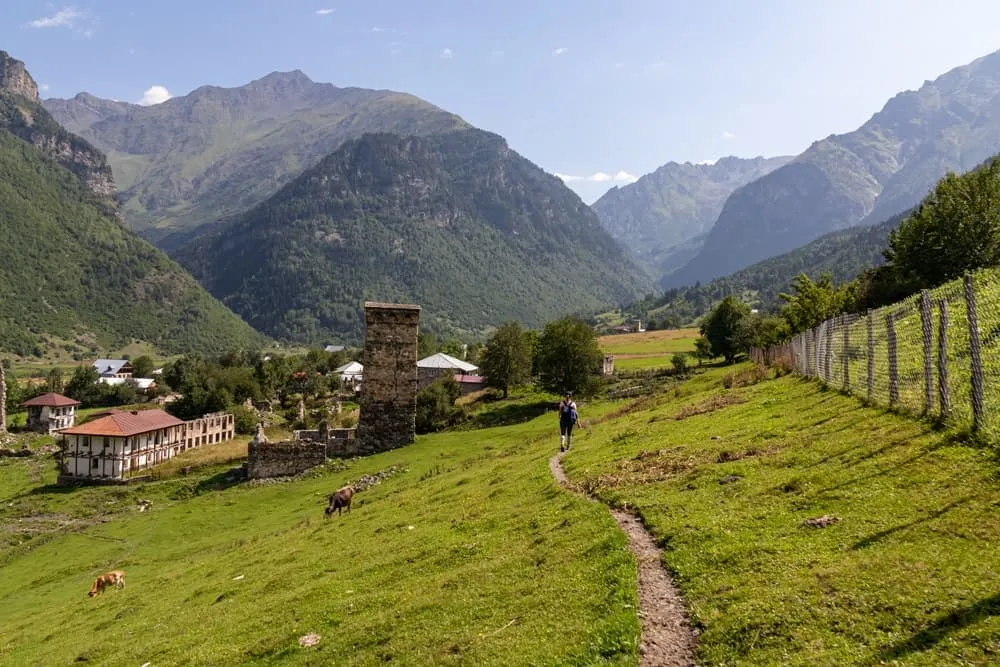
Svaneti is the heartland of Georgia hiking. Upper Svaneti is a UNESCO World Heritage Site, and the string of villages from Mazeri through Mestia to Ushguli forms the backbone of the classic multi-day trek. Guesthouse trekking is the norm here: villages are close enough that you rarely need a tent, and the family-run guesthouses provide hearty half-board dinners and packed lunches. The region feels remote but is increasingly well served with infrastructure, making it the natural starting point for first-time visitors.

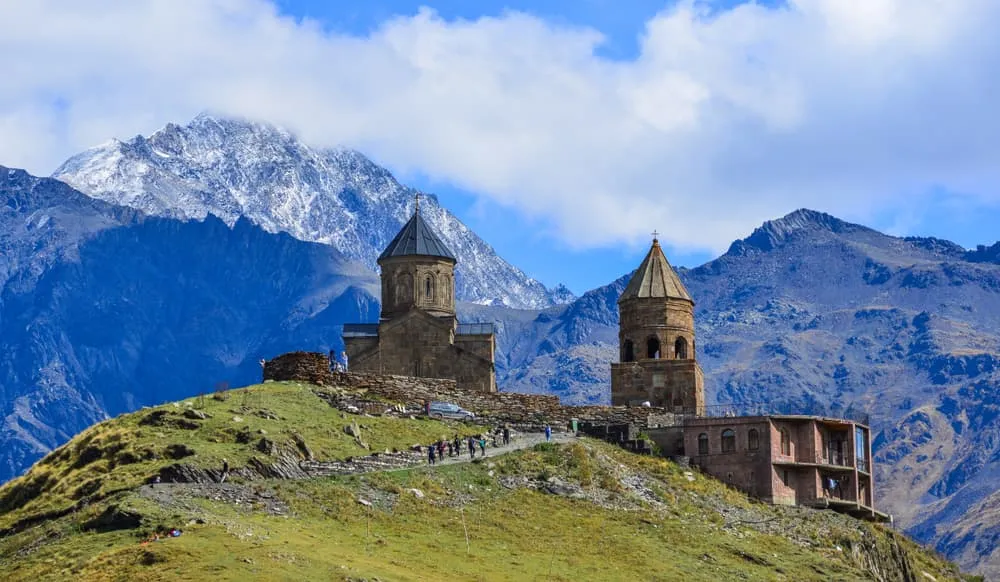
Kazbegi (officially Stepantsminda) sits just under four hours by road from Tbilisi, making it the most accessible highland region in Georgia. The Gergeti Trinity Church perched on its hilltop above the town is probably the most photographed landmark in the country. From Kazbegi you can hike to the Gergeti Glacier, walk the Truso Valley with its extraordinary travertine formations, or cross to the Juta Valley — all as day hikes or combined into a short multi-day trip. Our 3-day Hiking in Georgia trip is based here and suits anyone who wants a taste of the Caucasus without committing to a full week.

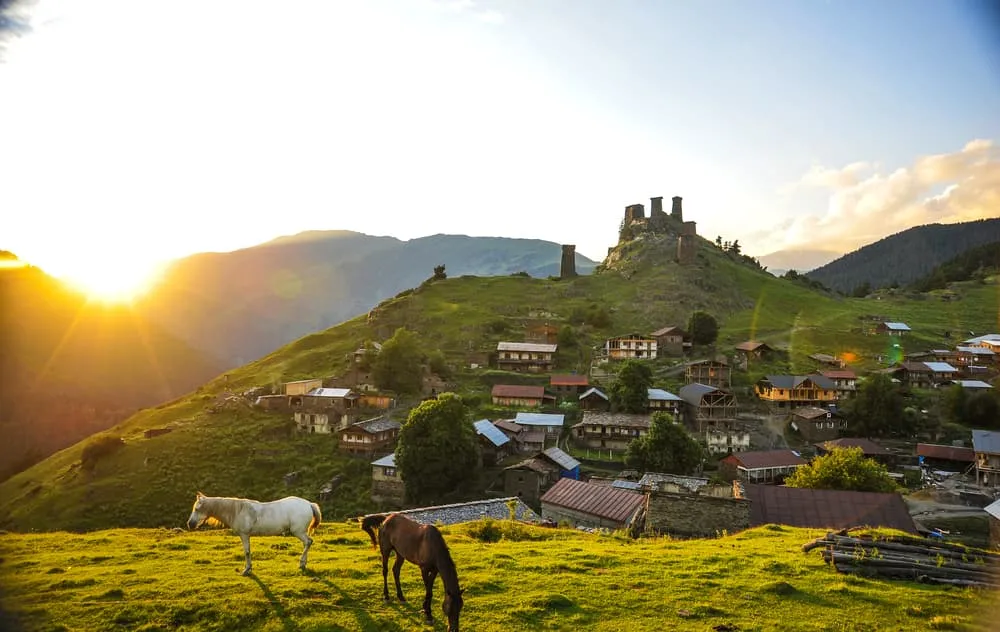
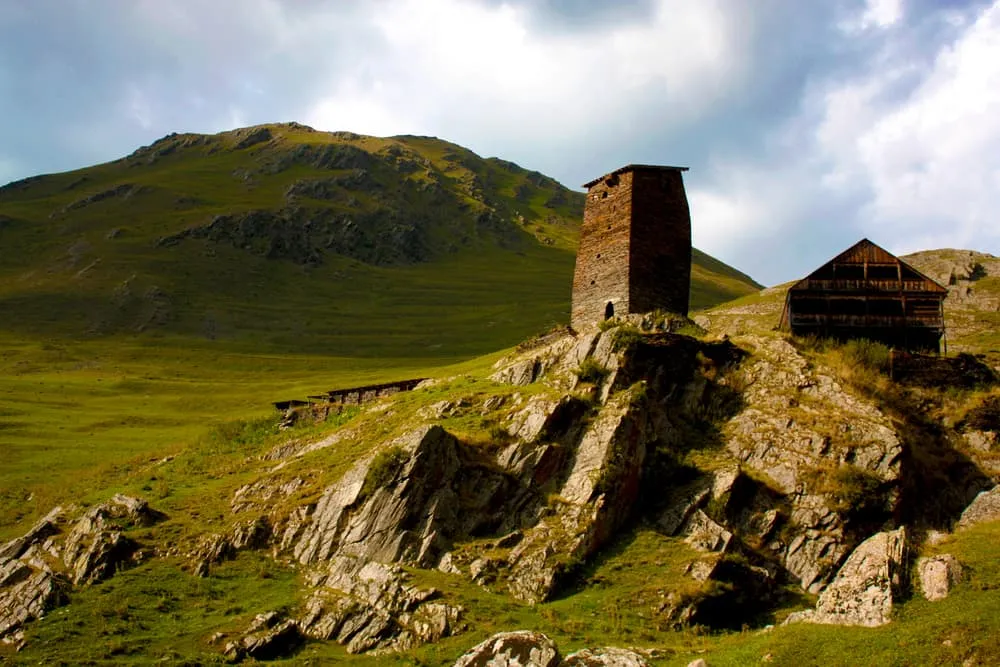
Tusheti and Khevsureti are the remote options. The Tusheti Military Road is one of the highest and most challenging unpaved mountain roads in Europe, closing the region off for most of the year and limiting the season to roughly July through September. The classic route crosses the Atsunta Pass (3,431 m) from Omalo in Tusheti to Shatili in Khevsureti, passing medieval stone tower villages that have barely changed in five centuries. This is where Georgia hiking feels most like stepping back in time.

Borjomi-Kharagauli National Park in the Lesser Caucasus offers a gentler introduction, with twelve marked trails ranging from easy three-kilometre loops to challenging 54 km multi-day routes through beech forest, past natural mineral springs and into the territory of bears and lynx. It suits walkers who prefer shade and greenery over high-alpine exposure.

Racha is the least visited of Georgia's highland regions, offering long valley walks toward glaciers like Buba and Udziro in relative solitude. Infrastructure is minimal and the area rewards those who come prepared.


Our Georgia treks and what they cost

Bookatrekking offers two bookable Georgia trekking trips, designed for different schedules and fitness levels.

The Hiking in Georgia 3-day trip starts from €694 per person (based on two travellers) and takes you into the Kazbegi region for a first taste of the Caucasus. Day 2 combines the walk to Gergeti Trinity Church and the Gergeti Glacier with approximately 16 km of hiking. Day 3 explores the Truso Valley with its travertine springs and abandoned medieval towers before returning to Tbilisi. It is graded as a beginner's trek and is an ideal option if your time in Georgia is limited.

The 8-Day Trekking in Svaneti starts from €1,980 per person (based on two travellers) and is the full Caucasus experience: the Ushba Waterfalls approach, the crossing to the Koruldi Ridge, and four days of the Mestia to Ushguli traverse finishing at the UNESCO towers of Ushguli. It is graded as intermediate.

Prices as of September 2026, per person based on two travellers.

Both trips include: certified English-speaking guide, all guesthouse accommodation, breakfast and dinner throughout, and all in-country transfers and transport between trailheads.

Not included: international flights to Tbilisi (TBS), travel insurance, lunches on the trail, and any personal spending.

"A fine 4 day, 3 night hiking trip in the Kazbegi area of Georgia. The first day's hike needs to be replaced due to construction, but the other three were very enjoyable. Nugo was a great guide, friendly and knowledgeable. The guesthouse in Kazbegi was beyond my expectations. Highly recommended if you have a few extra days in Georgia and don't want to spend it in the city."

— Kent, 5 stars on Trustpilot, July 2023

If you want to compare the Svaneti trek against other long-distance alpine itineraries, the Tour du Mont Blanc is a useful benchmark: it covers similar daily distances but with far more infrastructure, better waymarking, and significantly higher hut costs.



The best treks in Georgia, and what they cost

Mestia to Ushguli: Georgia's classic trek

The Mestia to Ushguli traverse is the route that put Georgia trekking on the international map, and it earns its reputation. Over four walking days, you cross two high mountain passes, ford the Adishi River on horseback, traverse alpine meadows below Tetnuldi (4,858 m), and arrive at the UNESCO-protected towers of Ushguli with the glaciers of Mount Shkhara (5,193 m) filling the skyline behind them.

The itinerary that forms the core of our 8-Day Trekking in Svaneti builds in two acclimatisation days at the start — a walk to the Ushba Waterfalls from Mazeri, then the crossing of the Guli Pass to the Koruldi Ridge — before the traverse proper begins.

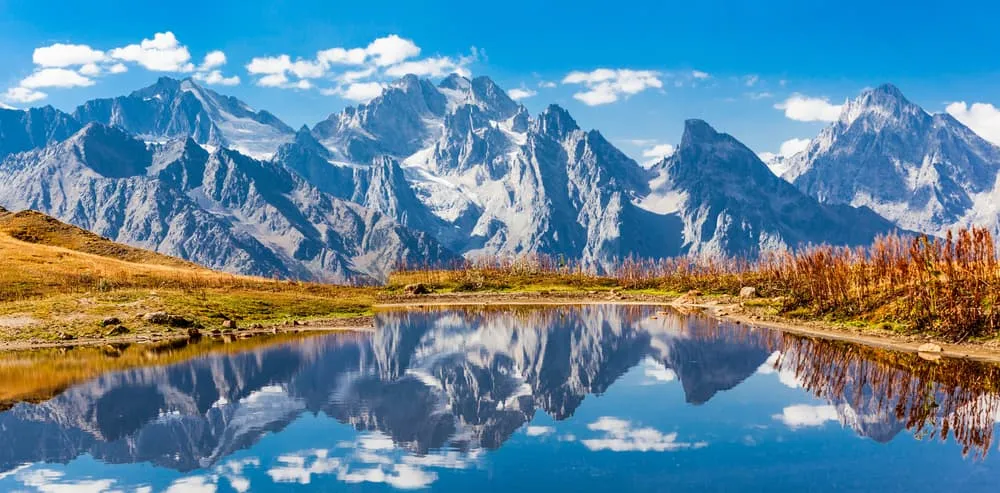
Day 3: Mazeri to Mestia via Guli Pass and Koruldi Ridge — 16 km with 1,602 m of ascent. This is the hardest day of the trek. The climb to the Koruldi Ridge at 2,960 m demands solid fitness, but the reward is a panorama that stretches across the main Caucasus ridge with Ushba's twin peaks dominant.

Day 4: Mestia to Zhabeshi — 16 km with 635 m of ascent, following a well-marked trail through forest and open meadow. A relatively gentle day after the effort of Day 3, giving your legs time to recover before the route enters the higher terrain.

Day 5: Zhabeshi to Adishi — 12 km with 909 m of ascent over the Tetnuldi Pass (around 2,500 m), descending to the ancient village of Adishi with its centuries-old stone houses and churches. The views from the pass across the Adishi Glacier are among the finest on the entire trek.

Day 6: Adishi to Iprali via Chkhutnieri Pass — 19 km with 754 m of ascent. The Adishi River crossing on horseback is one of the most memorable moments of the week, followed by the climb to the Chkhutnieri Pass at 2,655 m and a long descent to the valley floor.

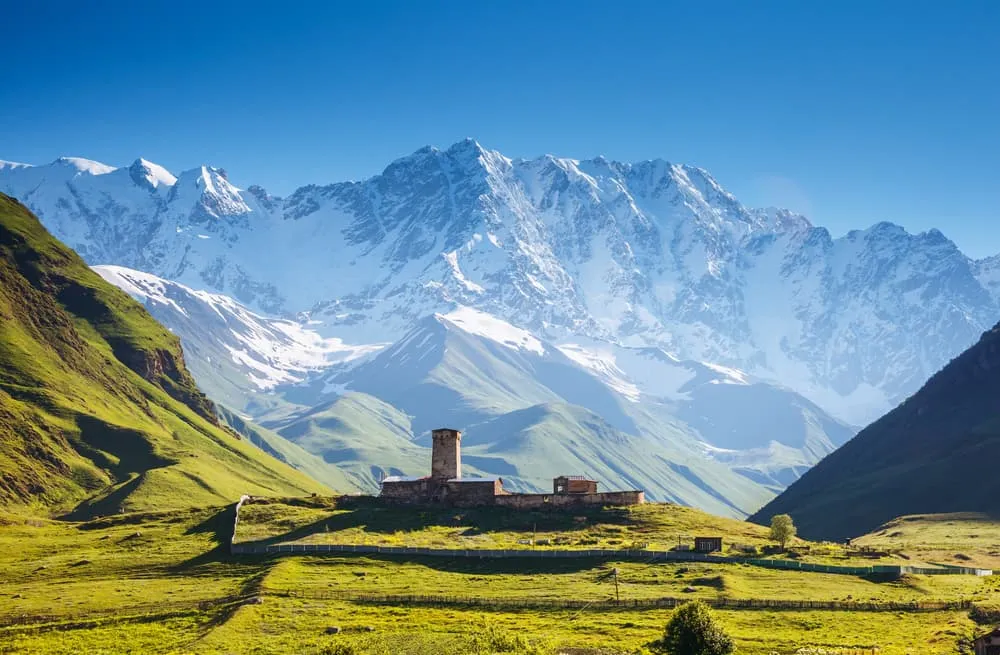
From Iprali, Day 7 brings you into Ushguli itself, a community of four villages and the highest permanently inhabited settlement in Europe. The Ushguli Ethnographic Museum occupies a 12th-century Svan tower house, and the medieval Lamaria Church stands at the edge of the village with the Shkhara Glacier as a backdrop. All figures above come from Bookatrekking's verified route data for the 8-day Svaneti product.


Mestia to Ushguli: Georgia's classic trek

Georgia hiking adventure in Svaneti: Itinerary

This itinerary is based on the 8-day Svaneti Trek as offered by TrekGeorgia.
Day
1

Tbilisi - Zugdidi - Enguri Dam - Mazeri

In the morning we travel to Svaneti. On the way we stop at Zugdidi and visit the Dadiani Palace, which was the residence of the local lords who ruled over a significant part of western Georgia.

We then drive to the Enguri Dam, which is one of the highest arch dams in the world (271.5 metres high). Then we drive to the region of Upper Svaneti, which is an outstanding example of an exceptional mountainous landscape with well-preserved villages with unique defensive tower houses, examples of ecclesiastical architecture and art of medieval origin. We drive to the village of Mazeri and spend the night there.

Overnight in Mazeri in a guesthouse with private facilities.

Mazeri

Info
Mazeri
Mazeri
Day
2

Mazeri - Ushba Waterfalls - Mazeri

Duration: 05:00 h
Distance: 142 km
Ascent: 450 m
Descent: 450 m

In the morning we start our walk from the village of Mazeri, following the river Dolra upstream. The path passes mineral water springs, a small church in a picturesque location, beautiful meadows, then slowly climbs through beautiful pine forests to the border post, from where the final climb begins. Then we reach the waterfalls.

After visiting the waterfalls we can do an optional walk to the Ushba glacier, weather permitting. This walk is optional and will be decided on the spot by the group and the guide. The distance is not too long, but the trail is quite rough and takes 4 hours to cover 6 km.

Overnight in Mazeri with private facilities.

Mazeri

Info
Mazeri
Mazeri
Day
3

Mazeri - Guli Pass - Koruldi Ridge - Mestia

Duration: 08:00 h
Distance: 16 km
Ascent: 1602 m
Descent: 614 m
Highest Point: 2950 m

In the morning we start another beautiful hike. We walk over the Guli Pass to the Koruldi Ridge, which is at an altitude of 2960m and requires good physical effort to climb. After the Guli Pass we descend into another valley and easily reach the Koruldi Ridges.

Overnight in a private guesthouse in Mestia.

Mestia

Info
Mestia
Mestia
Day
4

Mestia - Zhabeshi

Duration: 06:00 h
Distance: 16 km
Ascent: 635 m
Descent: 430 m

In the morning we start the real trek. We will walk to the Mulakhi community of Zhabeshi village. The route is easy and follows a well-marked trail.

Overnight at Zhabeshi Guesthouse with shared facilities.

Zhabeshi

Info
Zhabeshi
Zhabeshi
Day
5

Zhabeshi - Adishi

Duration: 06:00 h
Distance: 12 km
Ascent: 909 m
Descent: 477 m

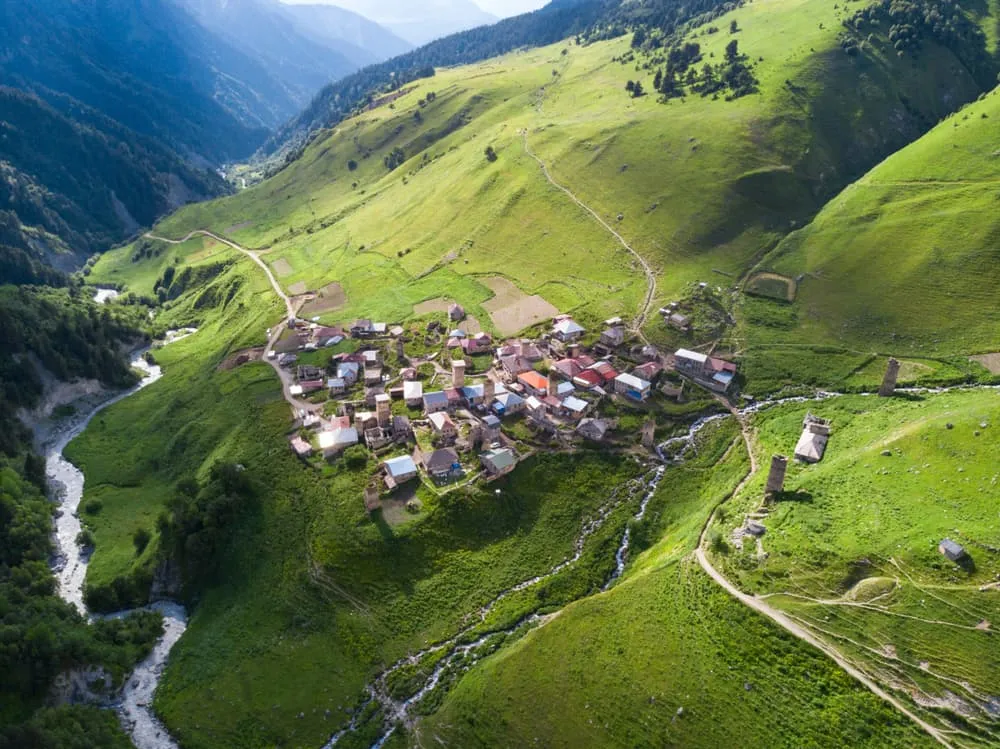
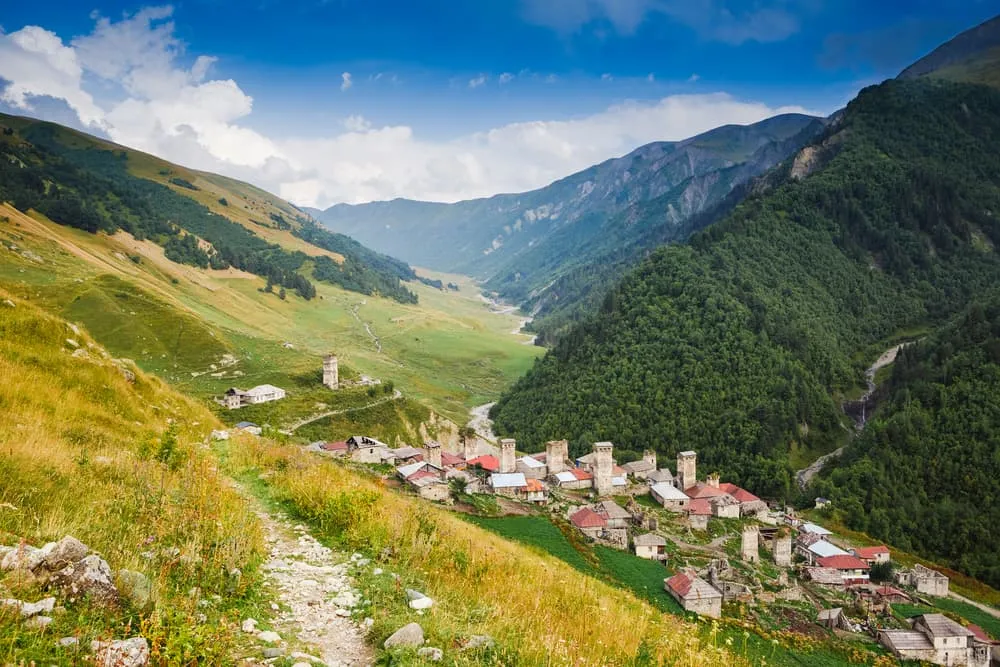
After breakfast we begin our journey into the wilderness. We hike up the slopes of Tetnuldi Mountain, pass a ski resort and descend into birch and rhododendron forests. After passing a mountain stream, the alpine meadows lie ahead. Here is the Adishi village, made up of stone towers and houses built several centuries ago. Its beautiful location, just below Tetnuldi Mountain, on the right bank of the roaring mountain river and nestled between high mountains with local architecture, makes this village so special and picturesque.

Overnight in a local guesthouse with shared facilities.

Adishi

Info
Adishi
Adishi
Day
6

Adishi - Chkhutnieri Pass - Iprali

Duration: 08:00 h
Distance: 19 km
Ascent: 754 m
Descent: 870 m
Highest Point: 2740 m

We start our Svaneti adventure early in the morning. Here we follow the river upstream. After an hour's pleasant walk along the river, we have to cross the raging Adishi River. For our safety we cross the river on horseback. We then climb to the Chkhunderi Pass (2655m). From here we have a majestic view of the picturesque Adishi Glacier. After lunch on the ridge we descend into the valley of the Khaldechala River. After an easy 2 hour walk we reach the village of Khalde, which was destroyed by Russian soldiers in the 19th century. From here we follow a dirt track to the village of Iprali.

Overnight in a local guesthouse with shared facilities in Iprali.

Iprali

Info
Iprali
Iprali
Day
7

Iprali - Ushguli

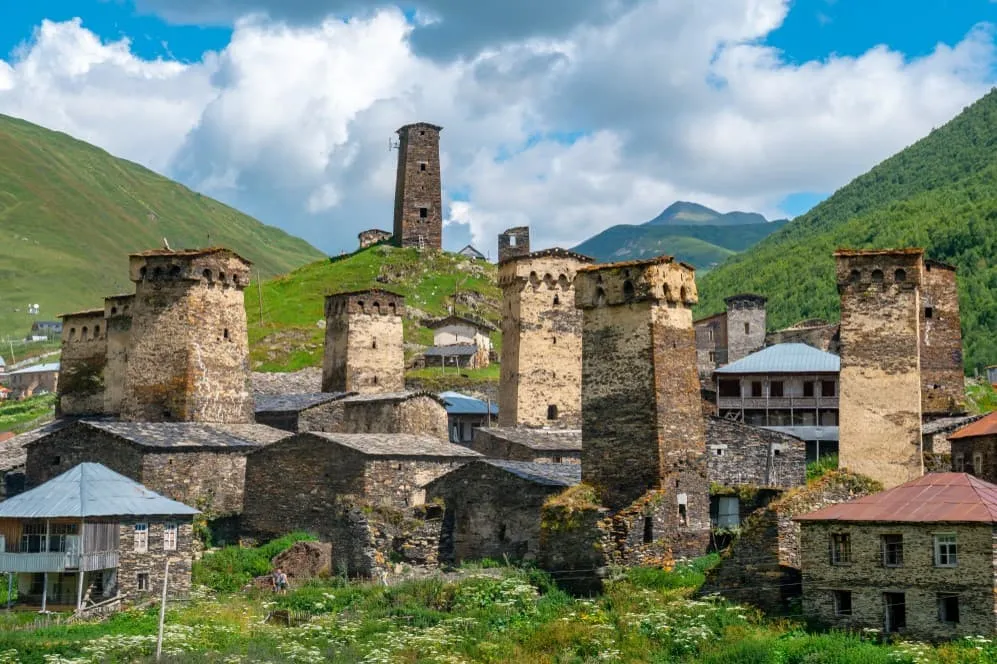
In the morning we trek through traditional Svani villages. After passing the villages of Kala and Davberi, we trek through the forest to reach Ushguli from above. Ushguli lies at the foot of Mount Shkara and at the confluence of the Enguri and Kvishiri Rivers. The highest permanent settlement in Europe (2200m) will amaze visitors with its unique blend of mountainous landscapes and medieval towers and churches. Here you will visit the Ushguli Ethnographic Museum in the old Svanetian tower house from the 12th century. We also visit the medieval Lamaria Church (of the Assumption of the Mother of God).

Overnight in Ushguli.

Ushguli

Info
Ushguli
Ushguli
Day
8

Ushguli - Tbilisi

After breakfast we depart for Tbilisi.

When is the best time to hike in Georgia, and how do you get there?

The best time to hike in Georgia is from mid-June to late September, with July and August offering the most settled weather and the best trail conditions at altitude.

Here is how the season breaks down month by month:

Early to mid-June: The Svaneti passes often hold snow into June, and some river crossings run high with snowmelt. The landscape is spectacularly green and the alpine flowers are at their peak, but expect wetter days and some pass closures on the highest routes. The road to Tusheti, one of the most challenging mountain roads in Europe, typically opens in late May or early June depending on snowpack.

July and August: Peak season, and deservedly so. High passes are clear, the weather is more stable and dry, wildflowers are in full bloom on the meadows, and guesthouses are operating at full capacity. Book well ahead for August in particular. Afternoons can bring thunderstorms in August — the mountains generate their own weather — so starting hiking days early is good practice.

September: Many experienced trekkers' favourite month. The summer crowds have thinned, the light is warmer and lower, and the alpine grass begins to turn amber. Rain is more frequent than in July, and you may encounter the first dustings of snow on the 3,000 m passes by late September. Pack a good waterproof and plan for the possibility of a rest day.

October: The trekking season effectively closes. Guesthouses in the most remote villages shut down, roads begin to close, and snow arrives at altitude with some regularity. Low-level hikes in Borjomi-Kharagauli and around Kazbegi town are still possible.

Getting there: The main gateway is Tbilisi International Airport (TBS), served by direct flights from London Heathrow and Gatwick, as well as numerous European hubs. From Tbilisi, Mestia is around six to seven hours by road through the Enguri Gorge — a journey that passes the enormous Enguri Dam, one of the highest arch dams in the world. Kazbegi is around three to four hours from Tbilisi on the Georgian Military Highway, a dramatic road that crosses the Jvari Pass at 2,379 m.


When is the best time to hike in Georgia, and how do you get there?

How difficult is trekking in Georgia, and where do you sleep?

Honest answer: trekking in Georgia is moderately demanding and significantly less signposted than equivalent trails in the Alps or on the Camino de Santiago. Anyone who approaches it expecting Swiss-standard waymarking and mountain huts every few kilometres will be surprised.

The main challenges are as follows. Waymarking on the Svaneti traverse has improved considerably since the Transcaucasian Trail Association began marking the route, but outside Svaneti it remains patchy. Off the main corridor, route-finding requires a GPS track or local knowledge. The Bookatrekking app provides the route description and navigation layer for your trek.

Daily elevation is substantial. Days with 900 m to 1,600 m of ascent are normal on the Svaneti traverse. Descents are long and hard on the knees. The terrain is mostly grassy or rocky path, not technical climbing, but the sustained effort over multiple consecutive days adds up.

River crossings are a feature rather than an exception. The Adishi River crossing, for example, requires fording on horseback because the water volume in summer makes wading unsafe. A guide who knows current conditions is genuinely useful here.

Altitude on this trek peaks at around 2,960 m on the Koruldi Ridge and 2,655 m at the Chkhutnieri Pass. These are not extreme altitudes, but trekkers coming from sea level should allow a day of gentle acclimatisation before tackling the hardest passes.

Beginner-friendly options do exist. The Truso Valley walk near Kazbegi is a low-gradient, high-reward day hike suitable for walkers with modest fitness. Our 3-day Kazbegi trip is graded as a beginner's trek and involves around 16 km of walking over the active hiking days, with transfers handling all logistics. Svaneti, by contrast, is better suited to people who are comfortable hiking five to seven hours a day on consecutive days with a loaded daypack.

Do you need a guide? For the Svaneti traverse, a guide adds real safety value: river crossing decisions, weather calls on the passes, and navigational confidence on less-marked sections. For the Kazbegi day hikes, experienced walkers with good GPS navigation skills can go independently, though a local guide enriches the cultural experience enormously.


Where you sleep: guesthouses in the mountains

Accommodation on Georgia trekking routes is almost exclusively in family-run guesthouses, and this is one of the defining pleasures of the experience. In Svaneti particularly, the same families who have farmed these valleys for generations now open their homes to trekkers, providing a level of warmth and local insight that no hotel can replicate.

The standard offering is half board: a hearty dinner and a substantial breakfast, often with home-produced wine, homemade cheese, freshly baked bread and khinkali (dumplings). Dinner in a Svan guesthouse can turn into a supra — the traditional Georgian feast where the tamada (toastmaster) leads a series of toasts that cover everything from peace and family to the mountains themselves. It is not just a meal; it is a cultural ceremony.

Practically: rooms in mountain guesthouses are simple and clean. Shared bathrooms are common in smaller villages, private facilities in larger ones like Mestia. Beds have linen; hot showers are generally available, though water pressure in remote villages can be modest after a full group arrives. Wi-Fi exists in Mestia and some larger guesthouses along the route but is unreliable above a certain altitude.

Payment is almost always cash only in remote guesthouses. Carry Georgian lari; card machines are rare beyond Mestia and Kazbegi town. Bookatrekking pre-books all accommodation on our organised trips, which matters in August when the most popular guesthouses along the Svaneti traverse can fill up weeks in advance. Independent trekkers heading out in high season without reservations risk arriving in a village to find everything full.

The Bookatrekking app shows the weather forecast for the specific coordinates of each night's guesthouse — useful for deciding what to put in your daypack versus the luggage transfer vehicle the following morning.


What to pack for my Georgia trekking adventure

Your gear is your best friend while being out in the mountains. It, in fact, doesn’t matter where you are going, your equipment is key. In extreme cases, gear can make the difference between life and death. In every case, the right equipment can make the difference between you having a good time and ending up miserable. Trekking in Georgia is very similar to trekking in the Alps. Just note that that you will not be seeing any large towns or malls for a good few days in a row, so get prepared. Getting prepared you can also do in Tbilisi. You don't need to drag everything into the plane.

Before we start, note one important thing; we are trekking, not climbing. Hence, you can leave the ropes, the chalk and the carabiners in your closet.

Packs to Carry

If you have to carry something for a prolonged time and you choose what you carry, then don’t compromise. The bags that you bring on your trekking should be of decent quality and you want to be used to them. Don’t swap a winner backpack for a new untested one a week before you head out. Assuming you will have porters to assist you on your trek, you need the following:

  • Duffel bag
  • Rucksack with rain cover
  • Daypack

Happy Feet

We don’t always give our feet the attention they deserve. That may sound weird to you, but just think about what they have all done for you. You can’t go anywhere without your feet. So for your upcoming trekking in Georgia, you better make sure you look after them. Or do you want blisters en route to Ushguli?

  • Hiking boots
  • Sandals or shoes
  • Hiking socks
  • Trekking poles (Only if you know how to use them)
  • Inner socks

Dress for the Occasion

You don’t have to go overboard when it comes to your trekking gear. Find a healthy balance between comfortable and durable. If you are new to trekking or you only do it once a year, you don't need to invest in high-end expedition gear.

  • Thermal baselayer
  • T-Shirts
  • Fleece pullover or jacket
  • Light weight thermal tops
  • Waterproof jacket
  • Sports bra for her
  • Hiking shorts
  • Hiking pants
  • Waterproof pants

Sleep Is Everything

A good night of sleep is the best recovery. Your wellness during trekking relies partly on the energy you are tanking in the night. When you are staying in guesthouses, you don't need to worry about this section too much. Guesthouses in Georgia are very comfortable. If you are on your own in the mountains, take note of the following:

  • Sleeping bag
  • Pillow
  • Earplugs

Get Cover

There are multiple reasons for covering your head. Whether it’s sun, snow or rain: It is likely it strikes your head first. Protect yourself against sun rays and bring something that keeps you dry when it gets rough.

  • Wool hat
  • Sunhat
  • Buff
  • Sunglasses

Some Extras

No one is the same and everyone has his own level of comfort. There will be things missing on this list, simply because you attach more value to them than others. Bring what you want to bring. The next things are definitely worth bringing:

  • Sunscreen
  • Water bottles
  • Head lamp
  • Wet wipes
  • Sanitizer
  • Creams
  • Pain medication
  • First aid kit
  • Towel
  • Toiletries

Leave This in the Closet

There always things that you can just leave at home. Light and Fast: The lighter your backpack, the easier your life on the trails will be. Ease is a joy. Here is what you should not bring along.

  • Leather
  • Jeans
  • Unnecessary electronics
  • Jewelry
  • Classic towel

One last thing: Whatever you pack, make sure you don’t overpack. Someone needs to carry all that stuff and that person is you.

What to pack for my Georgia trekking adventure

Tipping while on a trekking tour in Georgia

Tipping is a common practice if you get assistance from anyone all over the world. Especially in Nepal and while climbing Kilimanjaro, where you get assistance from both guides and porters. In Georgia tipping is not expected but it still fairly common practice. If you book an organized trek, it is common to tip 10% to 15% of the total price to your guide. You, however, only need to do this when your expectations are met and you are happy about your experience.

How to train for hiking in Georgia, Europe?

If you live anywhere else other than the Alps, it will be hard to get your legs ready for higher altitudes. This is why we have to be clear upfront: Unless you have hiked at a higher altitude before, it will be difficult to get a 100% ready for your adventure. If that sounds bad to you, then comfort yourself with the fact that there is absolutely no need to be 100% ready. You are not climbing K2 or Mount Elbrus and not running a mountain race. This is trekking. In fact, you are actually supposed to take it easy. It doesn’t matter how fit you are, once you are out there on the trails, you have to stick to your own pace. But of course, the fitter you are, the more you can enjoy your days. Let’s get ready!

Hike and Hike Even More

One solid approach to get the hang of what you do is to rehearse. The best practice for climbing is climbing. Seeing that you are keen on a multi-day trekking experience, we accept that you enjoy walking. Awesome, do it more. If you are fortunate to be encompassed by some hills or even mountains, the time has come to see them all the more frequently. When? In the event that you are new to this, we recommend beginning a half year the start of your trek, essentially going for 60 minutes (or two) climb seven days. When you get the hang of it, after around three weeks, you will have an ideal opportunity to reinforce your power. Convey a pack of 10 to 15kg and include a more drawn out climb of three hours to your week. On the off chance that this way of life is different to you, you will before long receive the rewards of this moderate exercise.

Health Benefits

Some of the health benefits of trekking and hiking include a lower risk of heart disease, improved blood pressure and sugar levels and of course it helps to control your weight. Once you are ready for the hills, it only gets better. According to Gregory Miller, president of the American Hiking Society, "a 5% to 10% incline equals a 30% to 40% increase in calorie burn.” Our personal health benefits are a clearer mind and an elevated mood. Trekking keeps us sane. After a good few months of solid hiking, it is time to put your endurance to the test. Do back to back long hikes. You can simulate a few days of constant trekking by going hiking for a few days. Easy at that. Plan a smaller trekking holiday or keep it simple by hiking your favorite route on repeat. If you are comfortable hiking for 4 hours a day, 3 days in a row while carrying a 10kg to 15kg backpack, you will be fine.

Get Stronger

One misconception about trekking is that the ascent is the hardest on your body. Wrong. Descending is actually very demanding. When you hike downhill, your quadriceps is being put to work. If you notice any overly sore muscles and weak spots in your quads while going out on hikes, it can be wise to add some strengthening exercises to the mix. If your quads and glutes are suffering, your knees and ankles might also take too much strain.

One way to get stronger is to do some basic exercises. You don’t need a gym membership, as merely using your bodyweight can already give you the results you are looking for. Once or twice a week, depending on how you are feeling, you can do two sets of 10 lunges, 10 squats, and 10 step-ups. If you want to push yourself a bit more, you can try to add some pull-ups and push up to your routine. Going the extra mile in your strengthening is, however, really not necessary. You can already enjoy trekking when you just stick to the basics. This is not a fitness competition.

Elevation Simulation

An elevation mask is an elevation reproduction gadget that restrains your intake of oxygen. Usually utilized by endurance athletes who contend at a higher altitude. Likewise, hikers and trekkers can also benefit from it. When you are going trekking in Georgia, there is definitely no compelling reason to go this far, yet in the event that it settles your stresses, you out it an attempt. On the off chance that you are thinking about to roll out exceptional improvements in your way of life, always make sure to consult a medical professional first. Especially if you want to mimic altitude.

Safety tips for the Georgia

Although this is far from being a trek in the Himalayas, unexpected things can always happen and you might also find obstacles on the hiking trails along the way. The Georgia is safe, the trails are quite straight forward and there is not an extreme difference in altitude. However, for your safety, every hike deserves a level of respect; respect for the terrain, the trails, wildlife and vegetation, local rules and regulations, and above all, your physical capabilities and safety. Therefore, for an unforgettable and safe hiking memory, please keep the following safety recommendations in mind:

  • Know your limits

    Always prepare each stage carefully to use your energy wisely, respect your physical and mental limitations, and avoid taking unnecessary risks. When ascending or descending, if applicable, always use the aids provided, such as handrails and ropes. Is this trek suitable for you? Well, familiarize yourself with the grading system and figure out if this trek matches your capabilities. If you still need professional advice you can always contact Bookatrekking.com experts.

  • Stay on marked trails

    The most important thing is to never leave the marked paths. For easy navigation we work with our trusted partner Komoot, whose interactive maps, also available offline, provide you with the necessary digital means to get from A to B in the Georgia. As a backup, make sure to bring a hiking guide or a paper map with you.

  • Fully equipped

    Make sure you have the necessary gear for the conditions you'll be facing, including appropriate clothing, footwear, and any necessary equipment for the terrain you'll be hiking on. Always wear clothing adapted to the weather of Georgia and protect yourself from cold and wetness or heat and sun. Besides, make sure you carry enough food and water for the duration of your trek. On the way, you might (or might not) be able to buy snacks.

  • Stay reachable

    If you are hiking solo or in small groups it is advisable to inform people back home about your plans, what route you are taking and when you plan to return. Even small incidents can lead to unpleasant emergencies so make sure you are available at all times. Bring a charged phone containing at least the phone numbers of immediate family members, your accommodations en route and the emergency phone numbers operating in the Georgia.

  • Respect for nature

    Do not litter, prevent noise, stay on the marked trails, do not disturb wildlife or grazing animals, and respect protected areas.

Where Can I Book My Walking Adventure in Georgia?

At Bookatrekking.com you can book many treks in Georgia. We take care of all the details for you, give you personal trekking advice and give you the best service possible. Find all our offers for Georgia here. Our easy-to-use platform allows you to browse and compare different trekking options and find the perfect fit for your interests, abilities, and budget.

If you have any questions about a specific trek or need help choosing the right one for you, our team of Trekking Experts is here to assist you. Simply reach out to us and we will be happy to provide you with personalized recommendations and advice to help you plan the trekking adventure of a lifetime.

Frequently asked questions about trekking in Georgia

  • What is the best time to hike in Georgia?

    The best time to hike in Georgia is July and August, when high mountain passes are clear of snow, weather is relatively stable and guesthouses are fully open. September is an excellent alternative with fewer crowds and golden autumn light, though rain becomes more frequent and the first snow can appear on passes above 3,000 m by late September.

  • What is the most famous trek in Georgia?

    The most famous trek in Georgia is the Mestia to Ushguli traverse in Upper Svaneti, a four-day route through UNESCO-protected medieval tower villages, across high alpine passes and along glacial valleys. It ends at Ushguli, the highest permanently inhabited settlement in Europe, beneath the glaciers of Mount Shkhara.

  • What is the most stunning hike in Georgia?

    The most stunning hike in Georgia is widely considered the Svaneti traverse from Mestia to Ushguli, combining 5,000 m peaks, glacial rivers, wildflower meadows and ancient Svan tower villages in a single continuous route. The Gergeti Trinity Church hike near Kazbegi, with its iconic backdrop of Mount Kazbek (5,033 m), is a close second for a single-day experience.

  • What are some beginner-friendly hikes in Georgia?

    Beginner-friendly options include the Truso Valley walk near Kazbegi (low gradient, rich in travertine formations and medieval ruins) and the walk to Gergeti Trinity Church from Stepantsminda. Both are manageable in a day with basic fitness. The 3-day Kazbegi trip from Bookatrekking is designed specifically for walkers who are new to multi-day trekking in mountain terrain.

  • What's the hardest trail to hike in Georgia?

    The hardest widely-hiked trail in Georgia is the Tusheti to Khevsureti crossing via Atsunta Pass (3,431 m). Accessing Tusheti itself requires a notoriously challenging unpaved mountain road, and the multi-day traverse to Shatili involves significant daily elevation gain, remote terrain and minimal infrastructure. The Koruldi Ridge day on the Svaneti traverse (1,602 m ascent in a single day) is also considered one of the toughest individual stages in the country.

  • Do you need a guide for trekking in Georgia?

    You do not legally need a guide for most Georgia hiking routes, but a local guide adds meaningful value. Waymarking outside Svaneti is patchy, river crossings require local knowledge of current conditions, and weather in the Caucasus changes quickly. On organised trips with Bookatrekking, a certified English-speaking guide is included. Independent trekkers should at minimum carry a downloaded GPS track and have the Bookatrekking app with offline maps and per-hut weather installed.

  • Is Georgia safe for hikers?

    Georgia is generally safe for hikers. Crime against tourists is rare, and the local culture is famously hospitable. The main risks are mountain-related: sudden weather changes, river crossings in high water, and trail-finding errors in unmarked terrain. Trekking with a guide, carrying a charged phone with emergency numbers saved, and informing someone of your route and expected return time are sensible precautions on any remote trail.

  • How difficult is the Appalachian Trail in Georgia?

    The Appalachian Trail in Georgia (USA) refers to the southern terminus section in the state of Georgia, not the country covered on this page. That section runs approximately 115 km through the Blue Ridge Mountains and is considered a moderately demanding trail, typically completed in five to seven days. This article covers trekking in the Republic of Georgia in the Caucasus — a completely different destination.

  • What are some good hiking tours in Georgia?

    Bookatrekking offers two Georgia hiking tours: the 3-day Hiking in Georgia based in Kazbegi (from €694, beginner-friendly) and the 8-Day Trekking in Svaneti covering the Mestia to Ushguli traverse (from €1,980, intermediate). Both include a certified guide, guesthouse accommodation, breakfast and dinner, and all in-country transfers.

About Us

At Bookatrekking.com, you will find the trek that will make your life unforgettable. Whether you want to explore the Inca Trail or climb Kilimanjaro. Bookatrekking.com has a wide and varied range of first-class treks. No false promises are made here. Transparent prices and bookings are fixed instantly. Find, compare, book and trek!
Read more about us
About Us
About Us