

Hiking in Mallorca: The Best Trails, Routes and Multi-Day Walks in the Serra de Tramuntana

Hiking in Mallorca: The Best Trails, Routes and Multi-Day Walks in the Serra de Tramuntana
Trekking experts per destination
Free cancellation up to eight weeks in advance
Quick personal advice

Hiking in Mallorca surprises most people who think of it as a beach destination. The Serra de Tramuntana runs the full length of the northwest coast: a UNESCO World Heritage cultural landscape of dry stone terraces, ancient olive groves, mule trails worn smooth over centuries and limestone ridges that drop almost vertically into the Mediterranean. The best hiking in Mallorca happens outside the summer beach season, in spring and autumn, when the light is clear, the air is cool and the paths are yours. At Bookatrekking, we book your accommodation, arrange luggage transfer between overnight stops, and give you our app with offline navigation, GPX tracks and a weather forecast for every stage. This guide covers where to walk, the best areas, day hikes, the long-distance route across the island, honest difficulty, the best season to go, getting around without a car, and our two bookable multi-day walks. Learn more about hut-to-hut hiking in Spain as the wider context before you dig in.


Why go hiking in Mallorca?

The case for hiking in Mallorca Spain starts with geography. In a single day you can cross a mountain ridge above 1,000 metres, descend through olive groves to a fishing village and finish with your boots off beside the sea. The island has a dense network of waymarked trails and centuries-old stone mule paths connecting villages that are rarely more than a day's walk apart. Spring flowers — almond blossom in February, orchids and cistus through April and May — give the Tramuntana hillsides a colour and scent that is hard to match elsewhere in Europe at that time of year. Because Mallorca sits at a lower latitude than the Alps, the walking season runs from late winter into early winter, which suits anyone who cannot get away in July or August.

The best hiking in Mallorca is honest about its downsides too. The terrain is mostly limestone: rocky, sun-exposed and porous, which means springs and streams are scarce and you carry more water than you expect. In summer, temperatures at low altitude push beyond comfortable walking range and the coastal villages are at their most crowded. The mountains are not vast — the highest point walkers can reach freely, Puig de Massanella, stands at around 1,365 metres — but the combination of rough ground, sustained ascent and heat means a single stage can be more demanding than the numbers suggest. Go in spring or autumn and these downsides mostly disappear.


Where is Mallorca and how do you get there?

Mallorca (sometimes spelled Majorca in English) is the largest of the Balearic Islands, sitting off Spain's east coast in the western Mediterranean. Palma de Mallorca is the gateway: the airport is large and well connected, with direct flights from most UK airports and from several US hubs via a European connection. Ferries run from Barcelona, Valencia and Dénia on the Spanish mainland if you prefer to arrive without flying or want to combine Mallorca with a mainland walking trip.

From Palma you have more options than most visitors realise. The historic Palma–Sóller railway is a pleasure in itself, threading through the Tramuntana on a narrow-gauge line before the Sóller tram continues down to the port. Public buses connect Palma with Sóller, Valldemossa, Deià, Pollença and Port de Pollença, all of which are key walking bases. The coastal Ma-10 road over the mountain passes is spectacular and makes remote trailheads accessible by hire car, but it is not essential.

Hiking in Mallorca without a car is entirely practical on a point-to-point walking holiday. The villages that sit on or near the long-distance route — Sóller, Port de Sóller, Valldemossa, Deià, Pollença and Port de Pollença among them — are all reachable by public bus or train from Palma. When we arrange luggage transfer for you, your main bag travels ahead by road and you walk with a day pack, which removes the main practical argument for having a vehicle. Timetables and fares change seasonally, so check the current TIB (Transport de les Illes Balears) schedule before you travel; we do not publish them here because they shift each year.


The best areas for hiking in Mallorca

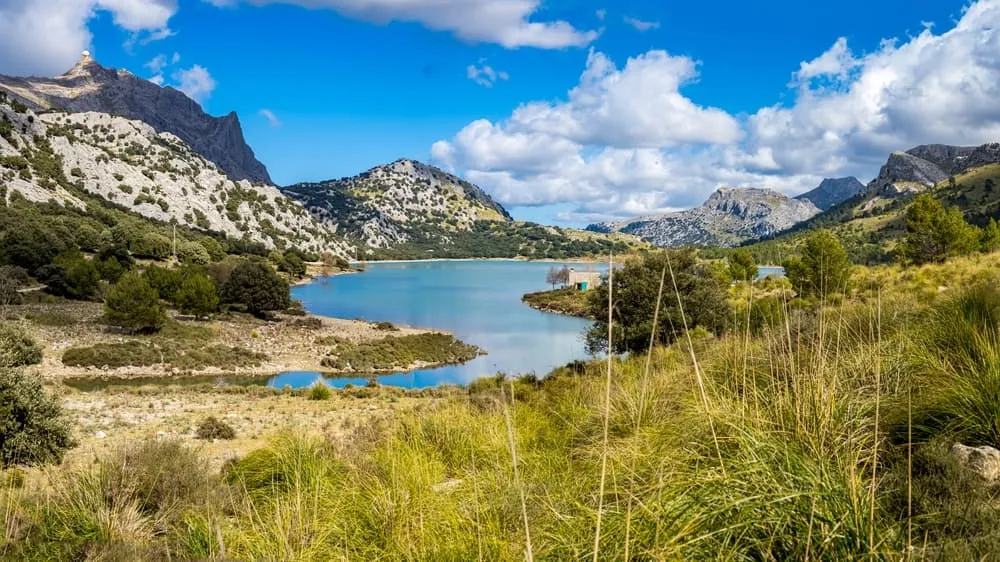
The Serra de Tramuntana is the main event for any serious walking trip. The range stretches roughly 90 kilometres along the northwest coast, reaching its highest point at Puig Major (1,445 m), which has a military installation at the summit and is closed to the public. The walker's high point is Puig de Massanella, approached from the Cúber and Gorg Blau reservoirs — a classic destination that gives a full panorama of the range and the sea. The Sóller valley is the natural hub for hiking Mallorca Tramuntana: the town of Sóller, the port below it and the village of Fornalutx above are linked by stone terraced paths through orange and lemon groves that are among the most beautiful short walks on the island. Deià, Valldemossa, Banyalbufar and Estellencs each have their own character and sit within easy walking reach of the long-distance route. This is also where hiking Mallorca Soller earns its own search traffic: the valley's micro-climate, citrus culture and dense path network make it the single most rewarding week-long base on the island.

The northeast around Pollença and Cap de Formentor offers a gentler landscape than the high Tramuntana, with pine-covered ridges, a long bay and the dramatic Cap de Formentor headland at the tip of the island. Walking here tends to be quieter in terms of crowds, even in peak season.

The Llevant hills in the east, between Artà and the coast, are lower and less dramatic than the Tramuntana but offer solitude and some fine coastal walking along cliff tops and into hidden coves. The Parc Natural de la Península de Llevant protects the north-eastern tip and has a network of signed trails.

The south coast and the Serres de Llevant are flatter and better suited to easy walking between fishing ports and limestone coves than to mountain hiking. Good for a rest day or for walkers who want low-level paths without sustained climbs.


Multi-day walking in Mallorca: our self-guided routes

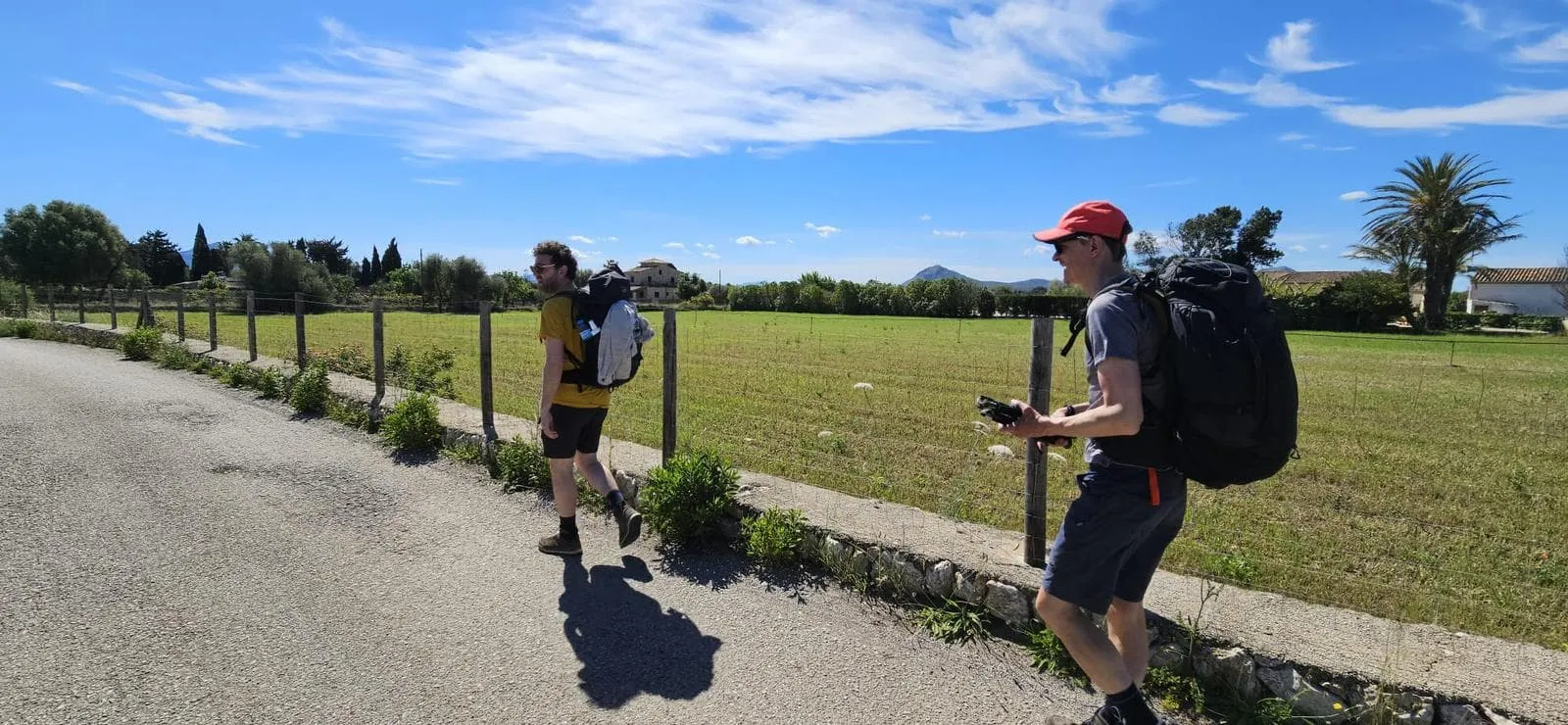
A multi-day walk on Mallorca follows the logic of the Tramuntana itself: you move from village to village across the mountain range, sleeping in small hotels, guesthouses and mountain refuges, eating in village restaurants, and waking up to a different view each morning. Self-guided means no group departure time, no guide walking alongside you, and no fixed pace: you set off when you like, follow the waymarked path and the route in the Bookatrekking app, and arrive at your next overnight stop at your own speed. We handle all the logistics: accommodation at each stage, luggage transfer by road between overnight stops so you carry only a day pack, and the app with offline maps, GPX and a per-stage weather forecast based on the coordinates of each overnight location.

We offer two bookable options for a walking holiday Mallorca that covers the heart of the range.

The Short Mallorca Trail is a 7-day self-guided walk across the most dramatic section of the Tramuntana, starting in Valldemossa and finishing in Pollença. It is the right choice for a first multi-day hike Mallorca experience, for walkers with a week available, or for anyone who wants to cover the most scenic and culturally rich stretch of the range without committing to the full crossing.

The Full Mallorca Trail is a 12-day self-guided walk from Port d'Andratx in the southwest to Pollença in the north, the complete end-to-end crossing of the Serra de Tramuntana. It suits walkers who want to understand the full range, who have two weeks available, and who are comfortable with back-to-back walking days over a longer period.

Both trips use the same Bookatrekking app, the same luggage transfer model, and the same accommodation-first approach. The difference is scope and duration, not quality.


The GR221 dry stone route in brief

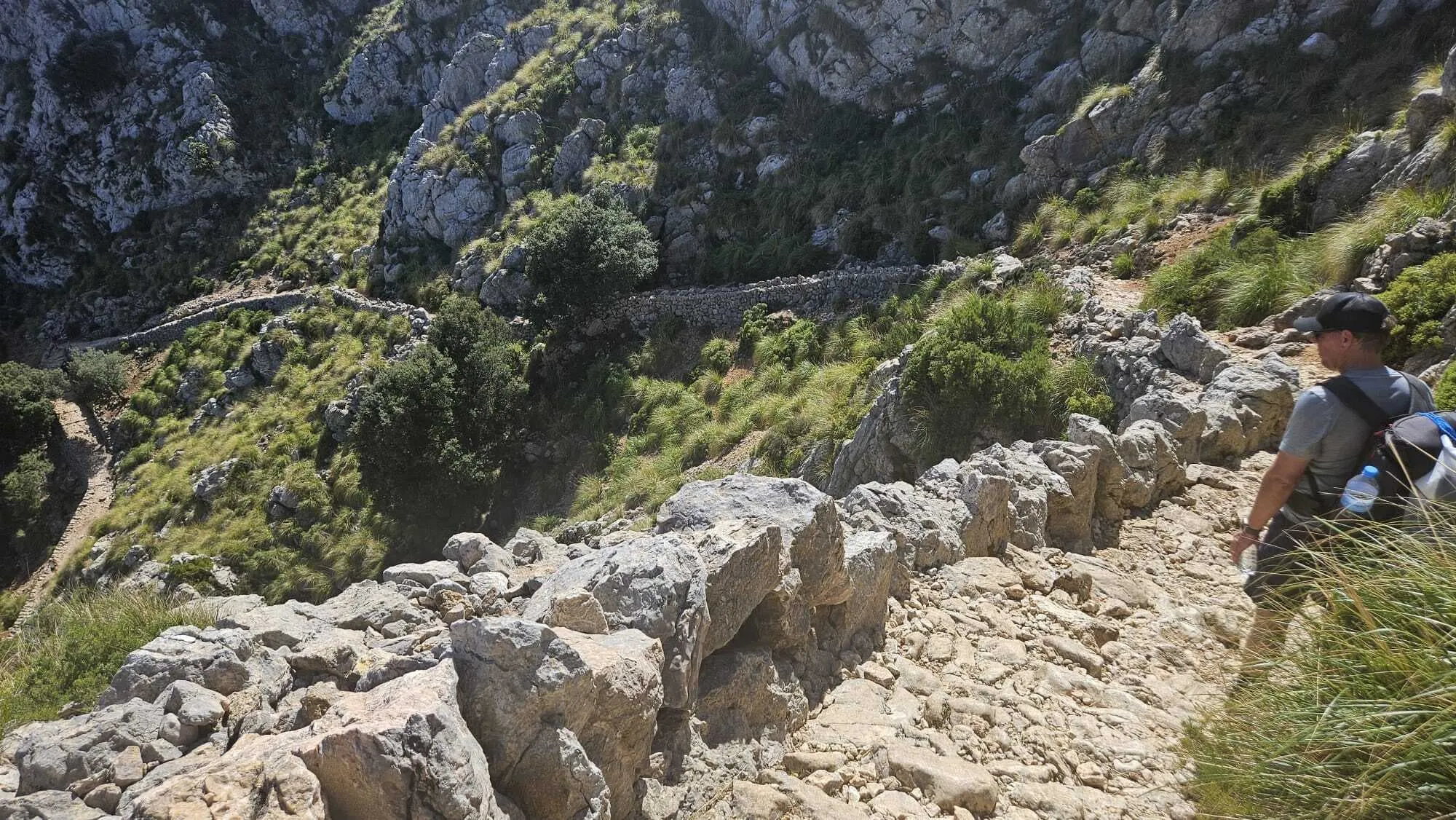
The GR221, also known as the Ruta de Pedra en Sec or Dry Stone Route, is the waymarked long-distance path that runs the length of the Serra de Tramuntana. It follows restored mule trails and dry stone paving through a chain of mountain villages and a network of government-run mountain refuges. The route is the backbone of both our multi-day trips and takes its name from the centuries-old Mallorcan tradition of building terraces, steps and field boundaries without mortar. For full planning detail — stages, refuges, water points, navigation notes and practical booking information — see our complete guide to hiking the GR221 in Mallorca.


Day hikes and shorter loops for hiking in Mallorca

Not every visit needs to be a multi-day commitment. The Mallorca hiking trails network is rich enough to fill a week of day walks from a single base, and several classic routes are worth knowing about.

The Camí de s'Arxiduc above Valldemossa follows a path originally commissioned by Archduke Ludwig Salvator in the nineteenth century. It runs along an exposed limestone ridge with commanding views of both coasts and is one of the most photogenic of the Mallorca hiking routes without requiring any technical skill.

The walk to Cala Tuent from the road above Sa Calobra passes through the Torrent de Pareis gorge landscape. A note here: the full through-gorge route inside the Torrent de Pareis involves scrambling, wading and squeezing through narrow rock passages. This is not a hiking path and it is not something we run as a guided or self-guided trip; if you want to attempt it, go with a local guide who knows current conditions. The short walk to Cala Tuent itself, however, is a fine coastal excursion.

The Castell d'Alaró sits on a limestone crag above the plain and is reached by a straightforward path through pine and oak woodland. The views from the battlements extend across the whole island and the route is popular enough to be well worn underfoot.

The Talaia d'Alcúdia above Pollença gives a ridge walk with views north over the Pollença bay and south across the whole Tramuntana, and is a good option for walkers based in the northeast of the island.

Cap de Formentor at the tip of the Formentor peninsula has a coastal path above dramatic sea cliffs. Access to the headland is restricted by vehicle during peak season, which makes walking from the bus drop-off point an increasingly practical option.

Puig de Massanella from the Cúber reservoir is the highest walk freely accessible to the public on the island. It is a sustained ascent on rough ground and should be treated with appropriate seriousness about footwear and water.

The terraced paths between Sóller, Fornalutx and Biniaraix form a compact network of stone-paved trails through citrus groves and terraced fields that represent the Mallorca walking trails experience at its most gentle and immediately rewarding. These are walkable from the centre of Sóller without any transport, which makes them a natural first morning for anyone arriving into the valley.

Access conditions on private land can change, and some routes in Mallorca cross privately owned terrain. Check current access locally before setting out on any walk that is not part of a marked public route.


How hard is hiking in Mallorca, and who is it for?

The difficulty of hiking Mallorca is worth being honest about. Very little of the classic terrain is technically demanding in the way an alpine route might be, but the underfoot conditions are consistently rough: old limestone paving, loose rocky paths, steep stone steps and exposed ridges. On our longer multi-day trips, each day involves real ascent and descent, and the cumulative effect over a week or twelve days is significant. A few of the harder variants include short sections with chain handrails or fixed ropes, particularly on steep descents, but there is no glacier, no via ferrata and no route-finding in the dark on our trips.

The main challenges are terrain and, in the warmer months, heat. Rocky limestone reflects and radiates warmth, you lose shade earlier than expected on west-facing slopes, and natural water sources are infrequent enough that you need to carry more than feels instinctive. Trekking poles help substantially on the descents; boots with a stiff sole, genuine ankle support and a grip pattern suited to limestone are not optional.

Who is this walking for? Reasonably fit walkers who are comfortable on uneven ground and who can manage consecutive days of walking without needing flat, smooth paths. You do not need to be an experienced mountaineer, but you should have done enough hiking to know how your knees feel after a sustained downhill and how much water you go through on a warm day. First-time multi-day walkers who are otherwise active and fit will manage the 7-day trip well. The 12-day trip asks for a slightly higher base fitness and the mental resilience to keep moving in the final days.


The best time to go hiking in Mallorca

The sweet spot for hiking in Mallorca Spain is roughly March to May in spring and late September to early November in autumn. Spring brings green hillsides, wildflowers, almond blossom in the lower valleys and a freshness to the air that makes long mountain days genuinely enjoyable. Autumn brings stable, warm conditions, quieter villages and the olive harvest in full swing in the Tramuntana groves. Both seasons offer the combination of comfortable walking temperatures and good trail conditions.

Winter is more nuanced. Low-level coastal walking and paths in the east and south of the island are often perfectly pleasant through December and January — this is when hiking Mallorca in December can be rewarding on the right routes. The high Tramuntana is a different matter: the ridgeline above 800 metres can be wet, windy and occasionally covered in snow, refuges may operate reduced hours or close entirely, and some village services thin out considerably. If you are planning a winter visit, focus on lower-level routes and build in flexibility.

July and August are the months to avoid for serious mountain walking. Temperatures in the Tramuntana valleys are consistently high, exposed limestone amplifies the heat, water becomes scarcer, and refuges and walking villages are at their busiest. Short early-morning walks from a coastal base are possible, but a multi-day crossing of the range in high summer is uncomfortable for most walkers.

The Bookatrekking app shows the current weather forecast per stage, based on the GPS coordinates of each overnight stop. Use it as your daily planning tool rather than relying on a general island forecast, which can differ significantly from what is happening at altitude.


Where you sleep and what happens to your luggage

Accommodation along the Tramuntana walking routes falls into two main categories. In the villages, you stay in small family-run hotels, guesthouses and rural properties, most of which have been hosting walkers for decades and understand the rhythm of a hiking trip. Along the long-distance route, a network of mountain refuges — government-restored stone buildings in remote locations — offers simple shared rooms or dormitories, a hot evening meal and breakfast. The refuge experience is communal: you share a dining table with whoever else walked in that day, and conversations tend to follow.

Booking ahead is not optional in spring and autumn. There are relatively few beds in the Tramuntana mountains, the most popular overnight stops fill months in advance during peak season, and the refuge booking windows open on a rolling schedule that rewards early action. This is precisely what we take off your hands: when you book through Bookatrekking, every night is confirmed before you travel and your bed is waiting regardless of how fast or slowly the day went.

Luggage transfer is the other piece of the practical puzzle. Your main bag is collected from each overnight stop in the morning and delivered to the next one by road while you walk. You carry a day pack with what you need for the day: water, a layer, snacks, your phone with the Bookatrekking app loaded. A small number of the most remote refuges on the long-distance route cannot be reached by vehicle, and on those nights you carry your overnight bag rather than a day pack. We flag this clearly in the trip information so there are no surprises.


Which hiking in Mallorca route suits you — and what does it cost?

Route Days Best for From, per person
Short Mallorca Trail (GR221) 7 days First multi-day walk on the island, the most scenic section of the range €465
Full Mallorca Trail (GR221) 12 days Complete crossing of the Serra de Tramuntana, end to end €1,140

As of September 2026, per person based on two travellers.

If you have one week or are doing your first long-distance walking holiday, the 7-day trip is the right choice. It covers the most rewarding and visually dramatic section of the Tramuntana, from Valldemossa through to Pollença, and is structured to be manageable for a fit first-timer. If you have two weeks and want to walk the full range from the southwest corner to the north, the 12-day trip gives you the complete picture, including the quieter southern stages that most visitors never see.

On navigation: the long-distance route is waymarked with red-and-white GR markers, but junctions in the terraced fields and on private land sections can be genuinely confusing, especially after recent path maintenance shifts a route slightly. We supply the Bookatrekking app with the offline map, the GPX track and a per-stage weather forecast based on the coordinates of your overnight stop. This is your primary navigation tool. A printed stage-by-stage summary is included in your trip documents as a backup.

For the broader picture of mountain walking across the Iberian Peninsula, our pillar page on hut-to-hut hiking in Spain covers the full range of multi-day routes we offer from the Pyrenees to the Balearics.


Frequently asked questions about hiking in Mallorca

  • Is Majorca good for hiking?

    Yes, Majorca is an excellent hiking destination. The Serra de Tramuntana, a UNESCO World Heritage mountain range, offers a dense network of waymarked paths through olive groves, stone villages and coastal ridges. Spring and autumn conditions are outstanding. It suits walkers of moderate fitness and is well set up with mountain refuges and small hotels for multi-day trips.

  • What is the best hike in Mallorca?

    The best hike in Mallorca is the long-distance GR221 through the Serra de Tramuntana, walking village to village across the full width of the mountain range. For a single day walk, the Camí de s'Arxiduc above Valldemossa or the terraced paths around Sóller and Fornalutx are consistently rewarding. See our detailed GR221 guide for the full route breakdown.

  • What are some good walking trails in Mallorca?

    Good Mallorca walking trails include the terraced citrus-grove paths between Sóller, Fornalutx and Biniaraix, the ridge route of the Camí de s'Arxiduc above Valldemossa, the coastal path at Cap de Formentor, the climb to Castell d'Alaró, and the ascent of Puig de Massanella from the Cúber reservoir. The long-distance GR221 connects most of these areas into one continuous route.

  • What are some good mountain walks in Mallorca?

    The best mountain walks in Mallorca are concentrated in the Serra de Tramuntana. Highlights include Puig de Massanella, the highest summit open to walkers on the island, the exposed limestone ridge of the Camí de s'Arxiduc, the Talaia d'Alcúdia above Pollença, and the sustained mountain stages of the GR221 between Sóller and Lluc, which involve the most significant ascent and descent on the island.

  • Where are the best walking areas in Majorca?

    The best walking areas in Majorca are the Serra de Tramuntana, particularly the Sóller valley, Deià, Valldemossa and the section between Sóller and Pollença. The northeast around Pollença and Cap de Formentor is calmer and scenic. The eastern Llevant hills offer quieter coastal walking. The Tramuntana accounts for the vast majority of serious trail walking on the island.

  • Which is the prettiest part of Mallorca?

    The prettiest part of Mallorca for walkers is the central Serra de Tramuntana between Deià and Sóller. The combination of stone villages above terraced orange groves, limestone peaks and the deep blue of the Mediterranean visible from the ridgeline gives this stretch a visual impact that is hard to match anywhere else on the island. Valldemossa and Fornalutx are frequently cited as the most beautiful villages.

  • How long does it take to walk the GR221?

    Walking the full GR221 from end to end takes roughly one to two weeks, depending on the itinerary you choose and whether you walk the official stages or break them differently. Our 12-day Full Mallorca Trail covers the complete route; our 7-day Short Mallorca Trail covers the most dramatic central and northern section. For a detailed breakdown of stages and planning, see our full GR221 route guide.

Packing List for the GR221 Mallorca

It doesn't matter where you are trekking or for how long: carrying the right equipment with you is paramount. For a hiking trip in the mountains, a good is backpack essential. Its size will depend on how many days you will be spending in the mountains, the season, and the clothes you will be taking with you. We have prepared a packing list with some essential clothing that you should include and some extras that you may find useful:
  • Essentials

  • Extras

Safe Hiking Tips for the GR221 Mallorca

When hiking, it is wise to be aware of a few points. Even if this is not your first time, you should never underestimate the mountains. Good tour planning and compliance with the regulations in the mountains will significantly increase safety. To ensure that your hiking adventure is a safe and enjoyable experience, here below you can find a list of 8 recommendations for safe hiking in the mountains:
  • Know your limits

    Hiking the GR221 Mallorca is the perfect outlet to escape from daily life. It is an endurance sport along with a beautiful nature experience with a positive effect on body and mind —as long as one is in good shape and has a realistic picture of one's possibilities and limits—. Never overestimate yourself or underestimate the route. Don't overdo it! Always choose the slower option and take more time for your plans. Hiking under time pressure is not fun and at too fast a pace it can be dangerous. Be wise!

  • Plan carefully

    Good planning is half the work! Hiking maps, literature, the Internet and expert advice are invaluable when planning the route of the GR221 Mallorca and enable you to determine the length, altitude difference, difficulty and conditions of the hike. When planning group treks, the itinerary should always be planned for the weakest member of the group! The weather in the mountains can change incredibly quickly and rain, wind and cold all increase the risk factor. For this reason, always check the weather forecast beforehand and contact our trekking experts to find your way before you start.

  • Be fully equipped

    Equipment is everything. In the most extreme case, it makes the difference between life and death, and in any case, it definitely makes the difference between having fun and having a bad time. Food and water, sunscreen and waterproof and warm clothes must always be in your backpack, as well as a first aid kit and a mobile phone with a full battery (in case there is an emergency). However, packing light makes hiking easier, so don't take too much extra luggage with you. Your equipment should always be suitable for the terrain you'll be hiking on in the GR221 Mallorca.

  • Wear suitable footwear

    Good walking shoes protect your feet and provide a better fit. Shoes with a good fit, with non-slip soles, water-resistant and lightweight are a must for additional walking pleasure during the GR221 Mallorca. Trail running shoes are great for a weekend in the mountains, but on longer hikes or more technical trails, you'll want at least A/B hiking boots. That means it is recommended wearing high mountain shoes that are water-repellent with extra ankle support to prevent sprains.

  • Stay on marked trails

    GR221 Mallorca has endless marked hiking trails, which are controlled and maintained and should not be deviated from. It may be tempting, but it's not a good idea to take shortcuts or alternative routes through unmarked terrain. It increases the risk of disorientation and you're more likely to get lost and have accidents or fall in the mountains. Even steep slopes of packed old snow are often underestimated and dangerous. Are you in doubt? Better don't do it. For easy navigation we work with our trusted partner Komoot, whose interactive maps, also available offline, provide you with the necessary digital means to get from A to B. As a backup, make sure to bring a hiking guide or a paper map with you. FYI, 75% of stumbles occur due to carelessness on marked paths or roads, not in open terrain!

  • Take regular breaks

    Remember you're on a hiking trip. Timely and regular breaks not only provide welcome relaxation but also make it possible to enjoy the GR221 Mallorca. The body needs a regular food and drink intake to maintain performance and concentration. Our advice is that if you have little time, it's better to follow the short itinerary than to speed up the long one.

  • Stay reachable

    If you are hiking solo or in small groups it is advisable to inform people back home about your plans, what route you are taking and when you plan to return. Even small incidents can lead to unpleasant emergencies so make sure you are available at all times. Bring a charged phone containing at least the phone numbers of immediate family members, your accommodations en route and the emergency phone numbers operating on the GR221 Mallorca.

  • Respect nature

    Leave no rubbish behind, prevent noise, stay on the marked trails, do not disturb wildlife or grazing animals, and respect protected areas.

Where Can I Book the GR221 Mallorca?

At Bookatrekking.com you can book the self-guided GR221 Mallorca and many other treks. We take care of all the details for you, including arranging accommodations and providing you with relevant information well in advance of your trek. Find our offers here. Our easy-to-use platform allows you to browse and compare different trekking options and to find the perfect fit for your interests, abilities, and budget.

If you have any questions about a specific trek or need help choosing the right one for you, our team of trekking experts is here to assist you. Simply reach out to us and we will be happy to provide you with personalized recommendations and advice to help you plan the trekking adventure of a lifetime.

About Us

At Bookatrekking.com, you will find the trek that will make your life unforgettable. Whether you want to explore the Inca Trail or climb Kilimanjaro. Bookatrekking.com has a wide and varied range of first-class treks. No false promises are made here. Transparent prices and bookings are fixed instantly. Find, compare, book and trek!
Read more about us
About Us
About Us