Walking in Valais: the Matterhorn, the Aletsch Glacier and the finest hut-to-hut tours

Walking in Valais: the Matterhorn, the Aletsch Glacier and the finest hut-to-hut tours
Trekking experts per destination
Free cancellation up to eight weeks in advance
Quick personal advice

Valais has the highest mountains and the largest glacier in the Alps — the question isn't whether you'll walk here, but where. Zermatt, with the Matterhorn right in front of you and cable cars reaching high altitude; Saas-Fee, ringed by four-thousand-metre peaks; the Aletsch plateau above the longest river of ice in the Alps; or French-speaking Lower Valais around Nendaz and the Muverans, where the same mountain world awaits without the crowds. Walking in Valais means a different answer to the same question every day. Our walking holidays in Switzerland come with pre-booked huts and mountain hotels, a route description and the Bookatrekking app with offline navigation, GPX tracks and up-to-date weather for each overnight stop — across three levels, from family treks to major Alpine crossings. This guide will help you find the right area and the right tour.


What makes walking in Valais special

Valais has more four-thousand-metre peaks than any other region in the Alps, and you feel it not only when you look up, but on the trail itself. Glaciers reach down into the valleys, the Rhône valley enjoys one of the driest and sunniest climates in Switzerland, and the side valleys feel like worlds of their own, each with its own language and rhythm.

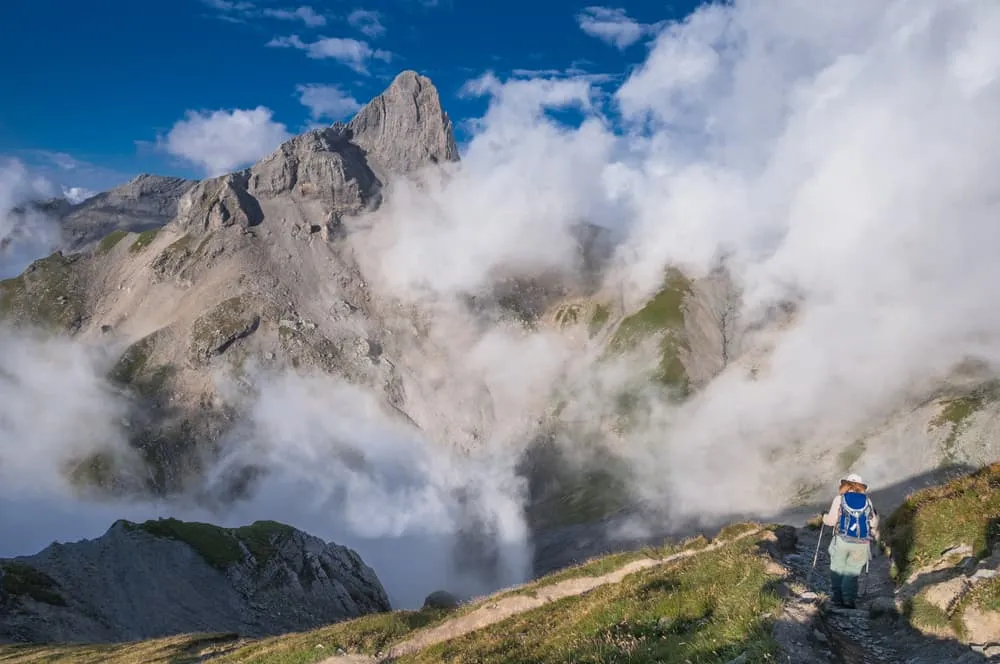
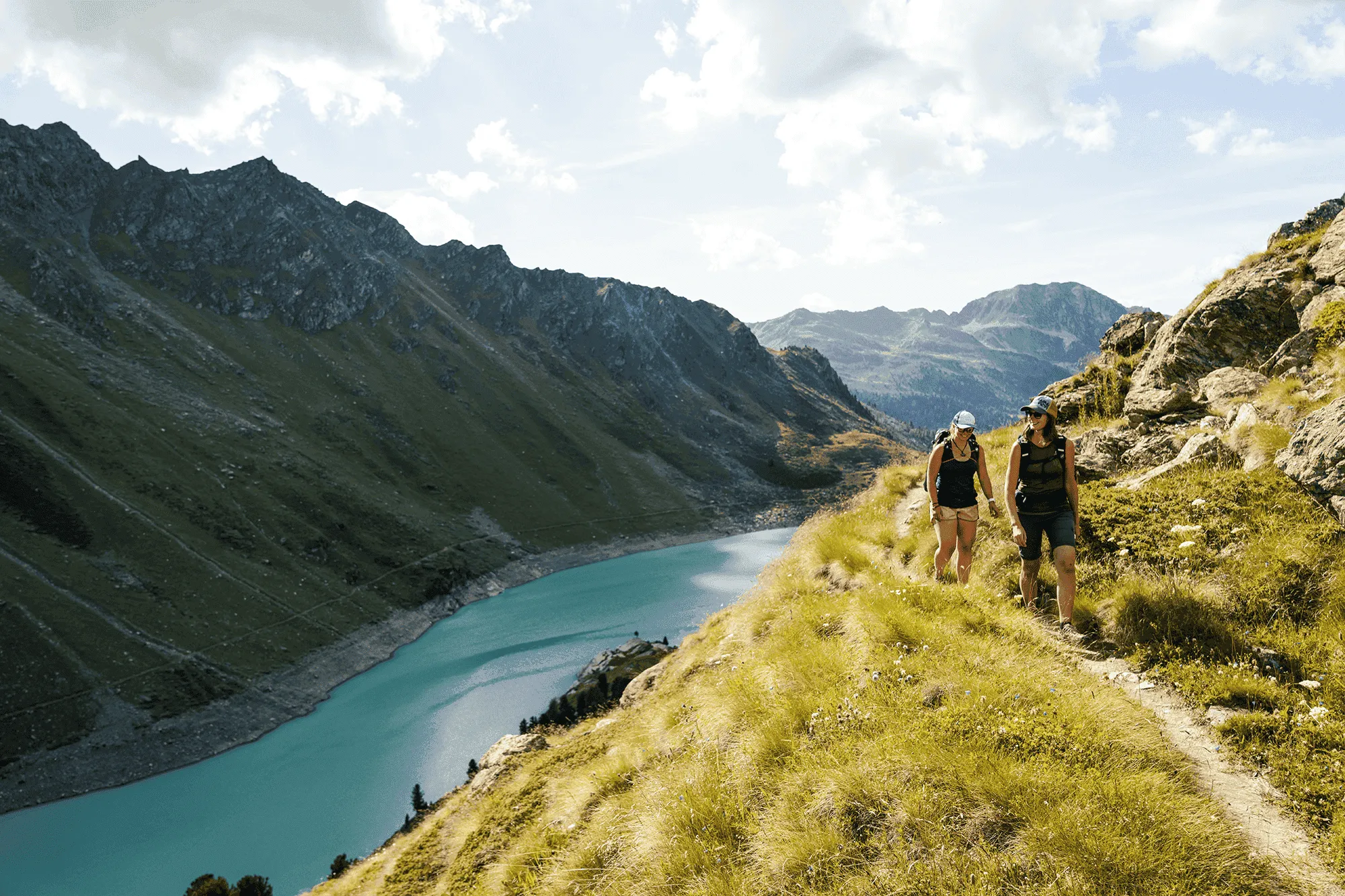
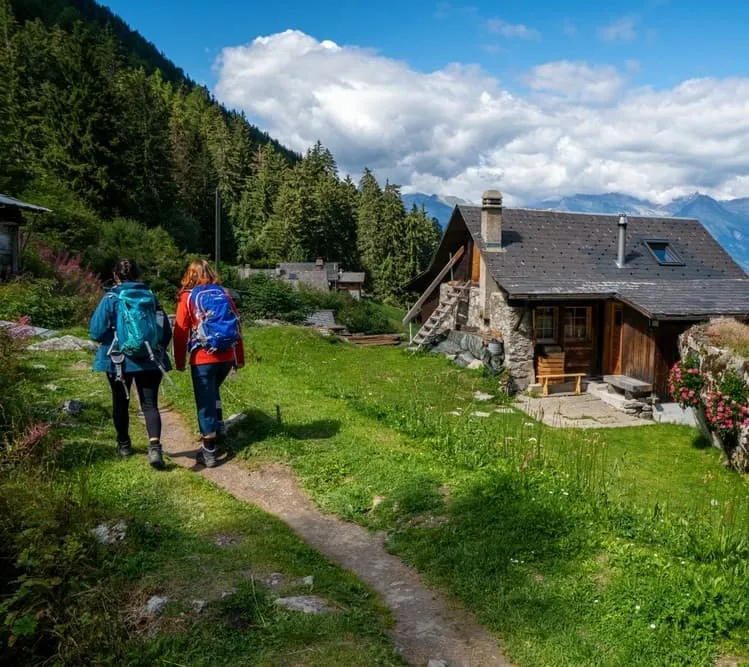
What sets walking in Valais apart from other Alpine regions is the sheer density of walking styles on offer. First, there are high-level balcony routes with cable-car access and four-thousand-metre panoramas, found in this concentration almost nowhere else — above all around Zermatt, Saas-Fee and on the Aletsch plateau. Second, there are hut-to-hut tours crossing passes from valley to valley, where you arrive at a different SAC hut or mountain hotel each evening, far from roads and villages. And third, there are the suonen: centuries-old irrigation channels that once carried glacier meltwater down to the dry vineyards and meadows. Alongside them run near-level paths through larch forest and across rocky flanks, well suited even to leisurely walkers without mountain experience.

For orientation: Upper Valais — Zermatt, Saas-Fee, Aletsch, Leukerbad — is German-speaking. Lower Valais — Nendaz, the Muverans, Martigny, Ovronnaz — is French-speaking. Waymarking is equally good throughout, and anyone wanting to walk in Valais will find routes on both sides that are just as beautiful in German-speaking and French-speaking areas alike. If you have the time and stamina, our hut-to-hut tours link both language regions on a single route.


Visp, Sion or Martigny: which side do you start from?

The Rhône valley is the main axis, and every walking area has its own gateway. Visp is the junction for Zermatt (train via Täsch, since Zermatt itself is car-free) and for Saas-Fee (postbus, also car-free). If you're heading up to the Aletsch plateau, you change in Brig, Mörel, Betten or Fiesch onto cable cars up to Riederalp, Bettmeralp or Fiescheralp — all three plateau villages are car-free. Leuk is the gateway to Leukerbad and the Gemmi. Sion opens the way to Nendaz (postbus and cable car up to Haute-Nendaz). Martigny and Riddes lead into Lower Valais, to Ovronnaz and Derborence, the starting points for our Muverans tours.

If you're travelling from Zurich, Basel or Germany, you'll come via Bern and the Lötschberg tunnel to Visp. From Geneva and Lausanne, the railway line runs straight up the Rhône valley. From there, postbuses and cable cars reach every starting point for our tours, so you can happily leave the car at home.


Walking in Valais: comparing the finest areas

Zermatt and the Matterhorn

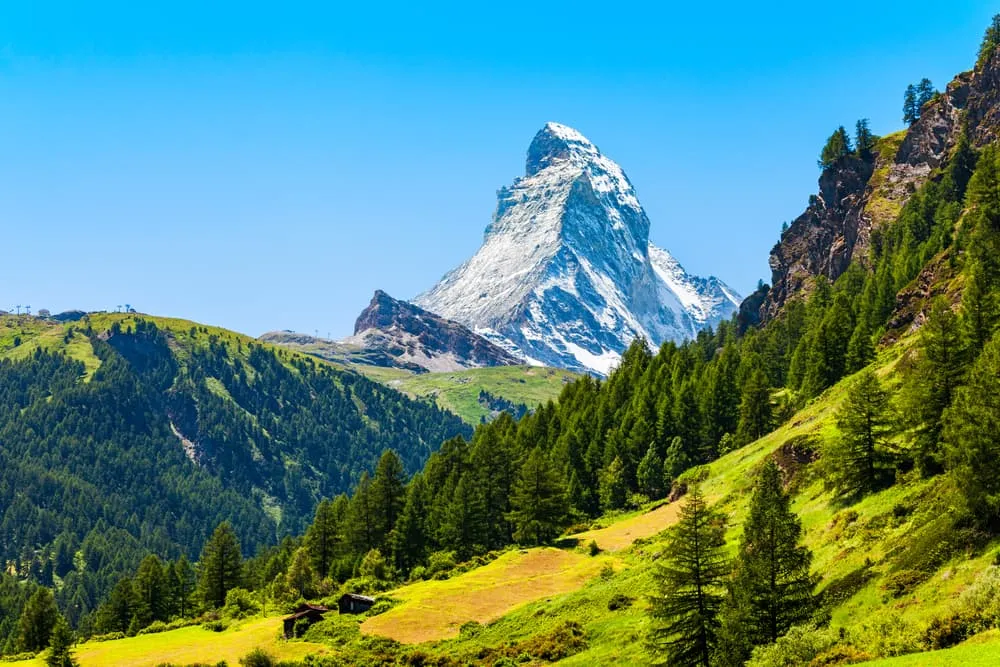
Walking in Zermatt is the classic choice — and deservedly so. The Matterhorn dominates every view, and the infrastructure means you can set off from above 2,500 metres without needing days of preparation. The Five Lakes Walk from Sunnegga is one of the most photographed trails in the Alps: the Matterhorn is mirrored in the Stellisee, Grindjisee and Leisee, each lake with its own character. From the Gornergrat, paths lead back down via the Riffelsee, while the Schwarzsee sits directly below the Hörnli ridge. Climbing up to the Hörnli hut brings you eye to eye with the Matterhorn, on paths fitted with safety cables and metal handholds.

Walking in Zermatt in summer, however, also means a very busy region. If you're after quiet, start early or come in the shoulder season of September. For those who prefer to walk over several days, Zermatt is the dramatic finishing point of the Walker's Haute Route — not the starting point.

Saas-Fee and the Saas valley

Walking in Saas-Fee feels calmer than Zermatt, even though the scenery is comparable: the glacier village sits within a ring of thirteen four-thousand-metre peaks, with ice reaching almost to the village itself. The high route from Saas-Fee to Grächen is one of the most spectacular panoramic trails in Valais, often quieter than the Zermatt classics and offering wide views over the Saas valley and the Mischabel range. Heading further down the valley, you'll find Saas-Almagell and the Mattmark reservoir — walks that work well for families too. Walking in Saas-Fee is particularly good for anyone wanting the four-thousand-metre panorama without the high-season crowds.

Aletsch: the plateau above the largest glacier in the Alps

Riederalp, Bettmeralp and Fiescheralp sit on a plateau with a direct view over the Aletsch Glacier — a UNESCO World Heritage site that winds through the valley like a dark ribbon of ice between white summits. The Aletsch forest, with its centuries-old arolla pines, is a nature experience in its own right. The panoramic trails here are wide, well marked and ideal for families and beginners. If you want to keep going from Aletsch: the Bernese Oberland lies right behind the ridge, and if you continue on from the Great Aletsch Glacier into the Bernese Oberland, you'll find the next stage on our walking in the Bernese Oberland page.

Lower Valais: Nendaz and the Muverans

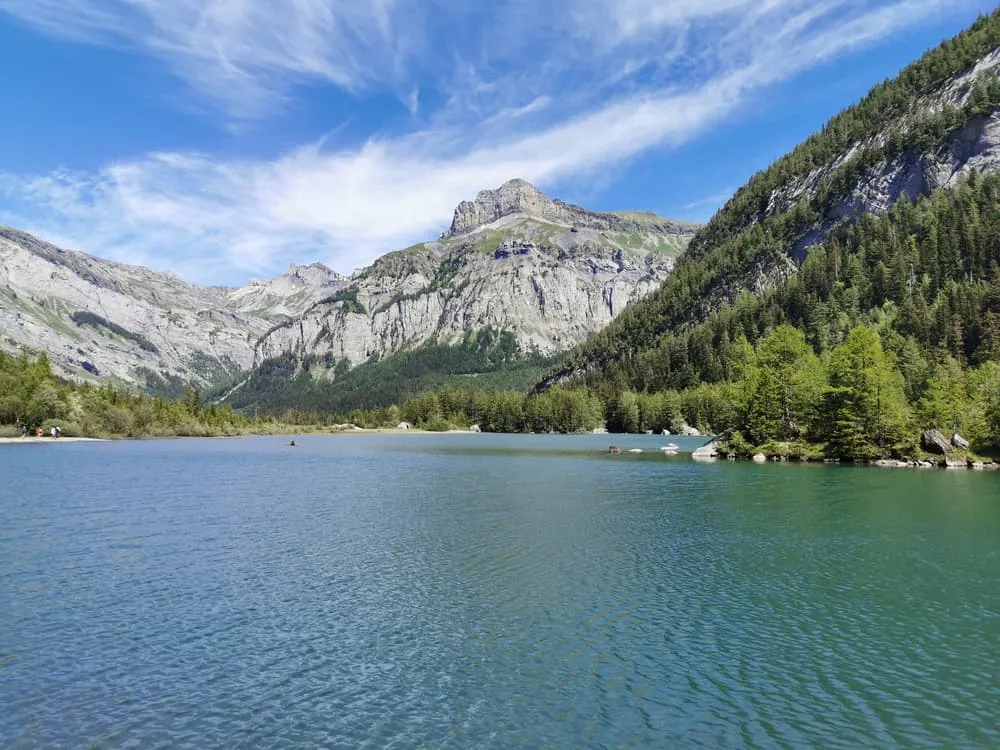
If you want Valais in French, head to Nendaz. Lower Valais is quieter, less well known, and has its own distinct walking offer: the suonen around Nendaz run as near-level paths across rocky flanks and through larch forest, while the Lac de Cleuson sits on a high plateau above the valley. Trekking in Nendaz means hut-to-hut tours over gentle terrain, ideal for a first multi-day experience. Further west, the Muverans massif rises between Valais and Vaud, with Ovronnaz and Derborence as starting points for our more demanding circular tours. To put Lower Valais in context: here you'll find the same Alpine world as in Zermatt, but without the crowds and with a different rhythm.

Leukerbad and the Gemmi

Leukerbad sits beneath sheer rock walls and is the gateway to the Gemmi Pass, one of the historic crossings into the Bernese Oberland. The route across the Daubensee on the Gemmi plateau is one of the most striking pass crossings in Switzerland: almost level on the high plateau, dramatic on the ascent and descent. The Torrent balcony trails above Leukerbad offer leisurely walkers panoramic views without technical difficulty. Leukerbad works well as a complement to a longer Valais week, rather than as a destination on its own.



Hut-to-hut tours in Valais: our multi-day tours by level and valley

A hut-to-hut tour means a different SAC hut or mountain hotel every evening, pre-booked, on a half-board basis, carrying your own rucksack. Huts are booked in advance because they fill up quickly during the season — especially at weekends and in high summer. With Bookatrekking, you book the package; we take care of the reservations.

Beginners and families: Nendaz

The family-friendly short Nendaz walk is the right choice for your first nights in a hut: three days in French-speaking Lower Valais, short stages past suonen and lakes, no exposed sections. For adults without hut experience who want to see a bit more, the long Nendaz trek for beginners is the four-day version of the same region, with gentle stages and more time to take in Lower Valais.

More experienced walkers: the Muverans

The five-day Tour des Muverans is a hut-to-hut circuit around the massif between Valais and Vaud, crossing passes and shifting perspectives along the way. If you have less time but want to experience the same landscape, the short Tour des Muverans for experienced walkers covers it in three days. This version is more demanding, as it packs the same highlights into more compressed stages. All the stages, huts and details are in our Tour des Muverans route blog.

Ambitious walkers: the great Alpine crossing

The five-day eastern Walker's Haute Route is the eastern section of the great Alpine crossing, finishing at the Matterhorn and crossing passes that demand real stamina. If you want to walk the whole route, book the twelve-day complete Walker's Haute Route from Chamonix to Zermatt. The route, stages and all the details are in our Walker's Haute Route route blog. You'll find our full Switzerland range under walking holidays in Switzerland.


The Walker's Haute Route in brief

The Walker's Haute Route links Chamonix at the foot of Mont Blanc with Zermatt at the foot of the Matterhorn, crossing Valais from west to east over a series of high Alpine passes. It's considered one of the great hut-to-hut tours in the Alps, demanding good fitness and mountain experience, though it requires no glacier equipment. Most walkers either tackle the full route over around two weeks, or the eastern section to Zermatt in five days.

The complete stage-by-stage description, with distances, ascents and passes, is in our Walker's Haute Route route blog.


Day walks in Valais: Zermatt, Saas-Fee and the suonen

Not every Valais walking week has to be a hut-to-hut tour. If you're based in one place and walking out day by day, Valais offers as many options as almost anywhere else in the Alps.

The Five Lakes Walk from Sunnegga is the classic among walks in Zermatt: five mountain lakes with Matterhorn reflections, varied terrain, and suitable for older children. The Aletsch panoramic trail over Riederalp and Bettmeralp is wide, well marked, and arguably offers the most impressive glacier view without any technical difficulty. A suone near Nendaz follows a near-level path across rocky flanks and through larch forest — one of the most peaceful walking experiences in Valais. The high route from Saas-Fee to Grächen is more demanding, but rewards you with panoramic views of several four-thousand-metre peaks at once. The Gemmi Pass from Leukerbad links Valais and the Bernese Oberland along a historic route and works as either a day walk or a crossing into the Bernese Oberland. The Schwarzsee below the Matterhorn is accessible as a day or half-day destination even for less experienced walkers.

Walking in Zermatt: Gornergrat and Schwarzsee. Both destinations are quickly reached by train, and you then walk back down into the valley. From the Gornergrat, the path passes the Riffelsee; at the Schwarzsee, you're right below the Hörnli ridge. To be honest, the train dictates the rhythm of the day, and on these classics you'll rarely be alone in high summer. Starting early is worth it, and it's worth checking the cable-car costs on the Zermatt Bergbahnen website beforehand.

Easy walks in Valais: the suonen in Lower Valais, the Aletsch panoramic trail and the lakeside paths around Nendaz are the best options for anyone without mountain experience or walking with a mixed group. The terrain is technically undemanding, yet the views are spectacular all the same.

Walking with children: cable car up, then walk down to a lake is the tried-and-tested Valais family formula. The Leisee above Sunnegga in Zermatt even has a small playground. For your first multi-day step, the family-friendly short Nendaz walk is the right introductory tour.

Walking with a dog: cable cars and huts have their own rules, which you should check directly before your tour — when booking your hut-to-hut tour, let us know that a dog will be joining you. Wildlife protection zones require dogs to be kept on a lead, as do areas with grazing livestock and livestock guardian dogs. Planned routes in our app show you where these protection zones lie.

The finest walks in Valais are spread across every area: the only thing stopping you doing them all at once is usually just limited holiday time.


How hard is walking in Valais — and who is it suited to?

Valais is high mountain terrain, and that's not a warning but simply a fact that shapes your planning. Altitude is the real factor: trails that look short on paper feel much harder when you're starting from 2,500 metres. Acclimatising and taking it slowly on the first day isn't weakness — it's smart strategy.

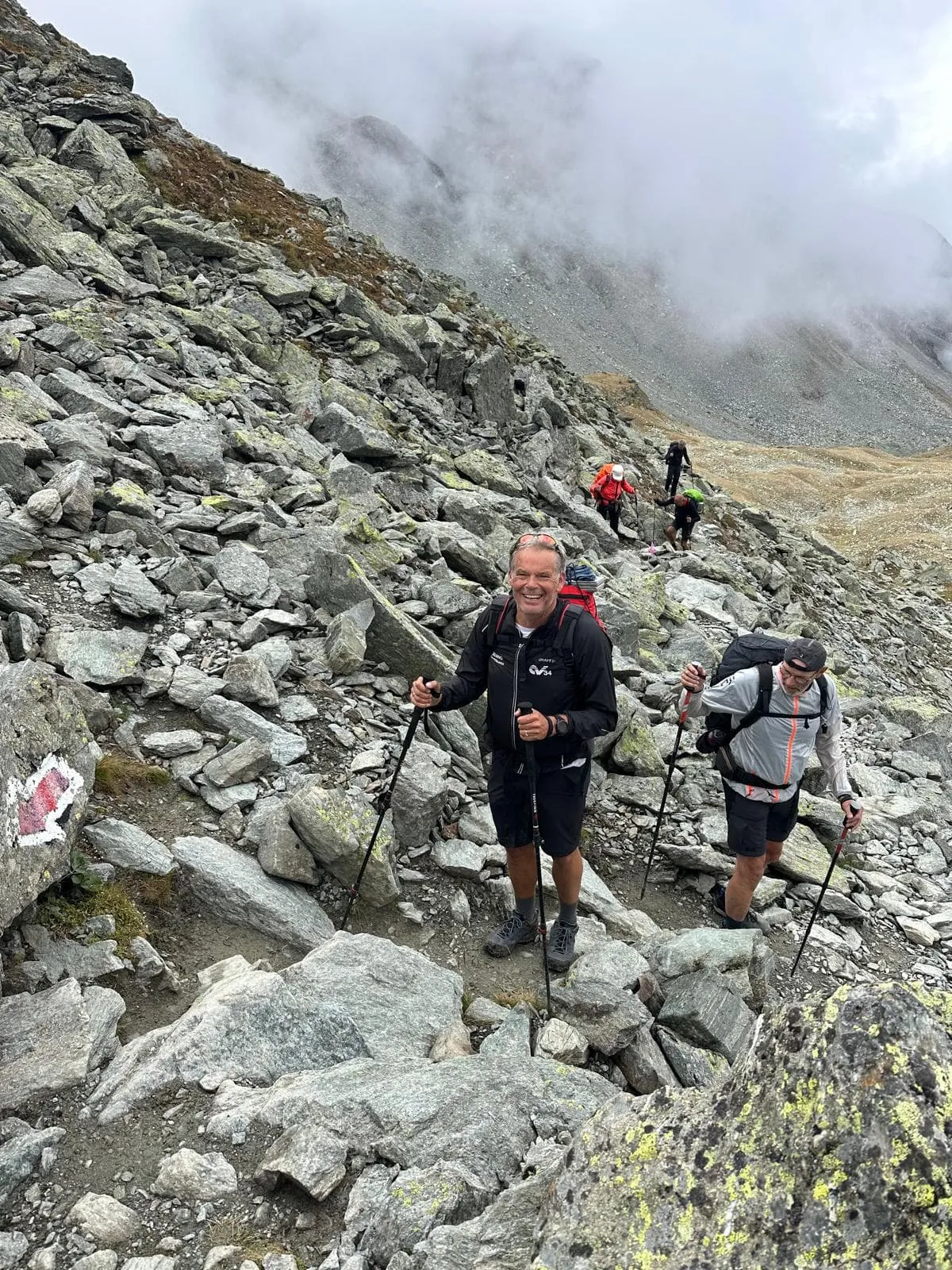
Switzerland's trail categories help with classification. Yellow-marked hiking trails are suitable for everyone, requiring sturdy footwear but no mountain experience — this is where you'll find the suonen, the Aletsch panoramic trail and most valley walks. White-red-white mountain trails require sure-footedness and a head for heights; almost all the high routes and our hut-to-hut tours fall into this category. White-blue-white Alpine routes require climbing technique and aren't relevant to this page.

Genuine pinch points when walking in Valais include exposed sections on high routes (particularly on parts of the Walker's Haute Route), lingering snow on passes into early summer, moraine and glacier forefields on the eastern routes, and trail closures after rockfall or storms, which can occur at short notice. Check current trail closures before setting off, either in the Bookatrekking app or directly with the local tourist office.

Ranking the six tours by difficulty: beginners should start with the family-friendly short Nendaz walk or the long Nendaz trek for beginners. With a bit of mountain experience, move on to the Tour des Muverans or the short Tour des Muverans for experienced walkers. If you're well conditioned and have hut experience, choose the eastern Walker's Haute Route or the complete Walker's Haute Route.

Which high route is best for beginners? The Aletsch panoramic trail and the Nendaz treks are the right answer: yellow-marked or lower-grade mountain trail, little exposure, plenty of views.


Best time to walk in Valais

Spring (April to May): the Rhône valley and the suone paths in Lower Valais are walkable early, and valley temperatures are pleasant. Higher ground is still under snow, cable cars often run a reduced service, and huts haven't yet opened. Too early for hut-to-hut tours, but ideal for valley day walks.

Early summer (June): huts open, usually in the second half of June. Passes can still carry lingering snow, especially on north-facing slopes. The Alpine meadows are in bloom, and Valais is still relatively quiet at this time. A rewarding period for experienced walkers comfortable with old snow.

High summer (July and August): full hut season, all cable cars running, Zermatt and Saas-Fee busy. Walking in Zermatt in summer means some routes are heavily used. Afternoon thunderstorms are typical at this time: start early and aim to be over the pass by midday. Book huts and mountain hotels well in advance.

September: for most people, the best time to walk in Valais. Stable weather, clear long-distance views, less traffic on the trails, and the larches beginning to turn gold. Our hut-to-hut tours are especially recommended at this time. Walking in Zermatt and Saas-Fee in September is also far more rewarding than in high season.

October: golden larch forests and stunning autumn colours — but huts close one by one, cable cars move to reduced schedules, and fresh snow can arrive on the higher passes. Still good for valley day walks.

Our hut-to-hut tours are tied to the hut season; the available dates are listed on each tour's product page. The Bookatrekking app shows you up-to-date weather for each overnight stop — including mountain stations and huts — for the exact coordinates of each accommodation.


Accommodation and luggage transfer in Valais

SAC huts are the backbone of every hut-to-hut tour in Valais. Dormitories rather than private rooms are the norm, and half-board is standard. Bringing your own hut sleeping bag liner saves you the hire fee. Booking ahead is essential: huts fill up quickly at weekends and in high summer. On our tours, we take care of the bookings for you.

On some high routes you'll find mountain hotels and guesthouses, offering more comfort than a hut. In the valley towns — Zermatt, Saas-Fee, Nendaz, Leukerbad — hotels and guesthouses of every category are also available, though Zermatt is in high demand during peak season, so early booking pays off.

Luggage transfer: on a hut-to-hut tour, you carry everything yourself. That's not a drawback but the very nature of the experience — and it makes a light rucksack the single most important gear decision. That's why, on our hut-to-hut tours, you'll want a clear packing list and should leave anything at home that you don't need daily.

Included in the package: our Valais tours include pre-booked accommodation on a half-board or breakfast basis (depending on the tour), the digital route description, and access to the Bookatrekking app. The app provides an offline map, GPX track, up-to-date weather for each overnight stop, and emergency contacts.


Which tour suits you? Walking in Valais by level and time budget

Tour Days Best for Character Book
Family-friendly short Nendaz walk 3 Families, first nights in huts Suonen and lakes in Lower Valais view tour
Long Nendaz trek for beginners 4 First hut-to-hut tour, no experience needed Peaceful Lower Valais, gentle stages view tour
Tour des Muverans 5 Experienced mountain walkers Hut circuit around a massif, passes view tour
Short Tour des Muverans, experienced 3 Experienced walkers with less time Same circuit, compressed view tour
Eastern Walker's Haute Route 5 Ambitious walkers with good fitness Passes and high routes to Zermatt view tour
Complete Walker's Haute Route 12 Those wanting the full Alpine crossing From Chamonix to Zermatt view tour

Current prices, dates and inclusions are listed on the relevant product page.

Choosing your tour: with children, or for your first hut-to-hut tour, Nendaz is the right choice — flatter stages, less exposure, and the suonen are an experience in their own right. Anyone with mountain experience and five days to spare will be happy with the Muverans circuit; if you want to experience the same region in three days, choose the short version. The great tour finishing dramatically at the Matterhorn demands fitness: the five-day eastern section is the focused introduction, while the twelve-day complete route is the full Alpine crossing. If you're only planning day walks, base yourself in Zermatt, Saas-Fee or on the Bettmeralp. If you want somewhere further afield and gentler, the Engadine is a good alternative.

Swiss trail signposts are reliable, and the yellow-white-red posts guide you even without mobile signal. On top of that, the GPX track and offline map in our app give you a second point of reference on every stage. You'll find our full Switzerland range on the overview for walking holidays in Switzerland.


Frequently asked questions about walking in Valais

  • Which walk in Zermatt is the most beautiful?

    The Five Lakes Walk is considered the most beautiful walk in Zermatt: it links five mountain lakes, three of which reflect the Matterhorn. If you want to see the Matterhorn up close, choose the route from the Gornergrat via the Riffelsee, or climb up to the Schwarzsee. All three routes are well marked and start with a cable car.

  • When is the best time to walk in Zermatt?

    The best time to walk in Zermatt is from July to September. Walking in Zermatt in summer means full infrastructure, but also a lot of traffic on the classic routes. September is the quietest and often most stable period: the high routes are free of snow, the cable cars are still running, and the huts have space.

  • Which walk in Saas-Fee is the most beautiful?

    The most beautiful walk in Saas-Fee is the high route to Grächen: it runs through the ring of four-thousand-metre peaks, offering uninterrupted panoramic views of glaciers and summits, and is quieter than the Zermatt classics. Alternatively, the panoramic trails directly above the glacier village are worth it for a compact Saas-Fee day.

  • Which are the finest walks in Valais?

    The finest walks in Valais are spread across every area: the Five Lakes Walk in Zermatt, the high route from Saas-Fee to Grächen, the Aletsch panoramic trail over Riederalp, a suone near Nendaz, and the Gemmi Pass from Leukerbad. If you want to cross Valais entirely, you'll find the complete description in our Walker's Haute Route route blog.

  • Are there any easy walks in Valais?

    The easiest walks in Valais are along the suonen: centuries-old irrigation paths that run almost level across rocky flanks and through larch forest, particularly lovely near Nendaz. The Aletsch panoramic trail and the lakeside paths near Nendaz are also technically undemanding. The family-friendly short Nendaz walk is a fitting multi-day option.

  • Which high route is suitable for beginners?

    The Aletsch panoramic trail over Riederalp and Bettmeralp is the best high route for beginners in Valais: yellow-marked, wide, no exposed sections, yet with a glacier view that's hard to match. The Nendaz treks — especially the long Nendaz trek for beginners — are the ideal introduction to multi-day hut-to-hut tours.

  • Are there any insider tips for walking in Zermatt?

    Starting early is the most important tip: before nine o'clock, you'll have the Five Lakes Walk almost to yourself. Taking the train up and walking down is often more rewarding than the circular route. Choosing September will find Zermatt noticeably quieter than in August. And if you're really after peace and quiet, head to Lower Valais — the same mountain world awaits there, without the crowds.

  • Where is the most beautiful part of Valais?

    That depends on what you're after: Zermatt is unbeatable for the Matterhorn panorama, Lower Valais is a convincing choice for peace and quiet and first hut-to-hut tours, and Aletsch offers a glacier view you won't forget. The Muverans region combines both in one. Details of the Muverans circuit are in our Tour des Muverans route blog.


    Valais is big enough for many trips, and varied enough that each one is different. If you want to see everything Switzerland has to offer for walking at a glance, you'll find it on the overview for walking holidays in Switzerland. If you're continuing on from Valais over the Gemmi, or from Aletsch into the Bernese Oberland, you'll find the next step on our walking in the Bernese Oberland page. And if you fancy somewhere quieter and further afield, the Engadine awaits as a gentler alternative on the other side of Switzerland.

Packing List for the Walkers Haute Route

It doesn't matter where you are trekking or for how long: carrying the right equipment with you is paramount. For a hiking trip in the mountains, a good is backpack essential. Its size will depend on how many days you will be spending in the mountains, the season, and the clothes you will be taking with you. We have prepared a packing list with some essential clothing that you should include and some extras that you may find useful:
  • Essentials

  • Extras

Safe Hiking Tips for the Walkers Haute Route

When hiking, it is wise to be aware of a few points. Even if this is not your first time, you should never underestimate the mountains. Good tour planning and compliance with the regulations in the mountains will significantly increase safety. To ensure that your hiking adventure is a safe and enjoyable experience, here below you can find a list of 8 recommendations for safe hiking in the mountains:
  • Know your limits

    Hiking the Walkers Haute Route is the perfect outlet to escape from daily life. It is an endurance sport along with a beautiful nature experience with a positive effect on body and mind —as long as one is in good shape and has a realistic picture of one's possibilities and limits—. Never overestimate yourself or underestimate the route. Don't overdo it! Always choose the slower option and take more time for your plans. Hiking under time pressure is not fun and at too fast a pace it can be dangerous. Be wise!

  • Plan carefully

    Good planning is half the work! Hiking maps, literature, the Internet and expert advice are invaluable when planning the route of the Walkers Haute Route and enable you to determine the length, altitude difference, difficulty and conditions of the hike. When planning group treks, the itinerary should always be planned for the weakest member of the group! The weather in the mountains can change incredibly quickly and rain, wind and cold all increase the risk factor. For this reason, always check the weather forecast beforehand and contact our trekking experts to find your way before you start.

  • Be fully equipped

    Equipment is everything. In the most extreme case, it makes the difference between life and death, and in any case, it definitely makes the difference between having fun and having a bad time. Food and water, sunscreen and waterproof and warm clothes must always be in your backpack, as well as a first aid kit and a mobile phone with a full battery (in case there is an emergency). However, packing light makes hiking easier, so don't take too much extra luggage with you. Your equipment should always be suitable for the terrain you'll be hiking on in the Walkers Haute Route.

  • Wear suitable footwear

    Good walking shoes protect your feet and provide a better fit. Shoes with a good fit, with non-slip soles, water-resistant and lightweight are a must for additional walking pleasure during the Walkers Haute Route. Trail running shoes are great for a weekend in the mountains, but on longer hikes or more technical trails, you'll want at least A/B hiking boots. That means it is recommended wearing high mountain shoes that are water-repellent with extra ankle support to prevent sprains.

  • Stay on marked trails

    Walkers Haute Route has endless marked hiking trails, which are controlled and maintained and should not be deviated from. It may be tempting, but it's not a good idea to take shortcuts or alternative routes through unmarked terrain. It increases the risk of disorientation and you're more likely to get lost and have accidents or fall in the mountains. Even steep slopes of packed old snow are often underestimated and dangerous. Are you in doubt? Better don't do it. For easy navigation we work with our trusted partner Komoot, whose interactive maps, also available offline, provide you with the necessary digital means to get from A to B. As a backup, make sure to bring a hiking guide or a paper map with you. FYI, 75% of stumbles occur due to carelessness on marked paths or roads, not in open terrain!

  • Take regular breaks

    Remember you're on a hiking trip. Timely and regular breaks not only provide welcome relaxation but also make it possible to enjoy the Walkers Haute Route. The body needs a regular food and drink intake to maintain performance and concentration. Our advice is that if you have little time, it's better to follow the short itinerary than to speed up the long one.

  • Stay reachable

    If you are hiking solo or in small groups it is advisable to inform people back home about your plans, what route you are taking and when you plan to return. Even small incidents can lead to unpleasant emergencies so make sure you are available at all times. Bring a charged phone containing at least the phone numbers of immediate family members, your accommodations en route and the emergency phone numbers operating on the Walkers Haute Route.

  • Respect nature

    Leave no rubbish behind, prevent noise, stay on the marked trails, do not disturb wildlife or grazing animals, and respect protected areas.

Where Can I Book the Walkers Haute Route?

At Bookatrekking.com you can book the self-guided Walkers Haute Route and many other treks. We take care of all the details for you, including arranging accommodations and providing you with relevant information well in advance of your trek. Find our offers here. Our easy-to-use platform allows you to browse and compare different trekking options and to find the perfect fit for your interests, abilities, and budget.

If you have any questions about a specific trek or need help choosing the right one for you, our team of trekking experts is here to assist you. Simply reach out to us and we will be happy to provide you with personalized recommendations and advice to help you plan the trekking adventure of a lifetime.

About Us

At Bookatrekking.com, you will find the trek that will make your life unforgettable. Whether you want to explore the Inca Trail or climb Kilimanjaro. Bookatrekking.com has a wide and varied range of first-class treks. No false promises are made here. Transparent prices and bookings are fixed instantly. Find, compare, book and trek!
Read more about us
About Us
About Us