Seceda Ridgeline: How to Get There, Best Hikes and When to Go

Sierd van der Bij
Sierd van der Bij
Sierd van der Bij
04 Oct 2026 • 9 min read
Seceda Ridgeline: How to Get There, Best Hikes and When to Go
Trekking experts per destination
Free cancellation up to eight weeks in advance
Quick personal advice

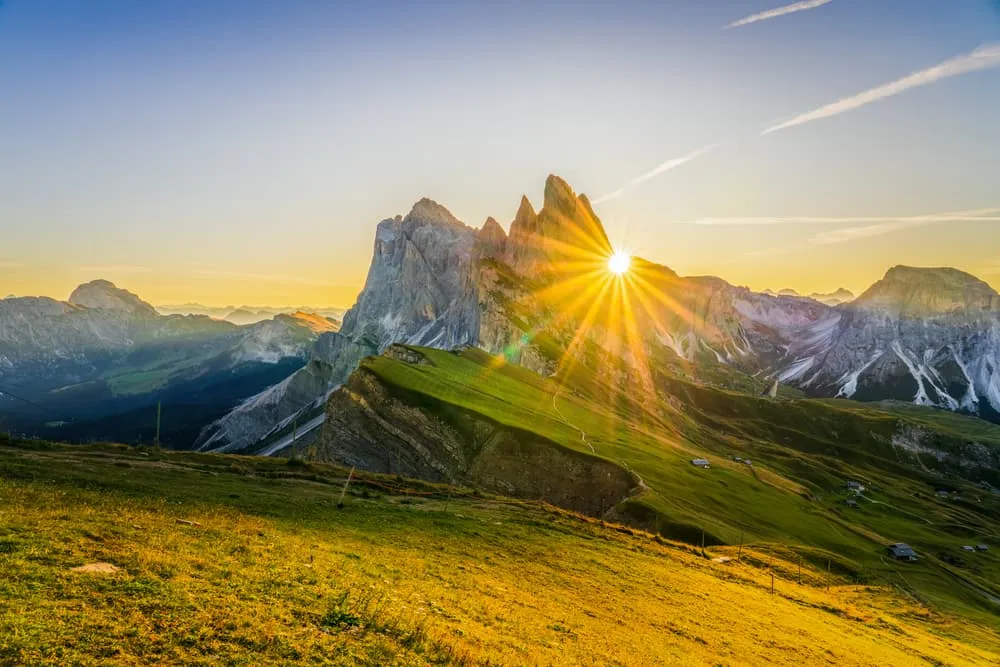
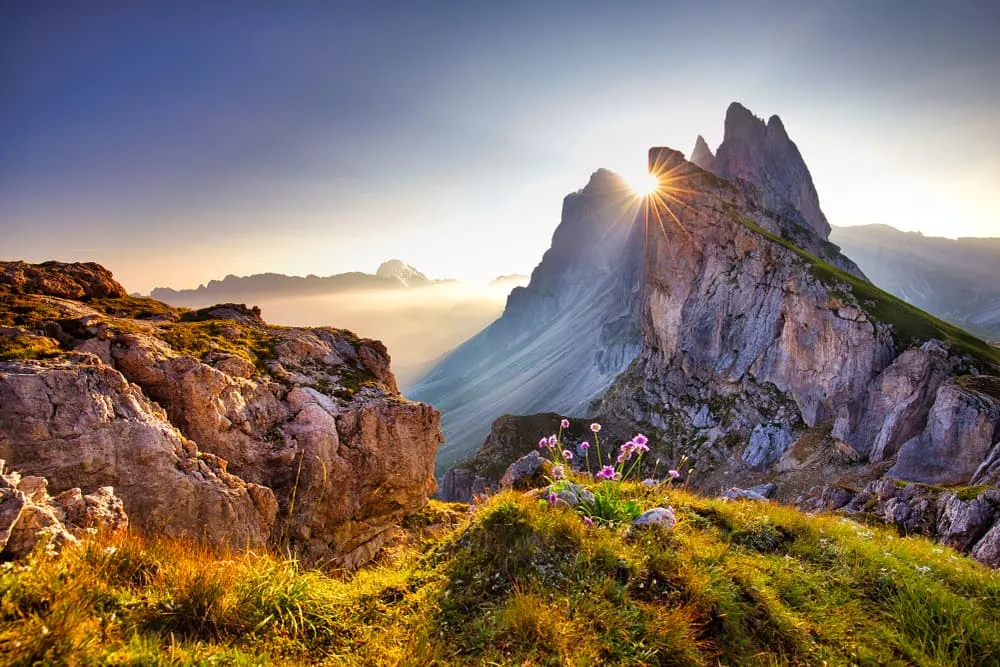
Seceda in the Dolomites is the ridge from the photograph you have probably seen: a bright green slope dropping sharply away, the jagged Odle spires rising behind it. This guide answers the practical questions before you go. Cable car or on foot? What does it cost? When should you visit? Which walk should you do once you are up there? And is it worth staying the night in a mountain hut instead of squeezing it into a day trip? All prices and opening times in this guide come from the operator and apply to summer 2026; 2027 figures have not been published yet, so check the operator's website before you travel.

Where is Seceda and is it worth it?

Seceda (2,519 m) sits on the sunny side of Val Gardena (German: Gröden), directly above the town of Ortisei (German: St. Ulrich, Ladin: Urtijëi), at the foot of the Odle (Geisler) peaks in South Tyrol, northern Italy. Near the summit cross a viewpoint with a panorama board has stood since 2007; the view reaches across the Sassolungo, the Sella and the Marmolada to the Ötztal and Stubai Alps and the Großglockner. The famous image is the sloping grassy ridge breaking off in front of the jagged Fermeda towers and the Odle spires.

Is it worth it? Yes, for the views and the easy walking at the top. Be honest with yourself about what to expect, though. In July and August the summit area is busy from mid-morning onwards. The return cable car ticket costs 74 euros for an adult in summer 2026. And in 2025, and again in June 2026, there was a turnstile on the most direct path to the ridge (more on that below). If you want quieter conditions, take the first cable car of the day, walk a loop away from the summit cross, or stay overnight in a hut and arrive on foot before the cable cars start running.

Why is Seceda so famous? In 2017 Apple showed photographs of Seceda and the Odle at its developer conference in San José, one of them during the launch of the new iMac. Millions of people followed the livestream, and every year since, thousands of visitors have come specifically to photograph that view. Source: operator seceda.it.

Seceda, the Odle peaks and Puez-Odle Nature Park

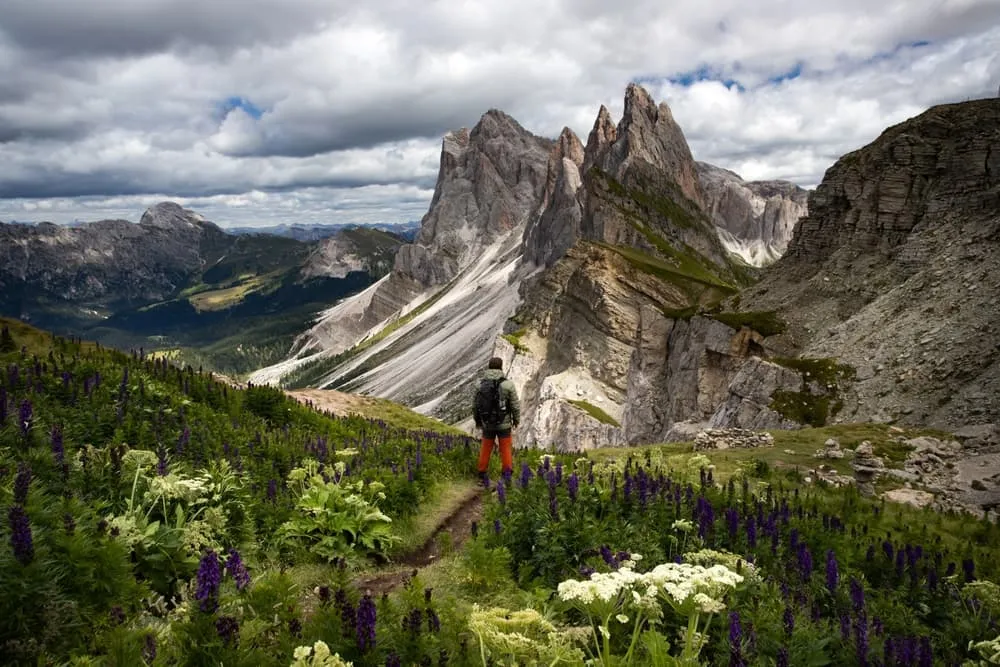
The Odle group forms the dramatic backdrop you see in every Seceda photograph: a row of jagged dolomite spires directly behind the ridge. The whole area, including Seceda, falls within the Puez-Odle Nature Park, established in 1978 and part of the Dolomites UNESCO World Heritage Site. Two well-known mountain huts sit inside the park: Rifugio Firenze (German: Regensburger Hütte) and Rifugio Puez. Both can be reached on foot from the Seceda side. The nature park has rules designed to protect the meadows and the rock faces: stay on marked paths and carry your litter back down. The meadows at Seceda are working alpine pastures, not a photo set, and eroded tracks are a real problem during peak season.

For readers who want to combine Seceda with other parts of the region, our guide to hiking in South Tyrol covers the wider area.

Where is Seceda and is it worth it?

How to get to Seceda: cable car from Ortisei or hike up

Most visitors take the Seceda cable car from Ortisei in two sections via Furnes; the alternatives are the Col Raiser gondola from Santa Cristina or the climb on foot from the valley. Here is how each option works.

Getting to Ortisei: Ortisei lies in Val Gardena in South Tyrol. The operator recommends arriving by public transport because parking in Ortisei is limited. From the Piazza S. Antonio bus stop in the centre it is a 6-minute walk via the "La Curta" pedestrian link to the valley station of the cable car.

Seceda cable car: prices and opening hours

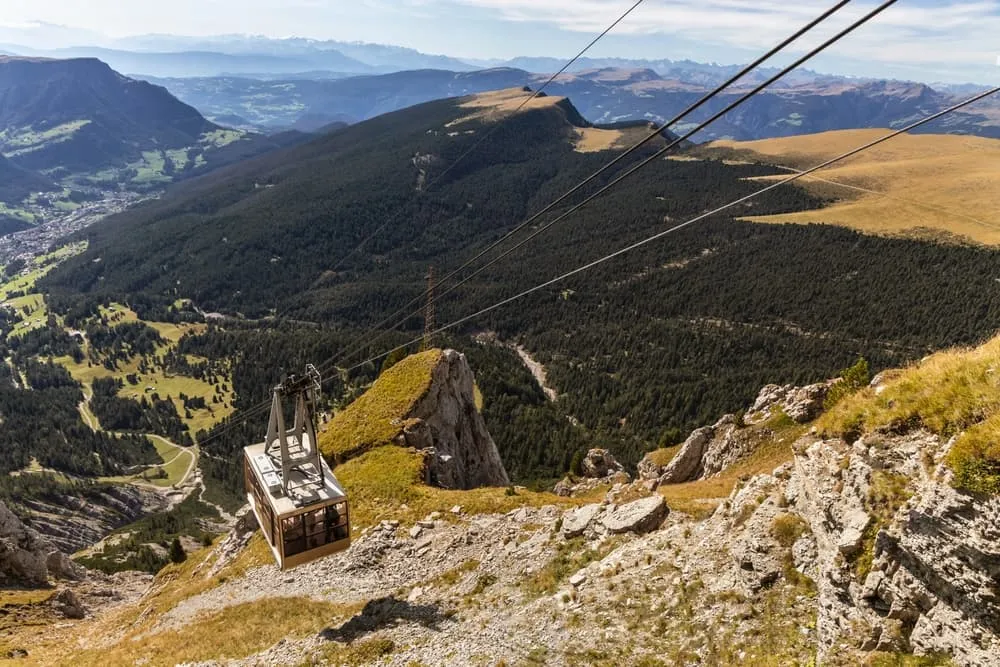
The Seceda cable car (Seilbahnen Seceda AG) runs in two sections: Ortisei to Furnes (2,500 m long, 450 m vertical rise) and Furnes to Seceda (2,050 m long, a further 700 m vertical). The combined lift covers 1,150 metres of altitude gain.

Ticket Adults Juniors (8-15)
Return (Ortisei–Seceda–Ortisei) 74 euros 37 euros
One way up 49 euros 25 euros
One way down 49 euros 25 euros

Children up to 7 years old travel free with a paying adult. Dogs and bicycles are charged at 7 euros each. The Dolomiti Supersummer pass is not valid on these lifts. The Gardena Card (3 days: 124 euros for adults; 6 days: 160 euros for adults, valid 6 June to 11 October 2026) does cover the Seceda cable car. The operator recommends buying your ticket online in advance. In summer 2026 the cable car runs from 22 May to 2 November, daily 8:30 am to 5:30 pm. These are summer 2026 figures; check 2027 prices and times with the operator before you go.

Col Raiser: the other lift towards Seceda

A cheaper alternative to the main Seceda cable car is the Col Raiser gondola from Santa Cristina (a village further up Val Gardena from Ortisei). In summer 2026, adult tickets cost 23 euros one way or 34 euros return, according to val-gardena.com as of October 2026. The gondola brings you up to the Col Raiser pastures at around 2,100 metres, from where you walk the rest of the way.

The standard loop from the Col Raiser top station takes you past Rifugio Firenze (Regensburger Hütte) and the Troier hut to the Seceda summit cross and back: 9.7 km, roughly 3 hours 20 minutes, with 484 metres of ascent and descent (source: valgardena-groeden.com). You cover more ground than arriving directly by the Seceda cable car, but you pay significantly less and you approach the ridge on foot, which changes the experience. Bear in mind you still need transport between Ortisei and Santa Cristina if you are not staying in Santa Cristina itself.

Can you hike Seceda without the cable car?

Yes. From Ortisei it is possible to walk all the way to the Seceda ridgeline without taking any lift. The climb from the valley involves more than 1,100 vertical metres, making it a long and demanding day. The main reason to do it is sunrise: the first cable car in summer 2026 leaves at 8:30 am, so walking up is the only way to be on the ridge at first light. Many hikers choose a middle ground: ride the cable car up and walk back down to Ortisei, which takes about 2.5 hours and is considerably easier on the legs than the ascent.

The Seceda turnstile and the free path

In 2025 landowners first put up a turnstile on a private stretch of the most direct path to the Seceda ridge. In June 2026 the turnstile was in place and walking through cost approximately 5 euros. The farmers introduced the charge to draw attention to the effects of heavy footfall: eroded meadows, litter and disturbance to working pasture. The province of Bolzano was examining whether the measure was legally permitted in 2026. A free alternative path exists; it is slightly longer and steeper than the main route. We cannot predict whether the turnstile will be there in 2027, so check before you go.

How to get to Seceda: cable car from Ortisei or hike up

When to visit Seceda: best season and time of day

The Seceda cable car runs in summer between late May and early November, and that is the season for a Seceda hike in the Dolomites. June and September are noticeably quieter than July and August, when the summit area fills up from mid-morning. If you are planning a hut-to-hut trek with nights in rifugios, aim for mid-June to mid-September, when the huts are fully open.

Time of day matters more at Seceda than at most Dolomites viewpoints. The first cable car of the day in summer 2026 leaves at 8:30 am; being on the ridge shortly after opening means fewer people around you. Alternatively, coming later in the afternoon as day visitors begin to head back down can also give you more space. Late morning in midsummer is the busiest time at the summit cross.

Weather: Seceda is at altitude, and the Odle spires are only spectacular when the sky is clear. If cloud is sitting on the ridge, the walk loses most of its appeal. Check the operator's webcam and the weather forecast for the specific elevation of Seceda before you leave the valley; on most of our treks the Bookatrekking app also shows the weather per hut. Take afternoon thunderstorms seriously: they arrive quickly in summer and the exposed ridgeline offers no shelter.

In winter, Seceda becomes part of the Val Gardena ski area. The La Longia run descends roughly 10 km from Seceda to Ortisei. It is a ski destination in winter, not a hiking one.

If you are planning more than a single day at Seceda and want to combine it with a multi-day route through the Dolomites, our hut-to-hut hiking in the Dolomites overview shows the full range of options.

When to visit Seceda: best season and time of day

Seceda hikes: from the ridgeline walk to a hut-to-hut trek

At the top of the Seceda cable car you have several choices: a short walk to the viewpoint and back, one of the official loops from the top station, the longer loop from Col Raiser, or a two-day hut-to-hut trek that brings you to the ridge on foot with a night in the mountains behind you. Here is how they break down.

The Seceda ridgeline walk and the Pieralongia loop

From the Seceda cable car top station, the summit cross and the Seceda viewpoint are a few minutes' walk away. That is enough for the photograph. For something more substantial, the operator lays out two official walks from the top station.

The Seceda–Pieralongia–Odles walk (5.8 km, about 1.5 hours, easy) follows the ridgeline to the viewpoint, then descends to the Pieralongia hut, which sits beneath two striking "stone teeth" after about 45 minutes. The path continues past the World Heritage Terrace at 2,200 metres and down to the family-run Odles hut, which has a small playground, before reaching the valley station of the Fermeda chairlift.

The shorter Troier hut and Fermeda loop (4.2 km, about 1 hour, easy) heads from the top station past the Troier hut and a small mountain lake called Lech da Iman to the Fermeda hut, from where it is 15 minutes to the Fermeda chairlift.

Both loops are designed to finish at the Fermeda chairlift, which was closed in summer 2026 according to the operator. If it remains closed, you need to plan your return: either retrace your steps to the Seceda top station, descend to Ortisei on foot (about 2.5 hours), or cross to the Col Raiser gondola at Santa Cristina. Check whether the Fermeda chairlift is running before you set out.

Where to eat: along these walks you pass several huts the operator lists, including the Troier hut, the Fermeda hut, the Pieralongia hut and the family-run Odles hut, which cooks mainly with produce from its own farm. Lunch is not included on our treks, so plan to stop at one of them. For experienced climbers the operator also points to via ferratas and climbing routes around Seceda; those are outside the scope of this guide.

Stay the night instead of a day trip: Spending a night in a mountain hut changes the Seceda experience entirely. The day visitors take the last cable car down, the light on the Odle peaks shifts from harsh midday glare to something slower and warmer, and you arrive on foot across the pastures rather than stepping out of a gondola. Rifugio Firenze and Rifugio Puez are both reachable from the Seceda side and give you that experience.

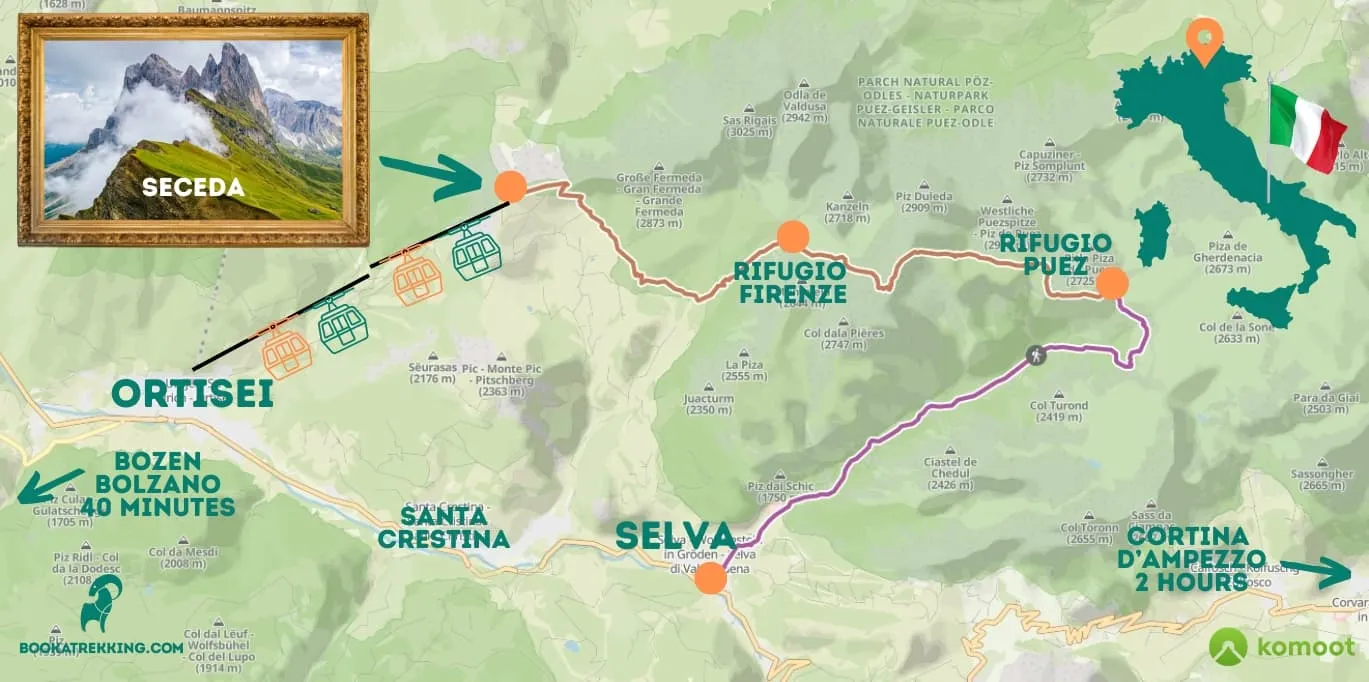
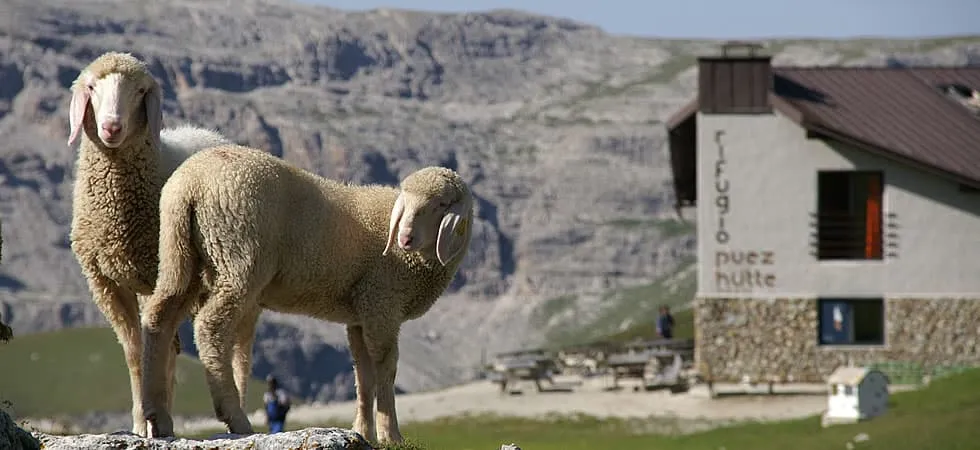
The Seceda Mini-Trek turns a Seceda visit into a proper mountain trip. It runs over two days, covering 20.1 km in total. On day one you walk from Selva (Sëlva, German: Wolkenstein) up through the Vallunga valley to Rifugio Puez, 8.8 km with 900 metres of ascent, taking around 4.5 hours. Rifugio Puez (2,475 m) was built by the Alpenverein in 1889, can only be reached on foot, and sits on the route of the Alta Via 2. On day two you walk from Rifugio Puez via Rifugio Firenze to Seceda, 11.3 km with 650 metres of ascent, roughly 5 hours 50 minutes of walking; from Rifugio Firenze it is about a further 4 km to the Seceda top. From there you take the cable car down, or walk about 2.5 hours to Ortisei, and take the bus back to Selva. What is included: one hut night with half board (dinner and breakfast), hut booked by Bookatrekking (normally a dormitory; private room available on request for 75 euros extra per room per night), daily route descriptions and the Bookatrekking app with the route on the map, your GPS position, elevation profile, offline maps and your booking information. Not included: travel to Selva, lunches, the cable car down from Seceda, the approximately 5 euros on the private path if the turnstile is in place, and travel insurance. The Seceda Mini-Trek starts from 160 euros per person for two people.

Our treks at Seceda:

Trek Days Distance Seceda on the route From (2 people)
Seceda Mini-Trek 2 20.1 km Finishes at Seceda 160 euros pp
Short Alta Via 2 – Alternative Route 3 31.6 km Day 2 across the Seceda pastures 270 euros pp
Half Alta Via 2 – Alternative Route 6 72 km Day 2 across the Seceda pastures 655 euros pp
Dolomiti Highlights Trek 3 38.8 km Views of Seceda; finishes in Ortisei 290 euros pp
4-Day Dolomiti Highlights Trek 4 47.7 km As the 3-day trek 420 euros pp

The Short Alta Via 2 on the alternative route takes three days (31.6 km) from Laion (Lajen) via Rifugio Resciesa to Rifugio Firenze on day two, crossing the Seceda pastures past the Fermeda hut, and then on to Passo Gardena. The Half Alta Via 2 on the alternative route follows the same first two days, then continues for six days in total via Rifugio Pisciadù and the Marmolada to Passo San Pellegrino (72 km). The Dolomiti Highlights Trek walks three days (38.8 km) from Bressanone (Brixen) through the Puez-Odle Nature Park to Ortisei, where the Seceda cable car station is located. The 4-Day Dolomiti Highlights Trek adds an extra first day from Bressanone to Rifugio Plose (47.7 km total). All treks have a start date of your choice and free cancellation up to eight weeks before departure; current availability is shown on each product page.

Is Seceda a difficult hike?

The walks from the cable car top station, including the Pieralongia loop (5.8 km, about 1.5 hours) and the Troier hut loop (4.2 km, about 1 hour), are graded easy and suitable for most walkers, including families with children. Hiking up from Ortisei without the cable car involves more than 1,100 vertical metres and is a demanding undertaking that requires good fitness and a full day.

What is the best hike at Seceda?

For a short visit, the official Pieralongia loop from the top station (5.8 km, about 1.5 hours, easy) takes you past the viewpoint and the Pieralongia hut in comfortable time. For a full day, the loop from Col Raiser via Rifugio Firenze to the summit cross and back (9.7 km, about 3 hours 20 minutes) rewards the extra walking with a more gradual approach. For an overnight trip, the Seceda Mini-Trek from Selva via Rifugio Puez is the option that puts the ridge in its proper mountain context.

Is it possible to hike Seceda without taking the cable car?

Yes, from Ortisei you can walk the full ascent without using any lift. The climb covers more than 1,100 vertical metres and is the only way to reach the ridge before the first cable car at 8:30 am (summer 2026), making it the route for anyone who wants to be there at sunrise. A practical middle ground is to take the cable car up and walk the descent to Ortisei, which takes about 2.5 hours. The Col Raiser gondola from Santa Cristina is a third option: it reduces the ascent while still giving you a walk across the pastures.

How much is the Seceda cable car?

In summer 2026 a return ticket from Ortisei to Seceda costs 74 euros for adults and 37 euros for juniors aged 8 to 15; children up to 7 travel free with a paying adult. A one-way ticket (up or down) is 49 euros for adults and 25 euros for juniors. Dogs and bicycles are charged at 7 euros each. The Gardena Card covers the lifts; the Dolomiti Supersummer pass does not. These are summer 2026 prices according to the operator; check 2027 prices on the operator's website before you visit.

Do I need to pre-book the Seceda cable car?

The operator recommends buying your ticket online in advance and arriving by public transport, because parking in Ortisei is limited in summer. Buying ahead makes for a smoother start to the day, particularly if you are aiming for the first cable car at 8:30 am (summer 2026).

How long does it take to hike the Seceda ridgeline?

From the cable car top station, the summit cross and viewpoint are just a few minutes' walk. The official Pieralongia loop (5.8 km) takes about 1.5 hours from the top station. The Troier hut and Fermeda loop (4.2 km) takes about 1 hour. The full Col Raiser loop, starting and finishing at the Col Raiser gondola top station, covers 9.7 km in about 3 hours 20 minutes with 484 metres of ascent and descent.

Can you walk from Col Raiser to Seceda?

Yes. The loop from the Col Raiser gondola top station (above Santa Cristina) via Rifugio Firenze and the Troier hut to the Seceda summit cross is 9.7 km long, takes about 3 hours 20 minutes and involves 484 metres of ascent and descent. It is a practical option for anyone who wants to approach Seceda on foot across the pastures without the cost of the direct cable car from Ortisei (34 euros return from Col Raiser versus 74 euros return from Ortisei in summer 2026).

Why is Seceda so famous?

Because of the view: the grassy ridge breaking off in front of the Odle spires. In 2017 Apple showed photos of Seceda and the Odle at its developer conference in San José, one of them as the backdrop for the launch of the new iMac, and millions of people followed the livestream. Since then thousands of visitors come every year to photograph exactly that view (source: operator seceda.it).


Seceda hikes: from the ridgeline walk to a hut-to-hut trek

For Overnighters: Seceda Mini-Hut-to-Hut Trek

If you want to make more of your trip to Seceda and turn it into a mini hut-to-hut trek which includes a night at the famous Rifugio Puez, then we have you covered. This trek starts at Sëlva, a small village just down the road from Ortisei. It is the highest village in Val Gardena and it has a lot of Ladin speakers. This is the old Rhaeto-Romanic language that dominates in this side of South-Tyrol. On this mini hut-to-hut trek you get a glimpse of the legendary Alta Via 2 hiking route.
Day
1

Sëlva - Rifugio Puez

Duration: 04:30 h
Distance: 8.8 km
Ascent: 900 m

Welcome to Sëlva (Wolkenstein), one of the favourite villages of Val Gardena. In winter, here you have a direct access to the famous Sellaronda ski circuit. In Summer, it gives you access to the imposing Group de Puez, which gave name to Ütia (Rifugio in Ladin) Puez. This first day of your Seceda Trek is all about gaining altitude. You hike through Val Vallunga up the plateau and find the most classic rifugio at 2,475 metres. Rifugio Puez was built in 1889 by the Alpenverein. After the First World War, the hut was taken over by the Italian CAI. It is a popular stop on the Alta Via 2 and, perhaps a good thing is that it can only be reached by foot. If you’ve never stayed in a mountain hut before, then this will be a day and night to remember.

Rifugio Puez

Info
Rifugio Puez
Rifugio Puez
Day
2

Rifugio Puez - Rifugio Firenze - Seceda

Duration: 05:50 h
Distance: 11.3 km
Ascent: 650 m
Descent: 640 m

Good morning! After a scrumptious breakfast, it is time to start moving. Don’t hang around too long at Puez so that you will still have enough time to take a break at Rifugio Firenze, another classic mountain hut in this part of the Dolomites. Also, you don’t want to be late at Seceda. If you miss the cable cars, it will still be an extra few hours to get down to Ortisei. No stress, you have the entire day to cover about 6 hours of hiking. If you do stop at Firenze (Regensburger Hütte), you must try their goulasch with polenta. Or anything, really. It is another 4 km hike to get to the ultimate goal of your journey: Seceda. Photo time! Well done. After this, you can take the cable car down. Feeling strong? It’s a 2.5 hour hike down to Ortisei. From here, you can then take the bus back to Sëlva.

Note: This route includes a private section where you will be charged about €5 to use the path. In addition, you will need to pay for the cable car down to Ortisei.

Where Can I Book the Seceda?

At Bookatrekking.com you can book the self-guided Seceda and many other treks. We take care of all the details for you, including arranging accommodations and providing you with relevant information well in advance of your trek. Find our offers here. Our easy-to-use platform allows you to browse and compare different trekking options and to find the perfect fit for your interests, abilities, and budget.

If you have any questions about a specific trek or need help choosing the right one for you, our team of trekking experts is here to assist you. Simply reach out to us and we will be happy to provide you with personalized recommendations and advice to help you plan the trekking adventure of a lifetime.

About Us

At Bookatrekking.com, you will find the trek that will make your life unforgettable. Whether you want to explore the Inca Trail or climb Kilimanjaro. Bookatrekking.com has a wide and varied range of first-class treks. No false promises are made here. Transparent prices and bookings are fixed instantly. Find, compare, book and trek!
Read more about us
About Us
About Us

Also Interesting